

What if the strongest way to sell is to be seen by fewer people, but the right ones? Selling a luxury apartment in Dubai privately can help limit the circulation of ownership and property details and reduce unqualified enquiries. Discretion alone, however, is not enough. A credible asking position and access to motivated buyers still matter.
A private sale should be controlled, not informal. Property details can be checked against Dubai Land Department (DLD) data to ground pricing discussions, while disclosure happens in stages rather than through a public listing. Buyers are introduced through a process involving licensed agents, with sensitive details shared only after an NDA is signed.
This guide explains the practical sequence: prepare an accurate brief, establish an evidence-led asking position, and reach relevant prospects through agent-to-agent matching. You’ll also see how a private Match Room limits access to the two participating agents, and why every match requires agents with valid RERA Office Registration Number (ORN) and Broker Registration Number (BRN) registrations. The goal is to preserve control while keeping a route open to qualified buyers in Dubai.
Key Takeaways
- For selling a luxury apartment in Dubai privately, prepare a concise evidence file covering the property’s area, building, layout, condition and relevant ownership details.
- Use Dubai Land Department transaction evidence to inform pricing discussions, not to assume a particular sale price.
- Choose exposure deliberately: private matching limits disclosure, while public marketing can reach a wider audience.
- Keep the process controlled with staged disclosure and agent-led discussions. Every DealDeed match requires RERA-licensed agents with valid ORN and BRN registrations.
- DealDeed connects seller-side agents with relevant buyer-side agents. Registration, brief submission and receiving matches are free for users.
Selling a Luxury Apartment in Dubai Privately: When a Quiet Sale Fits
A private apartment sale in Dubai uses controlled, agent-to-agent buyer matching with limited disclosure instead of broad public advertising. It changes how potential buyers are reached, but it does not guarantee a particular price, buyer response or sale timeline.
Visibility is a decision to manage, not automatically a threat to value. Public marketing may widen the audience; private matching may better suit an owner who wants to limit circulation of an apartment’s details. The right balance depends on the seller’s priorities, the property and the circumstances of the sale.
What does a private apartment sale in Dubai involve?
The seller works through an agent. In DealDeed’s process, property details are shared only after an NDA is signed, then relevant briefs are matched agent-to-agent. DealDeed makes introductions; it doesn’t represent the seller or buyer, negotiate as a broker, or publish property listings. Every match requires agents on both sides with valid RERA ORN and BRN registrations.
This is a controlled introduction route, not a public catalogue where anyone can browse an address or asking price. The seller’s agent remains the seller-facing representative, while the matching desk connects that agent with an agent whose buyer brief may fit the apartment.
Which sellers may prefer controlled exposure?
Controlled exposure may suit owners who want fewer people to receive property information, prefer a managed conversation with prospective buyers, or have circumstances that make broad advertising undesirable. It may also appeal to owners who would rather begin with relevant buyer interest than circulate details widely. These preferences do not mean private matching is right for every apartment.
Before choosing a route, define what “discreet” means in practice. Is the priority to limit who receives the address, avoid public price discussion, or channel enquiries through an agent? Clear boundaries help the agent decide what can be shared, with whom and at what stage. They also give the seller practical criteria for reviewing whether the process is meeting their needs.
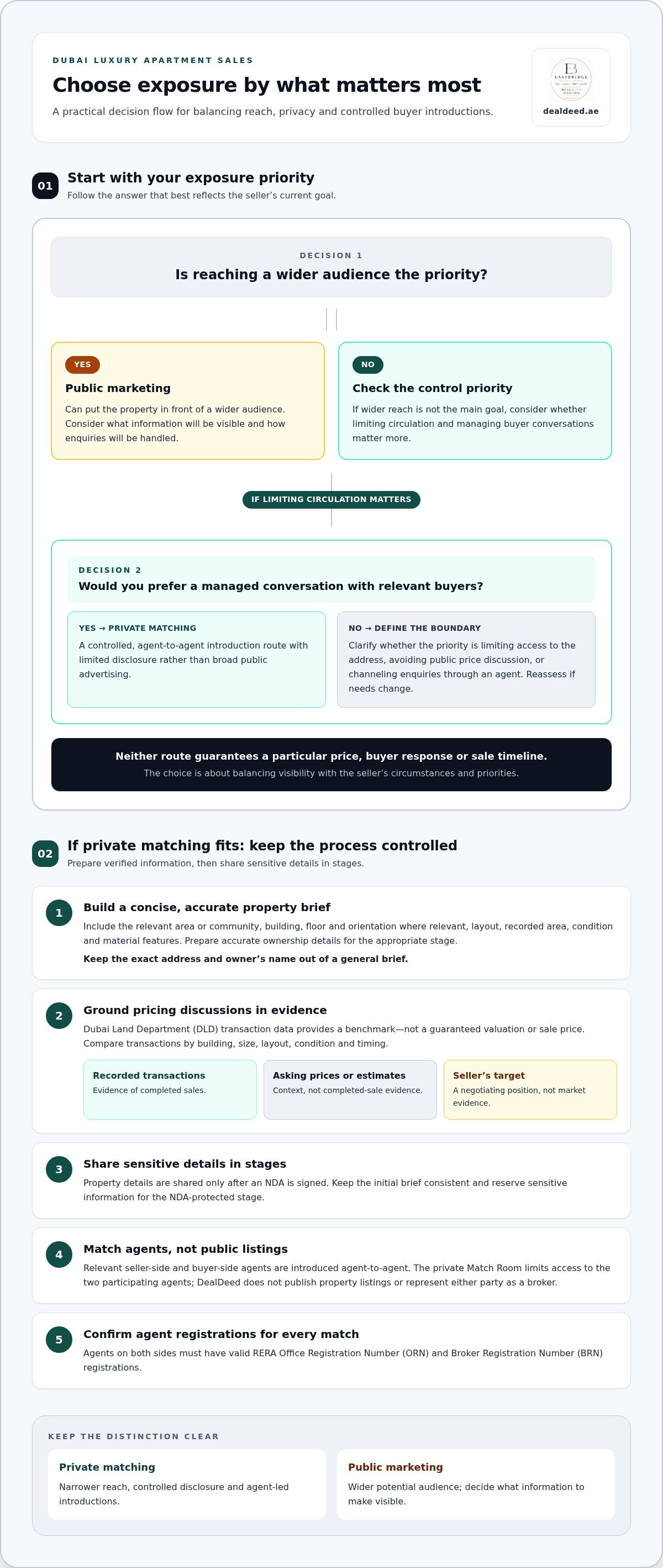
- Prioritise reach: Public marketing can put a property in front of a wider audience. Consider what information will be visible and how enquiries will be handled.
- Prioritise control: Private matching limits circulation and relies on introductions between agents. Weigh that narrower route against the reach you need.
- Review as circumstances change: Reassess the approach if the audience reached or level of disclosure no longer fits your goals.
Neither approach is universally right. A quiet route is most useful when confidentiality and a carefully managed buyer conversation matter more than maximum visibility. If broad reach is the priority, public advertising may be a better fit. Selling a luxury apartment in Dubai privately is ultimately a choice about balancing those priorities, not a promise of a better outcome.
Prepare the Apartment and Build a DLD-Evidenced Pricing Brief
A sound pricing discussion starts with a clear record of the apartment, not a headline figure or an unsupported expectation. Assemble a concise evidence file before buyer matching begins. It gives the seller’s agent a consistent basis for assessing interest and helps a buyer-side agent decide whether the property fits a client’s brief.
Keep three categories distinct: verified transaction evidence, current asking prices or estimates, and the seller’s target. Asking prices show what owners hope to achieve, not what a buyer has paid. An estimate can offer context, but it should not be presented as a completed sale. The seller’s target is a negotiating position, not market evidence.
Which apartment details belong in the seller brief?
Give agents enough verified information to assess suitability without circulating the owner’s identity or precise address in a general brief. Keep sensitive details for the NDA-protected stage. Use the same confirmed facts throughout so the property is described consistently in buyer conversations.
- Location: State the relevant area or community, then reserve the exact address for controlled disclosure.
- Building and position: Identify the building, floor and unit orientation where relevant to a buyer’s assessment.
- Layout and size: Describe the configuration and recorded area consistently.
- Condition: Note the current condition and material features that may affect how a buyer assesses the apartment.
- Ownership details: Prepare accurate ownership information for the appropriate stage, without including the owner’s name in a general brief.
How should DLD evidence inform a pricing discussion?
Dubai Land Department transaction data provides a benchmark, not a guaranteed valuation or sale price. DealDeed checks property details against DLD data, helping keep the discussion grounded in recorded evidence rather than assumptions. A useful comparison considers how closely each transaction matches the apartment in building, size, layout and condition, as well as when the transaction took place.
Differences matter. A sale in another building or from a different period may provide context, but it is not automatically a direct comparable. A distinctive floor plan or condition may also make a close match harder to find. Discuss the limits of the evidence openly and distinguish confirmed transactions from asking prices and estimates. For more on interpreting this evidence, see Dubai Land Department Verified Deals: The Professional Guide to Private Market Validation.
Describe a property as below-market only when that position has been verified against Dubai Land Department data. Otherwise, explain the asking position without presenting it as a verified discount. Selling a luxury apartment in Dubai privately benefits from a brief precise enough to support a serious discussion while protecting sensitive details until disclosure is appropriate.
Once the evidence file is ready, controlled matching can put it in front of relevant buyer-side agents without turning the apartment into a public listing. DealDeed’s private buyer matching connects seller-side agents with serious buyer-side agents using property details checked against DLD data.
Private Matching or Public Marketing: Choose the Right Exposure
Exposure is a strategic choice, not a test of whether an owner is serious about selling. Public marketing puts a property before a broader audience. Private matching narrows circulation and relies on relevant introductions between agents. Neither route guarantees a sale price, buyer interest or completion.
The practical question is what the seller needs the process to do. An owner seeking broad discovery may value visibility and enquiry volume. An owner prioritising discretion may prefer a smaller, controlled buyer conversation. The trade-off is straightforward: a private route can limit visibility, so the relevance of buyer matching matters.
| Consideration | Public marketing | Private matching |
|---|---|---|
| Audience reach | Broad discovery among people who encounter the marketing. | More limited reach through agent-to-agent introductions. |
| Information control | Depends on what is published and how widely it circulates. | Disclosure is staged, with details shared after an NDA. |
| Best aligned priority | Visibility and a wider pool of potential enquiries. | Confidentiality and a carefully managed buyer conversation. |
| Key consideration | More reach does not ensure a suitable buyer or completed sale. | A narrower audience makes relevant matching especially important. |
When can public exposure be the better fit?
Public marketing can suit sellers who want broad discovery and are comfortable with wider circulation of property information. It may bring the apartment to the attention of buyers beyond an existing agent network. That reach can be useful, but more enquiries do not automatically mean more qualified interest. Public exposure is a legitimate route; its suitability depends on the seller’s priorities, not on an assumption that visibility will damage value.
When does a discreet matching route make more sense?
Private matching may suit owners who want to control circulation and have prospective buyers approached through agents. DealDeed shares property details only after an NDA is signed, and the private Match Room is limited to the two participating agents. Both agents in every match must hold valid RERA ORN and BRN registrations. A relevant introduction can begin a serious discussion, but it is not a promise that buyer and seller will agree or complete a transaction.
To assess this narrower route, look beyond the number of introductions. Consider whether a buyer brief aligns with the apartment’s location, configuration and asking position, and whether the buyer-side agent can carry the conversation forward. Each match is manually reviewed to connect relevant briefs, but the seller still needs to assess interest and negotiate through their agent.
Selling a luxury apartment in Dubai privately makes most sense when controlled disclosure is a priority and the owner accepts that reach may be narrower. For a broader discussion of private disposals, Sell Property Quietly in Dubai: The 2026 Guide to Private Disposal explores how sellers can weigh discretion against exposure.
How to Sell a Dubai Luxury Apartment Privately: The Process
Selling a luxury apartment in Dubai privately works best as a sequence of controlled decisions. The seller communicates through an agent, property details are checked before matching, and sensitive information stays protected until an NDA is signed. DealDeed introduces agents with relevant briefs. It does not represent either party or act as a broker.
From seller brief to NDA-protected match
Start with a seller-side agent who can present the apartment accurately and manage the seller’s interests. The seller and agent prepare a fact-based brief. DealDeed manually reviews it, checks property details against Dubai Land Department data and considers relevant buyer briefs. Verification usually takes 24-48 hours. This is a verification timeframe, not a promise about how quickly a buyer will be found or a sale completed.
- Appoint a qualified seller-side agent. The seller works through an agent with valid RERA ORN and BRN registrations.
- Prepare the brief together. Record accurate apartment details and the seller’s asking position. Keep sensitive information out of material intended for initial review.
- Submit for review and verification. DealDeed manually reviews the brief and checks property information against DLD data. The usual verification period is 24-48 hours.
- Match relevant buyer briefs. A potential match is considered against the information in the briefs. An introduction is not confirmation that the buyer will proceed.
- Complete the NDA before disclosure. Sensitive property details are shared only after an NDA is signed. The initial circulation can remain limited while the parties establish a basis for discussion.
- Move the conversation to the agents. After the introduction, the seller-side and buyer-side agents handle discussions with their respective clients.
Agent-to-agent negotiation and completion
Both sides of every DealDeed match must involve RERA-licensed agents with valid ORN and BRN registrations. After an NDA, the two participating agents can use the private Match Room to coordinate the introduction. It is a space for those agents only, not a public forum or a channel for general circulation. DealDeed makes the introduction; it does not negotiate, represent the seller or buyer, or manage the transaction as a broker. Any agreed next steps remain between the parties and their agents.
A verified brief and relevant introduction can support a serious conversation, but neither guarantees agreement or completion. To prepare a controlled seller brief, submit an apartment brief for private matching.
Use DealDeed’s Private Matching Desk for a Quiet Disposal
If controlled disclosure and evidence-led introductions fit your priorities, DealDeed’s Private Matching Desk connects your seller-side agent with relevant buyer-side agents. It is a matching desk, not a public listing service or brokerage. You work with your own agent, who manages discussions on your behalf.
What sellers can expect from DealDeed
The process is human-led. DealDeed manually reviews submitted briefs, checks property details against Dubai Land Department data and looks for relevant buyer briefs. Verification usually takes 24-48 hours. That timeframe applies to verification only, not to finding a buyer or completing a transaction.
Disclosure is staged. Sensitive property details are shared only after an NDA is signed. You see matches involving your brief, not information about other private deals. If a match proceeds, the private Match Room is for the two participating agents only. You can consider an introduction without being obliged to proceed. Declining a match carries no penalty or cost.
DealDeed does not charge buyers or sellers. Registration, brief submission and receiving matches are free for users. If an introduced match completes, each participating agent is invoiced a fixed introduction fee. The fee is not a percentage of the agency commission. This means sellers can consider a relevant introduction without paying DealDeed to review a brief or receive a match.
Start with a confidential apartment brief
Prepare a clear starting brief with the facts an agent needs to assess the apartment and present it accurately. Include:
- Property facts: Area or community, building, floor, layout, size and condition. Keep the exact address and sensitive information for the NDA-protected stage.
- Seller objectives: Your preferred asking position, disclosure priorities and relevant context that may shape a buyer conversation.
- Agent details: The appointed agent’s information and valid RERA ORN and BRN registrations.
Precision helps. Keep figures and descriptions consistent, and distinguish recorded facts from estimates or expectations. DealDeed checks property information against DLD data, but the brief should still accurately reflect the apartment. Both the seller-side and buyer-side agents in every match must hold valid RERA ORN and BRN registrations.
Selling a luxury apartment in Dubai privately is a considered choice. The aim is to control disclosure while allowing relevant buyers to be reached through agents. DealDeed makes the introduction; the seller and their agent decide whether to engage with a match and how to proceed.
To begin, submit a confidential disposal brief through your participating RERA-licensed agent.
Set the Terms for a Discreet Next Step
Before your apartment enters a buyer conversation, decide what a well-managed process should protect: your identity, the property’s exact details, or your ability to consider each introduction on its merits. Put those priorities in your brief. They give your agent a clear framework for sharing information and help keep each discussion aligned with your intentions.
For selling a luxury apartment in Dubai privately, trust should rest on process, not promises. Property details are checked against Dubai Land Department data. Matching is human-led, and sensitive information is disclosed only after an NDA is signed. Every match involves RERA-licensed agents with valid ORN and BRN registrations. These safeguards support a considered introduction, while the decision to proceed remains yours and your agent’s.
If controlled disclosure fits your plans, take the next step with a concise, fact-based brief through your participating agent. Submit a confidential disposal brief to begin the conversation on your terms.
Frequently Asked Questions
Can I sell a luxury apartment in Dubai without advertising it publicly?
Yes. A private route can connect your seller-side agent with a relevant buyer-side agent without public advertising. DealDeed shares apartment details only after an NDA is signed, and both agents must be RERA-licensed with valid ORN and BRN registrations. You can set disclosure boundaries with your agent before submitting a brief, but private matching does not guarantee a buyer or mean DealDeed represents you.
Is a private property sale in Dubai handled without an estate agent?
No. A DealDeed match is not agent-free: the seller and buyer sides each require a RERA-licensed agent with valid ORN and BRN registrations. DealDeed makes introductions only; it does not broker the transaction or represent either party. For guidance on transfer steps or transaction formalities in Dubai, refer to current official guidance from the relevant UAE authorities rather than treating an introduction process as procedural or legal advice.
How is a Dubai luxury apartment’s price assessed in a private sale?
DLD transaction data can provide a benchmark for pricing discussions. When selling a luxury apartment in Dubai privately, compare evidence for properties with similar characteristics and distinguish completed transactions from asking prices or estimates. Comparable evidence can inform an asking position, but it does not guarantee a valuation, sale price or outcome. Describe a property as below-market only when that position has been verified against DLD data.
Does DealDeed charge the apartment seller a fee?
No. Registration, submitting a brief and receiving matches are free, and buyers and sellers do not pay DealDeed directly. If an introduced match completes, each participating agent pays a fixed introduction fee. It is not a percentage of agency commission. Sellers can submit a brief and consider a relevant match without paying DealDeed for access or for receiving the introduction.
What happens if I decline a buyer match?
You can decline a match without penalty or cost. Consider whether the buyer’s stated requirements align with your objectives, such as the apartment’s configuration or your preferred terms, before deciding whether to proceed. Declining does not create an obligation to negotiate. It is simply a decision not to pursue that introduction, leaving you and your agent in control of whether a conversation moves forward.
How long does verification take for a DealDeed match?
Verification usually takes 24-48 hours. That is the usual timeframe for checking property details, not a promised timeline for finding a buyer, reaching agreement or completing a sale. Whether a relevant match emerges depends on the apartment information and buyer briefs. Any later discussion or transaction steps depend on the parties and their agents.
Who can see my apartment details during a private matching process?
Property details are disclosed only after an NDA is signed. The matching process is private: you see matches involving your brief, not other deals or buyer briefs. If an introduction proceeds, the Match Room is a private online space for the two participating agents only. It is not a public forum, and your details are not placed in a public listing through this process.


