

Public exposure is a choice, not a requirement. In Dubai, sellers can advertise on public property portals such as Property Finder, Bayut and Dubizzle, or keep a property off-market and share details privately through RERA-licensed agents. The choice between public property portals and a private buyer-brief deal desk in Dubai comes down to reach, privacy and how buyers are qualified.
Portals make listings visible to people searching the market. A private route limits public exposure and gives sellers a more controlled way to reach potential buyers. Neither approach suits every sale; the seller’s priorities matter.
This comparison explains why sellers choose off-market deals and how buyer screening, proof of funds and privacy differ from the public portal process. It also sets out practical trade-offs, so you can decide which route fits your property and preferred level of exposure.
Key Takeaways
- Choose public exposure for broad reach; consider private distribution when controlling who sees property details matters more.
- Assess buyer readiness through clear qualification and evidence of funds before arranging sensitive next steps.
- Understand how portal visibility, paid promotion and advertising requirements shape a public listing’s reach.
- Use written confidentiality terms and controlled sharing to manage buyer exposure during a private sale.
- Match the route to your priorities: visibility, buyer screening and discretion each involve different trade-offs.
Why do sellers choose the off-market route?
Dubai sellers can publish a listing on major portals or distribute property details privately through RERA-licensed agents. The choice affects public reach, competition, privacy and how potential buyers first encounter the property.
Private Off-Market Distribution
Private distribution shares a property with selected buyers rather than publishing it for the general market. Through DealDeed, motivated sellers can be matched with serious, vetted buyers via participating RERA-licensed agents. This can limit public exposure and focus introductions on relevant buyer interest, though it does not guarantee a sale or a particular price.
A seller prioritising discretion may prefer a private approach to a public listing on Property Finder, Bayut or Dubizzle. The trade-off is reach: a private network targets selected buyers, while public portals make a listing discoverable to a wider audience. An exclusive mandate describes the broker’s appointment, not the marketing method. A property can be exclusive and still be marketed publicly.
Terms can also be confused. A pocket listing is marketed privately; off-plan describes a property’s construction or sales stage. They refer to different things. A completed home can be marketed privately, just as an off-plan property can be publicly listed.
Off-Market Risk and Price Benchmarking
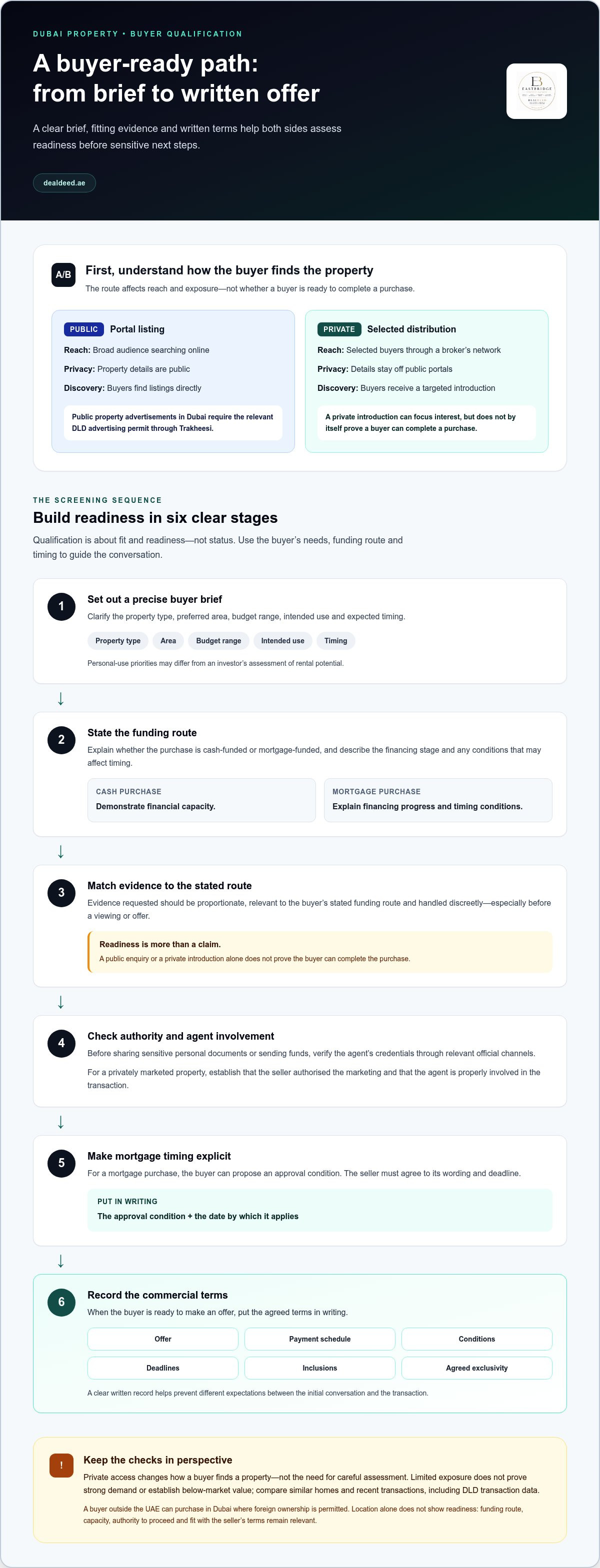
Private marketing does not establish that a property is below market value, and limited exposure does not prove strong demand. Buyers should compare the property with recent transactions for similar homes in the same building or community. Dubai Land Department (DLD) transaction data can help put an asking price in context.
For example, compare a private apartment with recent sales in its building, then account for differences in condition, view and layout. Buyers should also establish that the seller authorised the marketing and that the agent is properly involved in the transaction. Private access changes how a buyer finds a property, not the need for careful assessment.
Public advertising has its own process. Public property advertisements in Dubai require the relevant DLD advertising permit through Trakheesi. That requirement sits alongside the practical choice between broad exposure and targeted distribution. Sellers can weigh their intended audience against how much public visibility they want.
| Option | Audience reach | Privacy | Buyer discovery |
|---|---|---|---|
| Public portal listing | Broad audience searching online | Property details are public | Buyers find listings directly |
| Private distribution | Selected buyers through a broker’s network | Details stay off public portals | Buyers receive a targeted introduction |
Choose public portals when broad visibility matters most; consider private distribution when limiting exposure and targeting selected buyers are priorities.
Neither route determines the right asking price. Sellers can compare similar properties and recent sales before choosing how to present a home. Buyers can use the same comparisons to judge whether a private opportunity fits local demand, rather than treating exclusivity or limited visibility as evidence of value.
Buyer qualification and proof of funds
Buyer qualification is about readiness, not status. In Dubai, a seller or agent can assess whether a buyer’s requirements, funding route and timing fit the proposed transaction. A public enquiry may begin with a request for details; a private introduction can begin with a defined brief. Neither approach alone proves that a buyer can complete a purchase.
Start by setting out the intended purchase clearly. Identify the property type, preferred area, budget range, intended use and expected timing. A buyer considering an apartment for personal use may have different priorities from an investor assessing rental potential. A precise brief helps focus the search and gives the seller relevant context before further details are shared.
Proof of funds should match the buyer’s stated route. A cash purchaser needs to demonstrate financial capacity; a mortgage buyer should explain the financing stage and any conditions affecting timing. These are practical screening distinctions, not substitutes for transaction documents. Evidence requested should be proportionate and handled discreetly, especially before a viewing or offer.
For a mortgage purchase, the buyer can propose a mortgage-approval condition. The seller must agree to its wording and deadline, so both should be clear before the offer proceeds. For example, an offer can set out the approval condition and the date by which it applies. This gives each side a written basis for discussing timing rather than relying on an informal assurance.
Buyer location also matters. A person living outside the UAE can purchase property in Dubai in areas where foreign ownership is permitted. That buyer should state their intended funding route and transaction arrangements as clearly as a UAE-based buyer. Location alone does not show readiness; the relevant questions concern capacity, authority to proceed and fit with the seller’s terms.
Before sharing sensitive personal documents or sending funds, verify an agent’s credentials through relevant official channels. For a privately marketed property, establish that the seller authorised the marketing and that the agent is properly involved in the transaction. These checks protect the process without treating a private introduction as proof of ownership or authority.
Once the buyer is ready to make an offer, put the commercial terms in writing. Include the offer, payment schedule, conditions, deadlines, inclusions and any agreed exclusivity. A clear written record helps prevent different expectations from emerging between the initial conversation and the transaction.
- Brief: State property needs, budget, intended use and timing.
- Funding: Explain whether the purchase is cash-funded or mortgage-dependent.
- Authority: Verify the agent’s credentials and seller’s marketing authority.
- Offer: Record payment terms, conditions and deadlines in writing.
Public listings can bring enquiries from a broad audience, while a private brief can focus attention on buyers whose requirements appear aligned. The qualification steps remain relevant in either route. For sellers who want a more targeted introduction, a structured buyer brief can help frame the match around stated requirements before property details are shared.
Dubai property portals
Property Finder, Bayut and Dubizzle carry public Dubai listings, while private buyer-matching services can work from stated area and budget criteria. The public property portals vs private buyer brief deal desk Dubai comparison is about broad browsing versus a brief-led search, not fixed area assignments.
Listing Freshness and Completeness
Listing freshness concerns whether an advertisement reflects the property’s current status and terms. Completeness means buyers can assess location, property type, asking price and relevant details before enquiring. On Property Finder, Bayut or Dubizzle, compare those details across listings rather than relying only on a result’s position.
If the same Dubai apartment appears on multiple portals, compare its description and asking price before arranging a viewing. Consistent details help you assess whether the property fits your plans. Portal visibility can be influenced by paid promotion, so prominent placement alone does not establish a better match or stronger demand.
Area and Budget Coverage
Area and budget coverage depend on the search criteria entered, not on a portal being reserved for one Dubai neighbourhood or price bracket. Use the same area, property type and budget filters on Property Finder, Bayut and Dubizzle. A private buyer-matching service can instead work from a brief identifying your preferred locations and spending range.
A buyer seeking an apartment in a named community can set that location and budget on each portal. An investor considering several communities can search each area separately, then narrow results by property type and intended use. A brief-led service focuses on those stated priorities rather than public search results.
Which Dubai portals or buyer services cover specific areas and budgets? Property Finder, Bayut and Dubizzle provide public listings that buyers can filter by location and price. A private buyer service can focus on the locations and budget in the buyer’s brief, rather than assigning itself to one neighbourhood or price bracket.
To make a portal comparison useful, keep the criteria consistent. Search the same area, property type and budget across platforms, then review relevant listings and asking prices. To assess value, compare the property with recent transactions for similar homes in the same building or community. Advertised prices and completed transactions serve different purposes.
Public advertising also has a compliance requirement. Public property advertisements in Dubai require the relevant DLD advertising permit through Trakheesi. That requirement relates to public advertising, while private distribution follows a different route. Sellers weighing channels can consider both the intended audience and the degree of public exposure.
A practical comparison can follow these steps:
- Enter the same Dubai area and property type on each portal.
- Set a consistent budget and compare listings that match.
- Review property details and asking prices before making an enquiry.
A mortgage buyer can use public searches to identify properties that fit their intended purchase, then assess the payment route separately. A listing does not establish mortgage readiness or show whether the seller’s terms suit the buyer’s financing timeline.
For buyers weighing public property portals vs private buyer brief deal desk Dubai options, the distinction is breadth versus focus. Public channels support browsing visible inventory; a private service can direct a search around the buyer’s stated criteria. The better fit depends on whether you want to scan public listings or begin with a defined brief.
Privacy and buyer exposure trade-offs
In Dubai, a public listing puts property details before a broad online audience. Private distribution narrows who receives those details, but privacy depends on how information is shared. Sellers should weigh reach against exposure, especially for luxury homes or residential properties where public attention is unwelcome.
Property Finder, Bayut and Dubizzle make listings searchable beyond a seller’s immediate network. That can increase discovery, but it also means details such as location, asking price and property features are publicly visible. A seller may prefer this reach when attracting broad demand matters more than limiting exposure.
Private marketing changes the audience, not the need for careful handling. Through DealDeed, property details are shared privately after an NDA is signed, and matching takes place between RERA-licensed agents. Sellers can consider what information is appropriate to share at each stage.
For a Dubai home where privacy is a priority, an NDA is required before property details are shared through DealDeed. This creates a defined confidentiality step before information is disclosed. It does not replace sensible handling of documents or establish that every detail will remain private after disclosure.
Consider a seller who wants to limit public attention around a luxury residence. A public listing may expose images, location details and asking terms to portal users. A private introduction can limit initial circulation to the agents and parties involved, with further property details shared only after an NDA is signed.
Privacy has a trade-off. A smaller audience may mean fewer people encounter the property than on public portals. A broad listing may attract buyers who would not have been reached through a private network, while targeted distribution can reduce unnecessary exposure and focus attention on stated interest. Neither route guarantees a sale or a particular level of buyer demand.
Buyers also have privacy interests. Before sending personal documents, sharing financial details or discussing a viewing, they should verify the agent’s credentials through relevant official channels. For a private property, establish that the seller authorised the marketing and that the agent is properly involved. These steps help keep sensitive information tied to a legitimate transaction.
Use a deliberate disclosure sequence:
- Share only the property details needed to assess initial interest.
- Agree on confidentiality terms before a viewing if the owner requests them.
- Release sensitive documents only through an appropriate transaction process.
- Record offers, conditions and deadlines in writing.
For sellers, the choice depends on the required balance: public portals prioritise visibility; private distribution prioritises controlled introductions. For buyers, a clearly defined brief can help focus a private search without broadcasting personal requirements across public listings. If limiting exposure is central to your search, arrange a private buyer brief around your property criteria and preferred level of disclosure.
DealDeed: Private Buyer Brief Matching
DealDeed’s Private Buyer Brief Matching connects serious, vetted buyers with motivated Dubai property sellers through a confidential, agent-to-agent process. It suits buyers who have defined their preferred area, property type and budget, and sellers seeking a targeted alternative to public listings. Property details are verified against Dubai Land Department data and shared only after an NDA is signed. Both sides of every match must involve RERA-licensed agents with valid ORN and BRN credentials.
For sellers seeking discreet distribution, DealDeed’s Quiet Disposals provide a private route. Its Agent-to-Agent Deal Desk supports confidential matching between agents. These services focus on introductions and private deal flow, not public portal advertising.
If a controlled introduction fits your priorities, contact DealDeed or visit dealdeed.ae.
Set Your Next Move on Your Terms
Before approaching the market, decide what you want the first conversation to achieve. A buyer can define the property criteria and funding route to make an enquiry more purposeful. A seller can decide what information to disclose initially and how widely it should circulate.
That decision gives the comparison between public property portals and a private buyer brief deal desk in Dubai practical weight: the right route depends on the level of exposure and control you want. DealDeed’s Private Buyer Brief Matching supports targeted buyer introductions; Quiet Disposals offer sellers a private route; and the Agent-to-Agent Deal Desk connects agents around deal opportunities.
Choose the next step that fits your position, whether you’re preparing a buyer brief or considering a private route for a property. Contact DealDeed about your options and outline what you’re looking to achieve. A clear brief is a focused place to begin.
Frequently Asked Questions
Are there any application or participation fees?
DealDeed charges no registration, brief-submission or subscription fee to users, and buyers and sellers do not pay it directly. A fixed introduction fee is invoiced to each participating agent only when an introduced match completes. Agents using the matching desk must hold valid RERA Office Registration Number (ORN) and Broker Registration Number (BRN) credentials. Standard property transaction costs, such as applicable agency commission or DLD fees, are separate from DealDeed’s fee arrangement.
Does a private listing mean a bargain?
No. Private marketing describes how a property is offered, not whether its price is below market value. Compare the asking price with recent transactions for similar properties in the same building or community. An apartment’s floor, condition and view can affect how closely another sale serves as a benchmark. Treat privacy as a distribution choice, not evidence of a discount.
How do off-market sales work in Dubai?
An off-market sale is marketed privately rather than promoted to the general public. A seller authorises an agent to share selected property details with potential buyers through a private network. Interested buyers can then discuss the property and make an offer through the transaction process. Private marketing does not remove the need to establish the seller’s authority or document agreed terms in writing.
What are the main public property portals in Dubai for buyers?
Property Finder, Bayut and Dubizzle are major portals where buyers can search Dubai property listings. To make a useful comparison, enter the same area, property type and budget on each platform. Then review the details and asking prices of matching properties. A portal search shows advertised inventory; it does not establish that an asking price reflects recent transaction values.
What is a private buyer brief or deal desk in Dubai real estate?
A private buyer brief sets out requirements such as preferred areas, property type, budget and intended use. A deal desk can use those criteria to match buyer interest with privately presented opportunities. DealDeed connects motivated sellers with vetted buyers through RERA-licensed agents. Participating agents must hold valid ORN and BRN credentials, and property details are shared only after an NDA is signed.
How do Dubai property portals compare with private buyer advisory services?
Portals such as Property Finder, Bayut and Dubizzle let buyers search public advertisements directly. A private matching desk works differently: it connects buyers and sellers through agents rather than publishing listings for public browsing. DealDeed is an introducer, not a buyer’s representative or a direct brokerage service. Buyers are paired with a vetted buy-side agent, and both sides of a match involve RERA-licensed agents.
What steps are involved in using a private buyer brief to find Dubai property?
Begin by defining your preferred areas, property type, budget and intended use. Submit the brief through a participating agent with valid RERA ORN and BRN credentials. DealDeed’s team makes matches manually; suitable opportunities are considered agent to agent, and property details are disclosed only after an NDA is signed. Stating whether you want a ready home or an investment property helps make your criteria more precise.
What are the risks of off-market property deals and private buyer services in Dubai?
Private access can limit the range of properties you see, and an off-market asking price is not automatically a bargain. Compare relevant DLD transaction data and establish that the seller authorised the marketing. Verify an agent’s credentials through official channels before sharing sensitive documents or funds. DealDeed verifies property details against DLD data, but buyers should still assess the property and document agreed terms carefully.


