

A strong offer is only as credible as the buyer’s ability and readiness to complete. To understand how to vet buyers for a private property sale in Abu Dhabi, establish how the buyer will pay, who can make the decision, and the intended timeline. A buyer’s deposit held by the agency is usually 10% of the sale price, so the deposit and completion terms deserve close attention.
Price matters, but it is not the whole test. A cash buyer may be able to complete faster than one who still needs mortgage approval. Understanding the buyer’s funding position helps you judge whether the proposed timeline is realistic, while a measured process keeps sensitive details under control.
This guide explains how to assess a buyer’s financial position, evaluate offer terms, recognise pressure tactics, and involve licensed property and legal professionals at the right stages. The goal is a quiet, evidence-led sale process without unnecessary exposure.
Key Takeaways
- Compare the offer’s deposit, payment schedule and completion timeline, then record each party’s obligations clearly.
- Before arranging viewings, establish how the buyer plans to pay, who makes the decision and when they can proceed.
- Slow down when a buyer presses for an immediate commitment or makes promises without clear supporting terms.
- Use appropriately licensed property and legal professionals to clarify regulatory requirements and contract responsibilities.
Offer terms and questions to resolve before signing
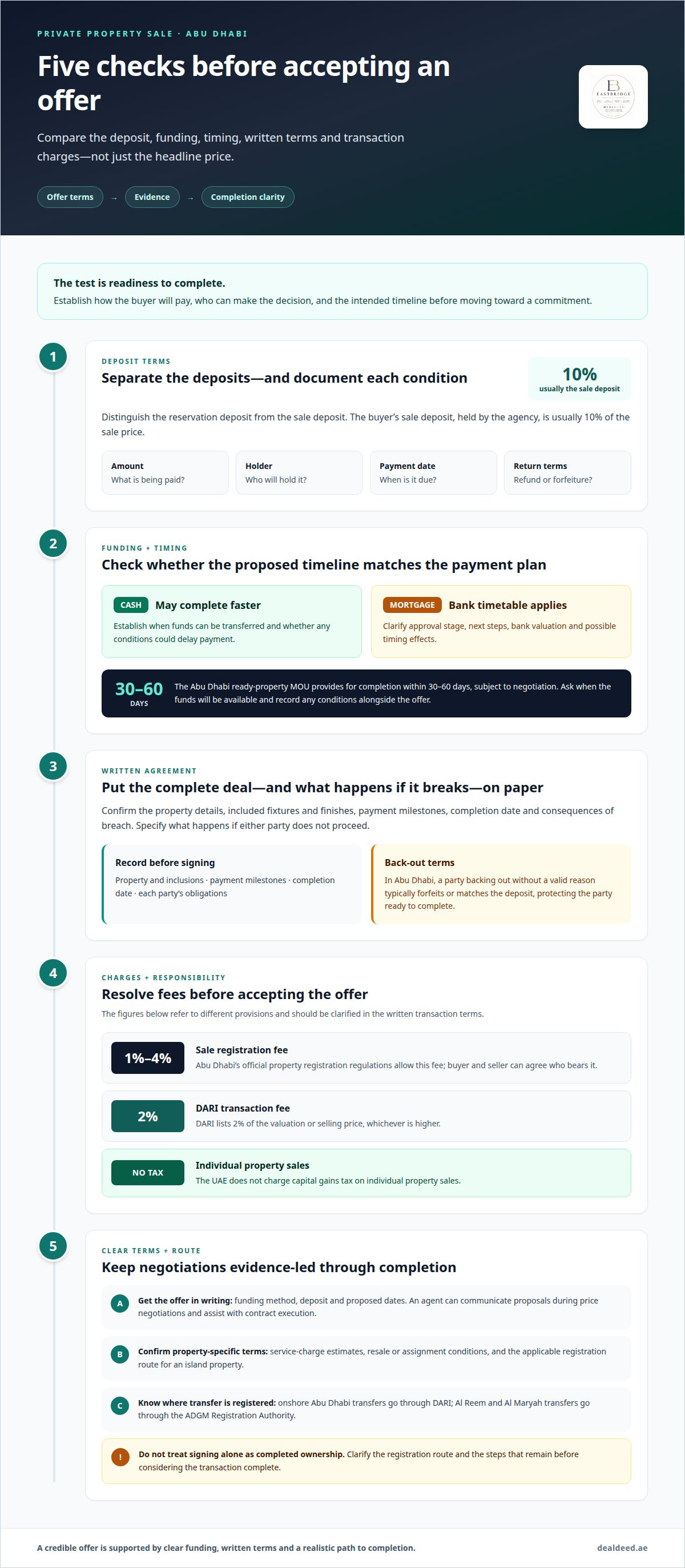
- Separate the reservation deposit from the sale deposit. The buyer’s deposit held by the agency is usually 10% of the sale price. Record the amount, holder, payment date, and refund or forfeiture terms before signing.
- Compare financing and timing, not just the headline offer. A cash buyer can often complete faster because a mortgage introduces a bank timetable and property valuation. Ask when funds will be available and what conditions could delay payment. The Abu Dhabi ready-property MOU provides for completion within 30-60 days, subject to negotiation.
- Put the full purchase agreement in writing. Confirm the property details, included fixtures and finishes, payment milestones, completion date, and any consequences of breach. Specify what happens if either party does not proceed. In Abu Dhabi, a party who backs out without a valid reason typically forfeits or matches the deposit, protecting the party ready to complete.
- Resolve charges before accepting an offer. Abu Dhabi’s official property registration regulations allow a sale registration fee of 1% to 4%, and buyer and seller can agree who bears it. DARI lists a transaction fee of 2% of the valuation or selling price, whichever is higher. The UAE does not charge capital gains tax on individual property sales.
- Negotiate based on clear terms, not pressure. An agent can communicate proposals during price negotiations and assist with contract execution. Ask the buyer to put the offer, funding method, deposit, and proposed dates in writing. Confirm service-charge estimates and any resale or assignment conditions. For an island property, clarify the applicable registration route before treating signing as completed ownership.
Buyer financial qualification before viewings
- Before arranging an apartment viewing, establish how the buyer plans to pay, who makes the decision, and the intended timeline. A practical approach to how to vet buyers for a private property sale in Abu Dhabi starts before the viewing. For a mortgage purchase, clarify the approval stage and the bank’s next steps. For a cash purchase, establish when funds can be transferred.
- Compare the buyer’s stated plan with the proposed transaction. A mortgage may involve a bank valuation and affect the timetable; cash may allow a faster completion. Record the funding method and any conditions alongside the offer. When deciding how to vet buyers for a private property sale in Abu Dhabi, distinguish written evidence from verbal assurances before treating a buyer as ready to proceed.
- Plan viewings to protect the seller’s time and privacy. Confirm each attendee’s name, decision-making role, preferred appointment window, and interest in the apartment. Where practical, group related enquiries into suitable time slots. After each visit, record attendance, questions, objections, and requested follow-up, then report these points clearly to the seller.
- Prepare the apartment before each appointment. Secure personal documents and valuables, ensure key rooms are accessible, and make relevant features available for inspection. Have accurate information on service charges and valuation ready. An orderly viewing helps clarify the buyer’s priorities without relying on estimates or informal claims.
- Understand the registration route before treating a signed agreement as completed ownership. Onshore Abu Dhabi transfers are registered through DARI; Al Reem and Al Maryah transfers go through the ADGM Registration Authority. After sellers accept a sale, buyers accept or reject it. Acceptance sends the application to DMT for review. Following approval, the seller books a DMT appointment to sign the contract. For discreet handling, a private buyer brief can keep criteria and viewing updates focused.
Identifying pressure tactics and unclear promises
Protect personal information by sharing only what the transaction requires, through a controlled channel. Abu Dhabi property transactions don’t accept cash, and UAE anti-money-laundering rules require brokers to report certain transactions involving physical cash of AED 55,000 or more.
- Confirm who is making the offer and who has authority to approve it. Record the buyer’s full name and direct contact details, and establish whether they are acting personally or for a company. If a representative attends a viewing, clarify whom they represent and who will sign the purchase agreement. Keep identity documents within the transaction’s secure verification process.
- Ask for details behind assurances. “Funds are ready” does not explain the payment route, timing, or conditions. Record whether the purchase depends on mortgage approval, an investment partner, or another sale. If the buyer repeatedly changes the decision-maker or explanation of funding, seek clarification before negotiations advance.
- Treat urgency as a reason to document carefully, not to skip review. Requests to sign immediately, bypass identity checks, or share a title certificate through informal channels are warning signs. Keep communication in writing, limit access to documents, and do not disclose tenant schedules or personal routines during a viewing.
- Separate a stated fee from a verified obligation. If a message cites “2%,” ask what the figure applies to and where it appears in the written transaction terms. A buyer shouldn’t use an unexplained charge or promised developer approval to press for signing before the agreement records the relevant conditions.
- Keep a brief record after each viewing: attendee names, questions, requested documents, and promised next steps. Compare these details with the offer and the named buyer. A genuine change, such as a new company or representative, should be explained and reflected consistently in later communications.
Using licensed real estate and legal professionals
- Check that the listing and the agent are properly authorised before relying on the listing information. Match the permit details to the property and the agent handling the transaction before relying on the listing information.
- Check the agent’s ADREC registration and individual agent licence number. Review their track record and client references, and confirm that the person handling viewings and offers is the registered agent. Clarify any change in representation before sharing documents.
- Involve the appropriate professional for each issue. A licensed real estate professional can guide you through transaction steps, while a legal advisor can review contract terms. A mortgage advisor or valuation specialist can address financing or valuation questions. For an off-plan purchase, the developer’s authorised sales team can explain project terms and handover conditions.
- Keep professional roles and written responsibilities clear. The agreement should identify the parties, payment obligations, property details, completion date, and consequences of breach. Ask a legal advisor to review unclear clauses or proposed changes before signing, especially when a representative is acting for a buyer or seller.
- Confirm the correct registration route for the property. Onshore Abu Dhabi transfers are registered through DARI; transfers on Al Reem and Al Maryah are registered with the ADGM Registration Authority. DARI allows either party to add a power of attorney optionally during the sale application. For confidential buyer introductions through licensed agents, discuss private buyer matching.
DealDeed: Private Buyer Brief Matching
DealDeed’s Private Buyer Brief Matching offers a discreet next step for sellers who want to focus on serious, relevant buyer interest rather than broad exposure. A clear brief can capture the property’s key terms, the seller’s priorities, and the buyer profile suited to the proposed sale.
Use this approach when you want to keep enquiries selective or coordinate buyer introductions through professional channels. Quiet Disposal Mandates support a discreet sale process, while the Agent-to-Agent Deal Desk helps licensed agents coordinate a transaction. These options are distinct from legal review and official registration, which remain separate steps.
Before proceeding, have the property details and preferred terms ready to shape the buyer brief. Contact DealDeed to discuss a private matching approach.
Set the Terms for a Discreet Next Step
The next decision is how much access your sale should allow. Before inviting further interest, define what information can be shared, which buyer profiles suit the property, and what progress you need before moving to a viewing or negotiation. Clear boundaries keep the process deliberate rather than reactive.
A considered approach to how to vet buyers for a private property sale in Abu Dhabi also shapes what happens after the first introduction. Decide who will manage updates, how offers should be presented, and when professional review is needed. These choices help keep decisions aligned as the transaction progresses, without letting urgency set the terms.
For a more discreet route to buyer introductions, take the next step when your priorities are clear. You can Contact DealDeed to discuss your sale and outline the kind of buyer and process you want. Keep the brief focused, the communication measured, and the decision yours.
Frequently Asked Questions
What documents should a seller request to verify a buyer's identity in Abu Dhabi?
Request a valid government-issued identity document and confirm that the buyer’s legal name matches the offer and sale paperwork. A buyer based outside the UAE can purchase property without an Emirates ID, so its absence alone is not a reason to disqualify them. If a representative or company is involved, establish who has authority to act and make sure the named purchaser is clear before sharing sensitive property documents.
How can a seller verify a buyer's proof of funds or mortgage pre-approval in Abu Dhabi?
For a cash offer, request recent proof of accessible funds, with unrelated account details redacted where appropriate. For a mortgage purchase, request written evidence of the bank’s approval stage and any remaining conditions. Compare the buyer’s name and proposed purchase amount with the offer, then clarify whether a valuation, further approval, or another sale could affect the funds or completion timing.
What are the steps to verify a buyer's eligibility to purchase property in Abu Dhabi?
First identify the property’s location and ownership category, then compare these with the buyer’s legal status. UAE nationals and public shareholding companies are eligible to buy in investment and development areas; other nationalities are eligible in investment areas only. Foreign nationals may acquire qualifying freehold rights in designated investment areas, subject to applicable legislation. Confirm the proposed ownership structure before progressing the sale application.
Do foreign buyers need special approvals or meet ownership-zone requirements in Abu Dhabi?
Foreign buyers should consider the property’s designated area and the ownership rights available there. Other nationalities are eligible to buy only in Abu Dhabi investment areas, while qualifying freehold rights may be acquired in designated investment areas under applicable legislation. A buyer outside the UAE does not need an Emirates ID to purchase. Clarify the property’s location and the buyer’s eligibility before agreeing to transfer terms.
How can a seller check a buyer's real estate agent and power of attorney in Abu Dhabi?
Check the agent’s ADREC registration and individual licence number, and confirm that the listing and agent have valid Madhmoun permits. If someone signs under a power of attorney, confirm that it covers the relevant sale actions and matches the representative’s identity. DARI allows a power of attorney to be added optionally during the sale application; one signed outside the UAE must be notarised and legalised for use in the UAE.
What are the risks of accepting cash, third-party payments, or suspicious funds in an Abu Dhabi property sale?
Cash isn’t accepted for Abu Dhabi property transactions. UAE anti-money-laundering rules require brokers to report certain transactions involving physical cash of AED 55,000 or more. A payment from an unexplained third party can also create a mismatch between the named buyer and the payer, complicating transaction checks. Keep the payer, purchaser, and documented payment route aligned, and pause if the source or purpose is unclear.


