

What does a property badge prove if your real question is ownership? That distinction sits at the centre of Bayut TruCheck vs Dubai Land Department direct verified matching: the checks address different questions, not competing versions of the same test. Bayut’s “Checked” badge relates to submitted property documents, while TruCheck is intended to confirm current availability through an agent’s visit. A direct DLD check can confirm official ownership or registration information.
It’s understandable to read “verified” as a broad assurance. But a listing badge doesn’t settle every question about title, transaction history or price, and official records don’t show whether a seller is open to a particular buyer’s terms. What matters is the evidence and the claim it supports.
This article explains what each method can and can’t verify, how to use DLD evidence without overstating it, and where private matching fits. For agents handling sensitive briefs, a confidential agent-to-agent introduction can complement due diligence without putting property details into public view. DealDeed connects serious buyers and motivated sellers through two RERA-licensed agents, with property details shared only after an NDA. Verification establishes facts; matching connects the right parties.
Key Takeaways
- Identify the claim you need to verify first, then choose evidence suited to that question rather than relying on a general “verified” label.
- Use TruCheck for confidence about a Bayut listing’s status; use relevant DLD evidence for official ownership, registration or transaction questions.
- Keep asking prices separate from transaction benchmarks. An advertised price alone doesn’t establish market value.
- Use a clear sequence for Bayut TruCheck vs Dubai Land Department direct verified matching, and avoid treating either check as proof of what it doesn’t cover.
- Confidential, agent-to-agent matching can connect a qualified buyer brief with an opportunity while keeping property details private until an NDA.
Bayut TruCheck vs DLD verification: why “verified” can mean different things
“Verified” is not one universal type of proof. It can refer to a listing’s authenticity, a check against official property records, or a comparison with recorded transaction data. Each check answers a different question. In Bayut TruCheck vs Dubai Land Department direct verified matching, the important point is not which label sounds stronger, but what evidence supports the specific claim an agent needs to make.
Bayut is a property classifieds website in the UAE, as outlined on the Bayut Wikipedia page. Its TruCheck feature validates listings on the platform. DLD evidence has a different role: it comes from official records or transaction data, depending on the check. Neither connects a buyer’s requirements to a confidential opportunity. Verification tests evidence; matching connects parties.
What does a Bayut TruCheck badge signal?
Bayut describes TruCheck as a listing-validation process. Its current process uses submitted property documents for a “Checked” badge, followed by an agent’s on-site visit and real-time photos through Bayut’s Profolio app for a TruCheck badge. The latter is intended to confirm current availability, with a rolling 48-hour validity window for listed properties. Off-plan resale listings have a separate process and validity period.
Bayut has stated that TruCheck listings receive five times more leads and 20 times more impressions than non-verified listings. These are portal performance comparisons attributed to Bayut, not proof of every property detail. Visibility and lead volume don’t establish transaction history, a buyer’s authority, or whether an asking price reflects market value.
What does checking against DLD data mean?
A direct check against DLD records is useful when the question concerns information held in the official register, such as title deed validity or ownership details available through the relevant DLD service. Transaction data serves another purpose: it can provide an official benchmark for comparing recorded deals. That comparison doesn’t, by itself, confirm current availability or explain every difference between a comparable sale and an asking price.
The evidence is only as broad as the record and fields consulted. A transaction benchmark can inform a pricing assessment, but it cannot establish that a seller will accept that figure. For a closer look at how official data can support discreet deal assessment, see the DLD verified-deals professional guide.
For a practical first distinction, separate the claim into three questions:
- Is this Bayut listing validated and presented as currently available? TruCheck addresses listing confidence on Bayut.
- What do official records or recorded transactions show? Use the relevant DLD evidence, and describe only what it supports.
- Does this opportunity fit a buyer’s private brief? That requires a separate matching process, not another verification badge.
Keeping these questions separate prevents a portal signal from being overstated as a full due-diligence finding, or a transaction benchmark from being mistaken for a live offer. Each check is useful when applied to the question it can answer.
What TruCheck and DLD evidence can, and cannot, verify
A useful comparison starts with the claim being tested. Bayut TruCheck relates to a listing on Bayut; DLD evidence comes from official records or transaction data. Neither makes every detail about a property, its seller or its price true by implication.
A badge validates a listing through a portal’s process; a DLD check supports only the facts contained in the official records consulted. These forms of evidence are not interchangeable. In Bayut TruCheck vs Dubai Land Department direct verified matching, the word “verified” needs a clear object: a listing, a record, a transaction benchmark or a potential match.
| Source | Subject checked | Evidence produced | Limits |
|---|---|---|---|
| Bayut TruCheck | A Bayut listing and its presented availability | For TruCheck, submitted documents and an agent’s property visit with real-time photos through Bayut’s Profolio app | Supports listing confidence; it isn’t a substitute for a separate ownership or transaction-record check, and availability can change |
| DLD ownership or title deed service | Information held in the relevant official property record | A result relating to the record or deed checked | Establishes only what that service and record show; it doesn’t confirm a listing’s present availability or price |
| DLD transaction data | Recorded property transactions | A historical benchmark for evidence-led comparison | Doesn’t set today’s asking price, establish seller willingness, or guarantee a valuation |
What a listing check does not automatically establish
TruCheck’s process includes document review for the “Checked” stage and a physical visit for the TruCheck badge. Bayut states that the latter is valid for a rolling 48-hour window. This is useful evidence about a listing at a point in time, not a lasting promise that the property will remain available when a buyer enquires.
Claims about legal ownership, current title status, a completed sale or an agreed price call for the relevant separate evidence. Keep the conclusion narrow: a listing check supports confidence in that listing, but it doesn’t answer every ownership or transaction question.
How DLD transaction data supports evidence-led pricing
A recorded transaction can help benchmark a deal against relevant sales, but historical evidence isn’t a live quote. Property characteristics, timing and deal circumstances affect the comparison. An asking price is the seller’s stated figure, not proof of market value; a benchmark is context, not an offer or guaranteed valuation. Describe pricing as “below-market” only when the comparison has been verified against DLD data.
DealDeed benchmarks deal information against official DLD transaction data as part of confidential, agent-to-agent matching. If verified evidence points to a potential fit for a private buyer brief, explore confidential property matching. The evidence informs the comparison; the introduction is a separate step.
Which option fits the Dubai property question you need answered?
Choose the evidence by starting with the decision in front of you. Are you assessing a listing shown on Bayut, comparing a potential deal with recorded transactions, or looking for an opportunity that fits a confidential buyer brief? These are separate tasks. Bayut TruCheck and DLD evidence can support the first two; neither performs the third by itself.
The practical distinction in Bayut TruCheck vs Dubai Land Department direct verified matching is the purpose of the check. Use portal validation for listing confidence, official transaction evidence for historical context, and a private matching process to connect buyer requirements with a suitable opportunity.
- Question: Does this Bayut listing have a TruCheck validation? Best fit: Bayut TruCheck. It applies to listings on Bayut and provides a platform-level signal about listing validation and availability. It doesn’t guarantee that a transaction will proceed.
- Question: How does this potential price compare with recorded deals? Best fit: Relevant DLD transaction evidence. Use it to contextualize comparable property pricing, not as an automatic valuation or current asking price.
- Question: Could a private opportunity suit this buyer’s requirements? Best fit: Confidential matching. This separate process considers the buyer brief and a potential opportunity. A badge or transaction record alone can’t establish that fit.
When a portal badge is useful
TruCheck is relevant when the listing appears on Bayut and the question concerns that listing’s validation or stated availability. It can help distinguish a listing that has gone through Bayut’s process from one that hasn’t. It is a useful platform signal, not a substitute for other checks an agent or buyer may need.
Keep the conclusion proportionate. A badge doesn’t promise that the property will remain available, that a buyer and seller will agree terms, or that a transaction will complete. If the property isn’t listed on Bayut, this particular portal check isn’t relevant.
When official data evidence is more relevant
For a pricing discussion, DLD transaction evidence can provide context from recorded sales. Comparisons are more informative when reference properties are meaningfully similar, but differences in property type, area, timing and other characteristics can affect how useful a benchmark is. A transaction record describes a recorded deal; it doesn’t set the price a seller is asking today.
For a buyer brief seeking a discreet opportunity rather than a public listing, verification alone won’t create a match. DealDeed’s private matching process introduces serious buyers and motivated sellers through two RERA-licensed agents, with property details shared only after an NDA. The private real estate matching guide explains how that separate process works. Evidence informs the assessment; matching connects the parties.
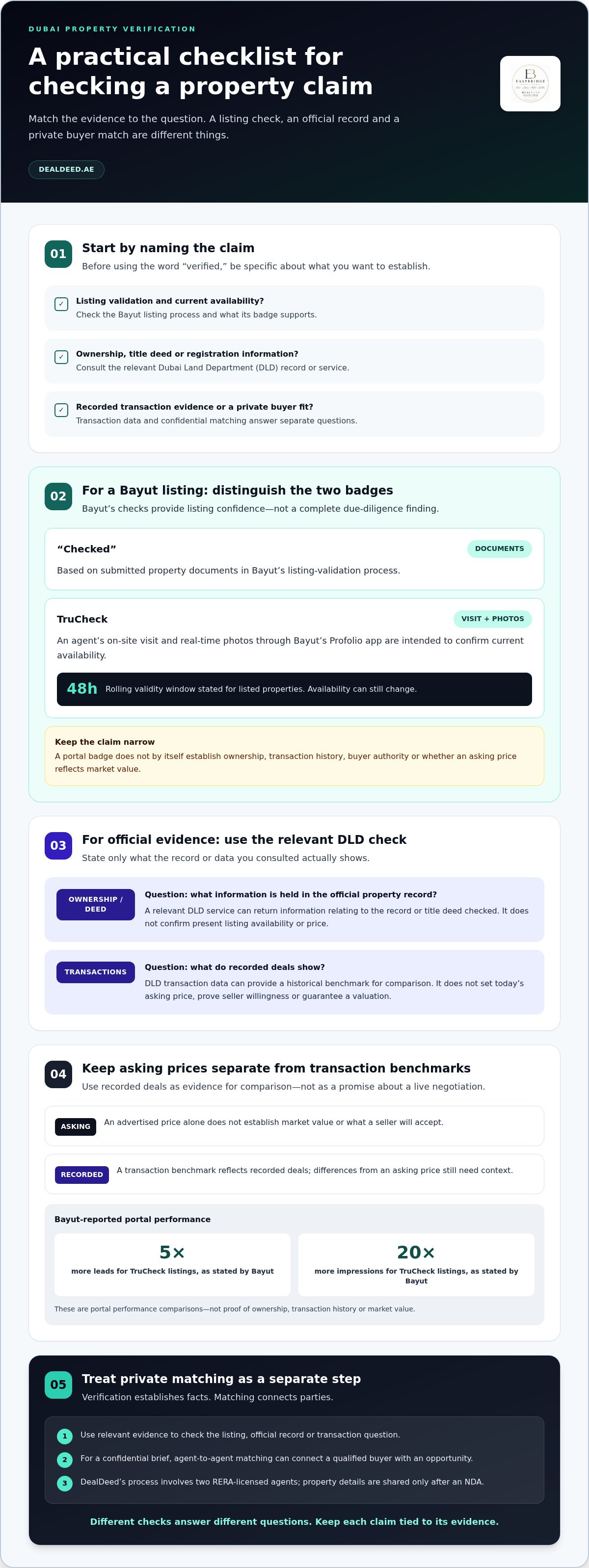
A practical verification workflow for Dubai property agents
A reliable workflow begins with a precise claim, not a badge or document already at hand. In the Bayut TruCheck vs Dubai Land Department direct verified matching discussion, keep three workstreams separate: checking a listing, checking transaction evidence, and identifying a possible fit for a buyer’s requirements. Each needs its own evidence and disclosure controls.
- Define the claim. Write down what needs to be established: whether a Bayut listing has been validated, what comparable transactions show, whether an ownership or title record supports a specific statement, or whether an opportunity could fit a buyer brief. Don’t combine these into one broad “verified” conclusion.
- Select the relevant source. If the property is listed on Bayut and the question concerns that listing, use the current TruCheck process. If the question concerns a recorded sale or official property record, consult the relevant DLD evidence. Confirm the current procedures and scope before describing either check publicly.
- Record the evidence and its limits. Note the source consulted, the claim it supports and what remains unverified. For a transaction comparison, identify why the properties are considered comparable, including property type, area and timing. Treat the result as context, not a guaranteed valuation or offer price.
- Keep identity checks distinct. A person’s identity, a property’s records and a listing’s status are different subjects. Evidence for one doesn’t establish the others. Where the evidence doesn’t support a detail, mark it unverified rather than filling the gap with an assumption.
- Control disclosure before matching. Share only the information needed at each stage. For a confidential opportunity through DealDeed, property details are shared only after an NDA is signed. Matching is agent-to-agent and requires two RERA-licensed agents, each holding a valid ORN and BRN.
This sequence reduces the risk of describing a narrow check as proof of a wider claim. TruCheck, for example, applies only when the listing is on Bayut. It can inform confidence in that listing, but it doesn’t replace relevant DLD evidence for a transaction benchmark. Neither check determines whether a private opportunity suits a particular buyer.
Keep a concise record of the distinction in any agent-to-agent discussion: claim checked, source used, evidence observed, limits, and information cleared for sharing. That discipline helps preserve accuracy without exposing sensitive details prematurely. The professional Dubai real estate deal desk guide covers how private matching can operate alongside evidence-led checks.
If you’re a RERA-licensed agent working with a buyer brief or confidential opportunity, submit a brief for private matching.
Where DLD-verified evidence meets DealDeed private matching
Once an agent has identified what the evidence supports, a separate question may remain: does a confidential opportunity fit a serious buyer’s requirements? That is where verification and matching meet, without becoming the same task. In the Bayut TruCheck vs Dubai Land Department direct verified matching comparison, TruCheck relates to a Bayut listing, and DLD data can inform evidence-led deal assessment. Neither tool connects a private buyer brief to an opportunity.
DealDeed is a confidential matching desk and introducer, not a broker or listing platform. Its team manually matches buyer briefs with motivated seller opportunities. Deal information is benchmarked against official DLD transaction data, so pricing is described as below-market only when that comparison has been verified. The benchmark informs the assessment; it doesn’t guarantee a price or outcome.
How the private matching desk differs from verification tools
Verification checks evidence against a specific claim. Matching considers whether a buyer’s requirements and a potential opportunity align. DealDeed makes introductions through two RERA-licensed agents, keeping the process agent-to-agent rather than publishing property details for general viewing.
The Match Room is private to the two agents, and matches are visible only to the users involved. Property details, prices, addresses and client names are shared only after an NDA. This gives agents a controlled way to assess a potential fit without exposing sensitive information publicly. It complements due diligence, but doesn’t replace the relevant checks on a property or transaction.
What agents should expect before participating
Agents participating in the matching desk must be RERA-licensed and hold valid ORN and BRN. The process is for licensed agents coordinating a buyer brief and an opportunity, not for direct representation by DealDeed. Each agent remains involved on their respective side of the introduction.
Registration, submitting a brief and receiving matches are free. If an introduced match completes, a fixed introduction fee is invoiced to each participating agent. Buyers and sellers don’t pay DealDeed directly, and no match means no introduction fee. The fee is fixed and consistent across agents.
These terms keep the next step distinct from a listing badge or data check. Evidence can help agents assess a claim; a confidential introduction can connect parties whose requirements may align. Neither should be overstated as a guarantee of a completed transaction.
RERA-licensed agents with a serious buyer brief or motivated seller opportunity can register and submit it for confidential matching. The process keeps the introduction between the participating agents, with property details disclosed only after an NDA.
Make the next property decision with a clear evidence trail
Use the distinction in Bayut TruCheck vs Dubai Land Department direct verified matching as a practical discipline: write down the decision you need to make, identify the evidence that can support it, and keep any remaining uncertainty visible. That gives colleagues and clients a clearer basis for the next conversation without turning a badge or benchmark into a broader promise.
When the next step is finding a discreet fit for a buyer brief, DealDeed benchmarks deal information against official DLD transaction data. A below-market description is used only when verified against that data. Matching is manual and takes place between agents with valid RERA ORN and BRN.
Bring a serious brief or opportunity into a process designed for controlled, agent-to-agent introductions. Submit a private brief or register as a participating agent, and take the next step with evidence and discretion in place.
Frequently Asked Questions
Is Bayut TruCheck the same as Dubai Land Department verification?
No. TruCheck relates to a listing on Bayut, while a DLD check consults official property or transaction records. They answer different questions. In the Bayut TruCheck vs Dubai Land Department direct verified matching comparison, treat the portal check as listing evidence and DLD data as evidence about the records consulted. Confidence in a Bayut listing doesn’t replace a separate check of a title deed or transaction record.
Does a Bayut TruCheck badge prove that the person advertising a property owns it?
No. A TruCheck badge isn’t, by itself, proof that the person advertising the property is its legal owner. It signals that the listing has gone through Bayut’s validation process, which has a specific scope. If the question is ownership, consult the relevant DLD ownership or title deed evidence. Listing validation supports confidence in the listing, not every claim about the advertiser.
Can DLD transaction data confirm a property’s current asking price?
No. DLD transaction data records completed transactions, not the current asking price of a property being marketed. An agent can use relevant recorded sales to add context to a pricing discussion, but should identify the comparison and its limits. A sale in the same area may still differ by property type, timing or other characteristics. Treat the asking price as the seller’s stated figure, not a DLD-confirmed value.
Can buyers or sellers submit a brief directly to DealDeed?
Buyers or sellers can register and submit a brief, but DealDeed doesn’t represent either party directly. Any matching introduction is conducted through agents, with a RERA-licensed agent on each side. An investor’s requirements, for example, can be considered alongside a motivated seller opportunity while the respective agents remain involved. This keeps the process agent-to-agent rather than creating a direct brokerage relationship with DealDeed.
Do buyers and sellers pay DealDeed a matching fee?
No. Buyers and sellers don’t pay DealDeed a matching fee. Registration, brief submission and receiving matches are free. If an introduced match completes, each participating agent is invoiced a fixed introduction fee. The fee isn’t billed directly to the buyer or seller, and it isn’t a percentage of an agency commission. It applies to participating agents only when the introduced deal completes.
How long does DealDeed verification usually take?
DealDeed verification usually takes 24-48 hours, but this is an indicative timeframe, not a guarantee. The review relates to the information being checked and isn’t a promise that a match or transaction will happen within that period. Keep the verification stage distinct from later discussions between the parties, and describe the timeframe as usual rather than guaranteed.
What happens if an agent declines a DealDeed match?
An agent can decline a match without penalty or cost. A match is an introduction to assess, not an obligation to proceed with a transaction. An agent may decide, for example, that an opportunity doesn’t fit the buyer’s stated requirements and decline it. The introduction fee applies only to a completed introduced match, so declining a match doesn’t trigger the fee.


