

What if a message meant for one buyer identifies the property, its owner or the seller’s position to a much wider circle? The risks of sharing property details on WhatsApp in UAE start with a basic uncertainty: you may not know who can see, save or forward a message or attachment. An address, ownership document or asking terms can reveal more than you intended.
It’s reasonable to want a quick way to qualify genuine interest without exposing sensitive details. The answer isn’t necessarily to stop communicating. Instead, share information in stages, matching each disclosure to what’s needed and who has been vetted.
This article explains which property details deserve care, what can go wrong when they circulate informally, and how to make disclosures more controlled. It also considers when private matching may be more suitable than broad forwarding. DealDeed privately matches sellers with serious, vetted buyers through RERA-licensed agents. Property details are verified against Dubai Land Department data, with no public listings or marketing.
Key Takeaways
- The risks of sharing property details on WhatsApp in UAE depend on what you disclose, who receives it and whether it may be passed on.
- Separate privacy exposure, impersonation, negotiation pressure and legal or evidentiary concerns. Each calls for a different response.
- Compare direct messages, public listings and private matching by audience reach, onward sharing and the information each route requires.
- Use staged disclosure: begin with a limited property summary, then share sensitive records only when the recipient and purpose are clear.
- Consider an agent-led private matching route when broad circulation isn’t appropriate, while keeping control over what information is shared at each stage.
What are the risks of sharing property details on WhatsApp in the UAE?
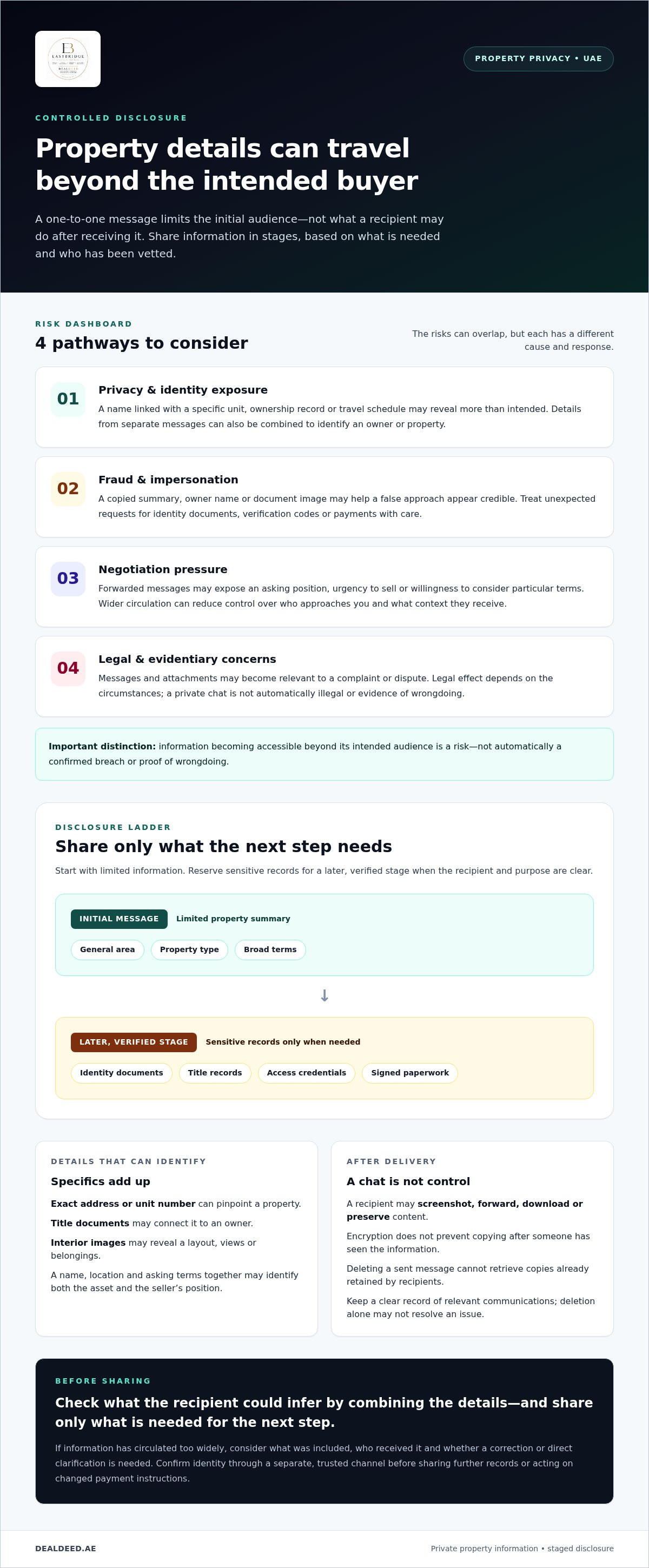
The central risk is losing control over information, not that every WhatsApp exchange is unsafe. A message sent to one person may be saved, copied or passed on, and its original context can disappear. For a property owner, that could mean an address or document reaches someone who was never meant to receive it. The risks of sharing property details on WhatsApp in UAE vary with the information shared, the recipient and what happens next.
Property-data exposure occurs when information about an asset or its owner becomes accessible beyond its intended audience. That is a risk, not automatically a confirmed breach or evidence of wrongdoing. The consequences differ: accidental disclosure is a mistake; commercial exposure may weaken a seller’s position; impersonation involves someone misusing details to appear credible; and legal concerns depend on the content and circumstances. These categories can overlap, but they aren’t interchangeable.
Which property details can identify an owner or asset?
An exact address or unit number can pinpoint a property. Title documents may connect it to an owner, while access details create a separate security concern. Interior images may also reveal an identifiable layout, views or personal belongings. An initial message may need only a general area, property type and broad terms. Identity documents, title records, access credentials and signed paperwork belong at a later, verified stage.
Details can become more revealing in combination. An owner’s name, a specific location and asking terms may help someone identify both the asset and the seller’s position, even if no single item seems sensitive on its own. Before sharing, consider what a recipient could infer by combining the information with other details. Share only what’s needed for the next step.
Why a one-to-one chat is not the same as controlled circulation
A private chat limits the initial audience. It doesn’t give the sender control over what a recipient does after delivery. Someone may screenshot, forward, download or preserve information, including outside the original conversation. General information about the platform is available from Wikipedia’s WhatsApp overview, but a messaging feature can’t govern a recipient’s choices.
Encryption can protect messages in transit or between intended endpoints, depending on the service and setup. It doesn’t prevent a recipient from copying content after seeing it, and it can’t guarantee confidentiality once information has been delivered. That distinction matters for property documents: technical protection and controlled circulation are not the same thing.
There may also be legal or evidentiary concerns. In the UAE, online communications may be relevant in a legal dispute, and privacy or cybercrime rules can apply to certain unauthorized disclosures. That doesn’t mean every private chat is illegal or creates liability. It means a message can have consequences beyond the moment it is sent, so handle sensitive property information deliberately.
How can WhatsApp property sharing create privacy, legal, and deal risks?
The risks of sharing property details on WhatsApp in UAE aren’t limited to a document reaching the wrong person. Information can affect an owner’s privacy, enable impersonation, change the tone of negotiations or become relevant if a dispute arises. Each risk has a different pathway, so assess what was exposed and what someone could do with it.
Privacy and identity exposure
A message linking an owner’s name to a specific unit, ownership record or travel schedule may reveal more than intended. Even without an identity document, details shared across messages can help someone connect the owner to the property. This doesn’t mean exposure has occurred simply because information was sent. It means the owner may lose control over who can access or combine those details once they leave the original exchange.
Fraud and impersonation
Property information can give an impersonator useful context. A copied listing summary, owner name or document image may help someone make a false approach seem credible to a buyer, agent or building contact. Treat unexpected requests for identity documents, verification codes or payments with care. Confirm a person’s identity through a separate, trusted channel before sharing further records or acting on changed payment instructions.
Negotiation and transaction pressure
Forwarded messages can expose an asking position, urgency to sell or willingness to consider particular terms beyond the intended buyer or agent. Wider circulation may reduce control over who approaches the seller, what context they receive and how they interpret the information. It may complicate discussions or affect buyer confidence, but disclosure doesn’t automatically lower a property’s market value or cause a sale to fail. The practical concern is losing control of the negotiation around it.
Deleting a sent message can’t retrieve copies already retained by recipients. If information was shared too widely, consider what was included, who received it and whether a correction or direct clarification is needed. Keep a clear record of relevant communications rather than assuming deletion resolves the issue.
Legal and evidentiary concerns
Messages and attachments may become relevant to a complaint or dispute, but their admissibility and legal effect depend on the circumstances. UAE cybercrime, evidence and personal-data rules may apply to particular conduct; check the applicable provisions against current law. This section is general information, not legal advice. Have qualified UAE counsel review legal claims and seek advice if a dispute or suspected offence arises. Preserve relevant records and avoid editing or circulating them further without guidance.
When broad forwarding isn’t appropriate, a structured introduction can keep the process focused on a relevant buyer rather than a wider audience. DealDeed privately matches buyers through RERA-licensed agents and verifies property details against Dubai Land Department data. Explore private buyer matching as an alternative to informal circulation.
WhatsApp, public listings, or private matching: how do disclosure risks compare?
There’s no universally risk-free route. Each channel trades reach for control. The risks of sharing property details on WhatsApp in UAE depend partly on whether you’re coordinating with a known contact, seeking broad public interest or looking for a more limited, agent-led introduction. Compare the likely audience and the information required before choosing.
| Route | Audience reach | Control over onward sharing | Information typically needed | May suit |
|---|---|---|---|---|
| Direct WhatsApp sharing | One recipient initially, or a group if sent to multiple contacts. | Limited after delivery. A recipient may copy or forward details, and group members widen the audience. | A brief, non-sensitive summary can start a conversation. Exact identifiers and ownership records can wait. | Initial coordination with a known contact, using only details needed to establish interest. |
| Public listing | Broad exposure by design, potentially reaching people beyond a seller’s intended circle. | Low control over who sees, records or shares publicly available information. | Enough information to present the property to a wide audience, subject to the relevant marketing process. | Sellers who prioritise broad visibility and are prepared for public enquiries. |
| Agent-led private matching | A more focused introduction between relevant parties through agents. | More structured than informal forwarding, but no route can guarantee that information will never be disclosed onward. | Property details suited to matching and verification, with sensitive records handled at an appropriate stage. | Owners seeking relevant buyer introductions without broad public marketing. |
When is WhatsApp appropriate for an initial property enquiry?
WhatsApp can be practical for limited, non-sensitive coordination when you know who you’re speaking with. A general area, property type and broad indication of terms may be enough to establish whether there’s a basis for discussion. Hold back the exact unit, title documents and access details until the recipient’s identity and purpose are clear. Group chats and forwarded messages expand the audience, so treat them differently from a one-to-one exchange.
The key distinction is between using a message to arrange a conversation and using it to circulate a complete property brief. Keep the first exchange narrow. Share further information only when it supports a clear next step.
When might private matching suit a discreet property mandate?
If public visibility isn’t the objective, agent-led private matching can connect relevant parties without placing the property on public listings. DealDeed handles matching confidentially between RERA-licensed agents and verifies property details against Dubai Land Department data. This is structured circulation, not a promise of absolute secrecy, so decide what information to disclose at each stage. The private real estate matching guide explains how this route differs from broad exposure.
Choose the channel that fits the seller’s priority. Broad reach can bring more visibility, while a private route can keep introductions focused. In either case, control depends on limiting the information shared and being deliberate about who receives it.
How should you share property information more carefully on WhatsApp?
A staged process lets you qualify interest without sending a complete property file at the outset. Reduce the risks of sharing property details on WhatsApp in UAE by deciding what each recipient needs, confirming their role and keeping a record of each disclosure. Treat an initial enquiry, a qualified discussion and formal transaction steps as separate stages.
- Classify the information. Separate general property facts from details that identify the owner, pinpoint the unit or provide access. Decide which category is necessary for the current conversation.
- Confirm the recipient. Check who the person is, their role in the enquiry and why they need the information. If an agent is involved, establish that they’re acting in that capacity before sending sensitive records.
- Share only what advances the next step. Start with a broad description and relevant, non-identifying facts. Don’t attach a full ownership file just to answer an initial question.
- Document consent and purpose. State what you’re sharing and how it may be used. Keep a note of the recipient, date, material sent and stated purpose. Consent clarifies expectations, but it can’t control what a recipient does after receiving a copy.
- Review onward use. Before sending anything further, consider whether the recipient needs it, whether the audience has changed and whether the information is still appropriate to share. Reassess before moving from a private chat to a group conversation.
What should you send before a buyer or agent is qualified?
For early screening, use a broad property description, general area, property type and other relevant facts that don’t identify the precise unit or owner. Avoid sending title documents, unredacted identity documents, access codes or exact occupancy details in an initial chat. Before sharing more, confirm the recipient’s role and intended use, then disclose only what’s needed for that purpose.
How can you reduce exposure when documents must be shared?
Once there’s a clear reason to provide records, prepare them for that specific recipient and purpose. Redact irrelevant personal identifiers, use a restricted sharing method suited to sensitive records where appropriate, and check the method’s instructions rather than assuming a setting works in a particular way. Keep an accurate record of what was sent and to whom.
Before sharing property images, remove or obscure visible faces, family photographs, mail and labels, identity papers, computer screens, valuables, access codes and details that reveal an exact unit or routine. Where practical, remove image metadata too, and check the relevant tool’s instructions.
For a more structured alternative to informal forwarding, explore private buyer matching through DealDeed. Its process handles matching confidentially between RERA-licensed agents and verifies property details against Dubai Land Department data.
How does DealDeed support discreet property matching in the UAE?
Some sellers want a relevant buyer introduction without putting a property before a broad public audience. DealDeed provides private buyer matching through RERA-licensed agents. Property details are verified against Dubai Land Department data, and deal flow is handled confidentially between agents. This offers a structured alternative to circulating a complete property file through informal chats, but it doesn’t promise absolute secrecy or a successful sale.
The distinction is practical. Public marketing aims for broad visibility. Private matching focuses on connecting a property brief with serious, vetted buyers through an agent-led process. The right route depends on the seller’s priorities and the level of exposure they’re prepared to accept. For owners in Dubai and Abu Dhabi concerned about the risks of sharing property details on WhatsApp in UAE, a structured introduction can provide a more deliberate path than casual forwarding.
What happens to a private property brief?
A seller or agent registers a brief or mandate for private matching. DealDeed works to match the property with serious, vetted buyers through RERA-licensed agents. The process is an introduction and matching service, not direct brokerage or a public property portal. Details are verified against Dubai Land Department data, helping ground the brief in official property information.
Verification is part of the process, not a substitute for sensible disclosure. Owners and agents should still consider what information is necessary at each stage and who needs to receive it. The Dubai Land Department verification guide explains how official data validation supports a more informed property brief.
Deal flow is handled confidentially between RERA-licensed agents. That describes the process, not a guarantee that information can never be shared beyond its intended audience. The aim is controlled, relevant introductions rather than public circulation. Participating agents pay a fixed introduction fee only if a matched deal completes. Sellers aren’t promised a match or outcome.
When is a private route worth considering?
A private route may suit sellers or agents who prioritise controlled exposure and relevant introductions over broad reach. Instead of forwarding a full property file to multiple chats, an agent-led process offers a more structured way to present a brief and connect it with potential buyers. Public visibility may serve a different objective. Neither route removes the need to handle sensitive documents with care.
Consider the trade-off: how wide should the audience be, what information is necessary to establish interest, and who should manage introductions? DealDeed’s private matching is designed for sellers seeking a discreet route through RERA-licensed agents, with property details checked against Dubai Land Department data. It keeps the process focused without claiming complete anonymity or a guaranteed sale.
If a private introduction fits your priorities, you can submit a private property brief for matching. It’s a considered alternative to informal forwarding when discretion and relevant buyer introductions matter.
Choose the next step with control
The risks of sharing property details on WhatsApp in UAE are a reminder to treat each disclosure as a decision, not a routine forward. Before sending more, ask what the next person needs to know and whether a broad audience serves your objective. A property brief can move forward without placing every detail into circulation at once.
If you’re considering a discreet route, DealDeed’s private matching is handled confidentially between RERA-licensed agents, with property details verified against Dubai Land Department data. The matching process uses no public listings or marketing. It offers a structured way to seek relevant introductions while leaving the decision about what to disclose in your hands.
Submit a private property brief to DealDeed to take the next step toward a more controlled introduction. Share with purpose, proceed at your pace and keep your property information aligned with the audience you intend to reach.
Frequently Asked Questions
Can WhatsApp messages be used as evidence in the UAE?
WhatsApp messages or shared files may become relevant in a UAE dispute or complaint, but whether they can be used and how much weight they carry depends on the circumstances and applicable law. Preserve the original conversation and files if a matter arises. A screenshot alone may not establish authenticity or context. For a specific case, get advice from qualified UAE legal counsel rather than relying on a general online explanation.
Is it safe to send a title deed over WhatsApp in the UAE?
A title deed contains sensitive ownership and property information, so don’t send it automatically in response to an initial enquiry. Confirm the recipient’s identity and why they need it. Ask whether a less detailed record will answer the question, and redact information that isn’t required. If a copy must be provided, use a controlled method suited to the purpose. A private chat can’t ensure the recipient won’t retain or share it.
Can someone forward my property details from a WhatsApp chat?
Yes. A recipient may be able to copy, photograph, screenshot or forward information, depending on the content and current app features. Some controls may restrict particular actions, but they can’t prevent every form of recording or onward disclosure. For example, a recipient could photograph a document displayed on another device. Limit each message to what that person needs, and don’t send identifying records before establishing the recipient and purpose.
What should I do if I shared property documents with the wrong person?
First, record what you sent, when you sent it and who received it. Ask the recipient in writing to stop using or forwarding the material and to delete any copies, while recognising that you can’t verify or guarantee deletion. Preserve relevant messages. If the documents exposed account or access credentials, secure the affected accounts or change credentials where possible. If misuse is suspected or the records are highly sensitive, seek qualified UAE legal or cybersecurity advice.
Can a seller share a Dubai property privately without a public listing?
A seller may explore private introductions instead of public marketing, depending on the mandate and transaction arrangements. Private handling still involves disclosure to relevant parties, so decide what information is needed at each stage. DealDeed matches private property briefs through RERA-licensed agents and verifies details against Dubai Land Department data. No matching route can ensure information will never be shared onward, and a private introduction doesn’t guarantee a buyer or completed sale.
Should I send the exact property address to a buyer on WhatsApp?
Not necessarily. For an initial enquiry, a broad location and concise property summary may be enough to establish interest. Share the exact address when it’s needed for a legitimate next step and you understand the recipient’s role. Consider whether the property is occupied and whether the message could reveal access or owner routines. Be especially deliberate in group chats, where the audience is wider than a direct exchange.
Does deleting a WhatsApp message remove the property information I sent?
No, deleting a message from your own chat doesn’t necessarily remove copies another participant has already seen, saved, screenshotted or forwarded. Deletion options and their limits can change, so check current WhatsApp guidance. If you sent a document by mistake, act promptly: preserve relevant records, then contact the recipient with a clear request not to use or circulate it. Don’t assume deletion alone resolves the exposure.


