

What if a buyer’s impressive bank balance isn’t money they can use to complete a Dubai property purchase? A statement or screenshot can look persuasive while leaving key questions unanswered: Is it current? Does the buyer control the funds? Do they match the stated source and purchase plan? Knowing how to verify a buyer's proof of funds in Dubai means looking beyond the figure on the page.
It’s reasonable to expect clear evidence before moving a transaction forward, but one document rarely tells the full story. A bank balance, mortgage pre-approval and proceeds from a property sale each need a different kind of review. Sensitive financial records also call for careful handling and limited disclosure.
This guide sets out a discreet, evidence-led process for assessing a buyer’s access to funds without treating an attractive balance as proof of readiness. It explains what documents can support different funding sources, how to compare the evidence with the proposed purchase, and when to pause for appropriate compliance or legal guidance. The aim is a clearer decision, not unnecessary exposure.
Key Takeaways
- Learn how to verify a buyer's proof of funds in Dubai by assessing whether funds are accessible for the proposed purchase, not just visible in an account.
- Match evidence to the stated funding source, from personal savings and financing to asset-sale proceeds, gifts, inheritance or company funds.
- Use a consistent review process that clarifies the funds’ amount, ownership, timing and intended payment route.
- Distinguish missing, inconsistent, expired, altered or unverifiable documents without assuming misconduct before the facts are clear.
- Prepare a concise buyer brief and handle financial documents discreetly, keeping private introductions separate from transaction-level funds and compliance checks.
What counts as proof of funds for a Dubai property purchase?
Proof of funds is evidence that money is available, or can be accessed, to meet the cost of a proposed property purchase. It helps assess purchasing capacity at a relevant point in time. It isn’t a legal certification, a guarantee that a transaction will complete, or proof by itself that the money came from a legitimate source. Put simply: Proof of funds shows whether a buyer can access the money they intend to use for a specific purchase.
A bank balance is only one piece of evidence. It may not show who owns the account, whether the buyer can access the funds, or how the money reached that account. A screenshot may also lack context, such as the account holder’s name, date, currency or any restrictions. The Proof of funds overview offers a general explanation of the term, but a Dubai property transaction still calls for evidence assessed against its specific circumstances.
Proof of funds, source of funds, and source of wealth
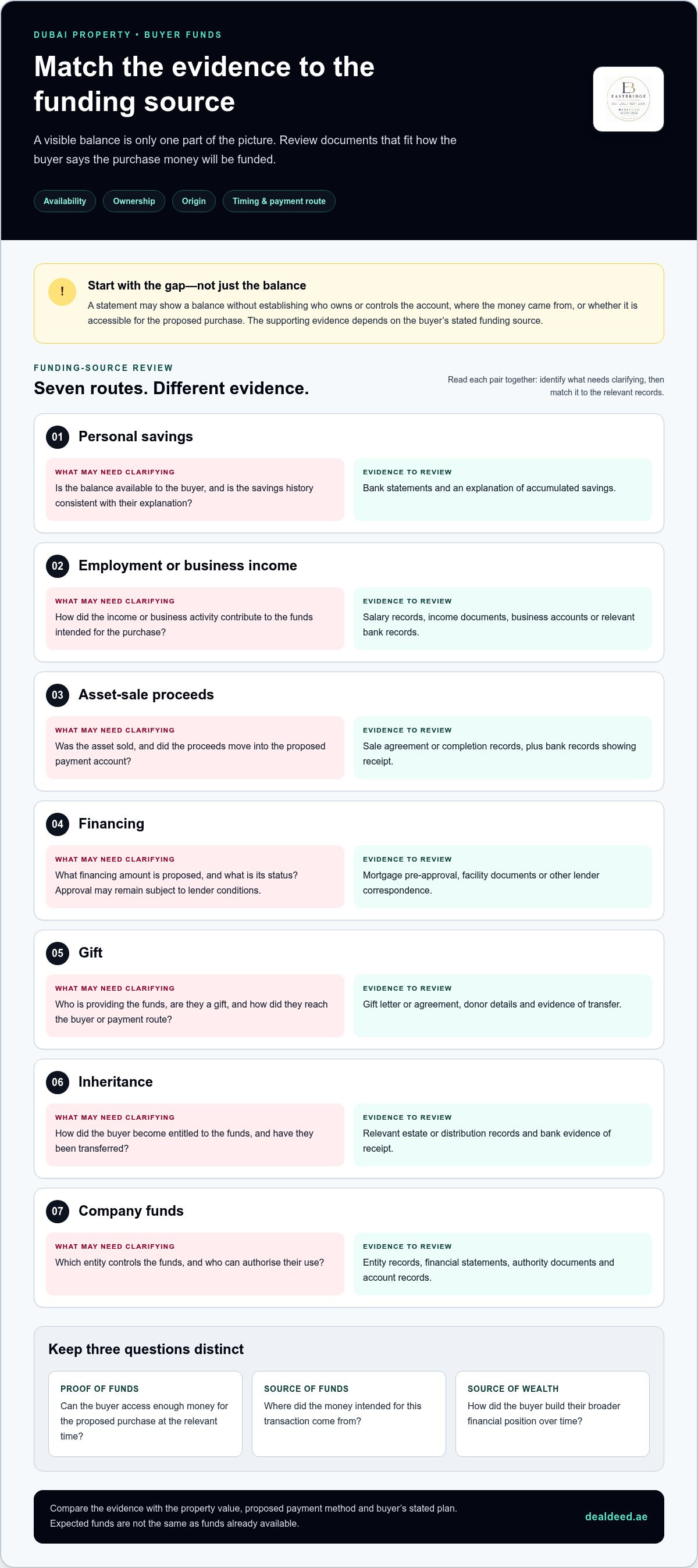
These terms answer different questions. Keep them separate when reviewing a buyer’s file:
- Proof of funds: Can the buyer access enough money for the proposed purchase at the relevant time? This is evidence of capacity, not a full account of the money’s history.
- Source of funds: Where did the money intended for this transaction come from? It might be savings, income, the sale of an asset, a gift or another stated source.
- Source of wealth: How did the buyer build their broader financial position over time? This could relate to business ownership, employment, investments or inherited assets.
For example, a statement may show a balance sufficient for a deposit. That supports a view of present capacity, but may not explain a recent large credit or establish that the buyer controls the account. Source of funds concerns that credit and the money intended for payment. Source of wealth looks more broadly at how the buyer accumulated their assets.
Why the distinction matters in a Dubai deal
Different participants may have different review responsibilities. An agent’s initial assessment, a bank’s financing process and other transaction checks aren’t interchangeable. A buyer brief or preliminary balance review shouldn’t be treated as a substitute for transaction-level verification or any applicable compliance process.
Assess the evidence in context by comparing the available or accessible funds with the property value, proposed payment method and buyer’s stated plan. A buyer intending to pay from savings presents a different picture from one relying on mortgage financing or expected sale proceeds. If the proposed route depends on money that isn’t yet available, record that distinction rather than treating expected funds as current funds.
The same discipline applies when reviewing property information. DealDeed checks property details against Dubai Land Department data, but that property check isn’t a finding about a buyer’s funds. Understanding Dubai Land Department verified deals can help distinguish verified property details from the separate evidence needed to assess purchasing capacity. That distinction is central to how to verify a buyer's proof of funds in Dubai: verify the specific claim using evidence that fits the purchase.
Which documents can support a Dubai buyer’s proof of funds?
The right evidence depends on where the purchase money is coming from. A bank statement may show a balance, while supporting records can help explain ownership, origin, timing and how the funds are expected to reach the transaction. Use documents that fit the buyer’s stated funding route, rather than applying the same checklist to every purchaser.
| Funding source | Example supporting evidence | What it may help establish |
|---|---|---|
| Personal savings | Bank statements and an explanation of accumulated savings | Available balance, account ownership and whether the savings history is consistent with the buyer’s explanation |
| Employment or business income | Salary records, income documents, business accounts or relevant bank records | Income flow and how savings or funds intended for the purchase accumulated |
| Asset-sale proceeds | Sale agreement or completion records, plus bank records showing receipt | That an asset was sold and proceeds moved into the proposed payment account |
| Financing | Mortgage pre-approval, facility documents or other lender correspondence | The proposed financing amount and its status, subject to the lender’s conditions |
| Gift | Gift letter or agreement, donor details and evidence of transfer | Who is providing the funds, whether they are a gift, and how they reached the buyer or payment route |
| Inheritance | Relevant estate or distribution records and bank evidence of receipt | How the buyer became entitled to the funds and whether they were transferred |
| Company funds | Entity records, financial statements, authority documents and account records | The company’s identity, its control of the funds and who can authorise their use |
Match evidence to the stated funding source
Read documents as a connected trail. For savings or income, compare relevant bank records with a clear explanation of how the funds accumulated. For an asset sale, look for evidence of the transaction and the movement of proceeds into the account proposed for payment. For a loan, gift or inheritance, identify the supporting agreement or records, then establish who will actually send the money. Evidence should fit the stated account. A mismatch calls for clarification, not an immediate conclusion.
There’s no universal statement period or document set that suits every buyer. The evidence needed can depend on the amount, funding route, transaction structure and current requirements. Keep the review proportionate, and have applicable UAE compliance questions assessed through the relevant transaction process.
Company funds and digital-asset proceeds
For a corporate buyer, review the entity’s identity, ownership, authority to purchase and proposed payment trail as separate points. A company account balance alone may not show who controls the entity or whether the person instructing the purchase can use those funds. Digital-asset proceeds also need a documented account of origin, conversion and movement into fiat funds. Accepted routes and current regulatory expectations can change, so seek appropriate UAE compliance guidance rather than assuming one route or document set applies.
A clear buyer brief can make a confidential introduction more focused, while transaction-level funds review remains with the relevant agents and compliance processes. Agents preparing a concise profile can use DealDeed’s private buyer brief matching to connect with relevant opportunities. The introduction itself isn’t a finding about the buyer’s funds.
How to verify a buyer’s proof of funds step by step
A consistent process keeps the review focused and discreet. It also helps separate a document that looks convincing from evidence that answers the transaction’s practical questions. When assessing how to verify a buyer's proof of funds in Dubai, test whether the stated funds, buyer and payment plan fit together. Don’t draw conclusions from a single balance or file.
- Define what needs to be established. Set the review against the proposed property and purchase plan. Clarify the expected amount, whether funds need to be available now or will come later, and which transaction participants are responsible for their own checks. Keep the request proportionate to the transaction.
- Ask for a clear funding explanation. Have the buyer state the source, amount, ownership, timing and intended payment route. Ask whether the purchase relies on savings, income, a sale, financing, a gift, inheritance or company funds. If several sources are involved, ask how each contributes to the total.
- Request relevant supporting records. Seek only documents that relate to the stated route and proposed purchase. If sale proceeds are intended to fund the purchase, for example, request records that connect the sale to receipt of funds. Handle documents through approved secure channels and limit access to those who need them.
- Check document details and provenance. Review the issuer, date, account holder and completeness. Where appropriate and within your role, use a secure channel to confirm a document with its issuer. Treat screenshots, cropped extracts and edited files as leads for further review, not conclusive evidence. A genuine-looking format alone doesn’t establish that the information is current or complete.
- Compare the evidence across the file. Check names, dates, currencies, account ownership and transaction amounts against the buyer’s explanation. Look for a reasonable connection between the stated source and the available balance. For instance, if a large recent credit is described as sale proceeds, the supporting sale and receipt records should fit that account.
- Trace the intended payment route. Follow the available records from the stated source to the account or payment method intended for completion. Note any gap, third-party involvement or unexplained difference. Don’t treat expected financing or pending sale proceeds as money already available.
- Record the outcome and next action. Note what you reviewed, what it supports, any unanswered questions and the decision reached under the relevant process. If an inconsistency remains, pause progression and follow approved escalation procedures, including seeking appropriate compliance or legal guidance where needed.
Verification means testing consistency and traceability, not simply collecting documents. A well-organised file can still leave a key point unresolved. Record uncertainty accurately rather than turning it into an allegation, and don’t present an initial review as a guarantee of funds or a replacement for other transaction checks.
What a bank letter does, and does not, prove
A genuine bank letter can confirm a detail about an account or balance at the time it was issued. It may help show that funds were present, but it doesn’t automatically establish who controls them, whether they remain available, how they originated or how they’ll reach the property transaction. A balance is a snapshot, not the full money trail.
Assess the letter against the buyer’s explanation and proposed payment plan. Check its date, named account holder, currency, amount and stated purpose. If it confirms a balance but the purchase depends on a recent asset sale, financing or funds from another person, the letter may not address the supporting evidence needed for that route. A valid document can still be incomplete for the question being asked.
Red flags that call for clarification
Some differences deserve a focused follow-up, not an immediate allegation. Examples include a name that doesn’t match the buyer, a balance that differs across records, an unexplained third-party payment, or a gap between the stated source and the documented trail. A letter may also be expired, incomplete, altered or impossible to verify independently. Treat each as a separate issue and record what needs clarification.
Take note if a buyer presses to bypass ordinary checks or is reluctant to explain a material funding source. Context matters. A name variation, timing issue or missing page may have a straightforward explanation. Indicators alone don’t prove wrongdoing. Ask a precise question, such as who owns the account or what a particular credit represents, and assess the response against the evidence.
Protect confidential financial information
Financial documents should be handled with the same care as the transaction itself. Use controlled channels, limit access to people who need the records for their role, and avoid forwarding unredacted statements broadly or leaving files in informal messaging threads. Collect only what is relevant, and follow organizational policy and applicable UAE requirements for access, security and retention. Confirm current obligations through appropriate compliance or legal guidance.
If evidence is missing, inconsistent, expired, altered or independently unverifiable, pause before relying on it. Tell the buyer what specific point remains unresolved and request only the information needed to address it. If the explanation and records still don’t align, follow approved escalation procedures. Keep clear the difference between a document that can’t yet be verified and evidence of misconduct.
That distinction is central to how to verify a buyer's proof of funds in Dubai: assess what the letter supports, identify what it leaves open, and keep the review proportionate. DealDeed’s private matching connects sellers and serious, vetted buyers through confidential agent-to-agent introductions. It doesn’t replace transaction-level funds review. Agents preparing for a private introduction can prepare a discreet buyer brief, while financial verification remains within the relevant transaction and compliance processes.
Prepare a credible buyer file before a private Dubai introduction
A concise buyer file helps agents understand the proposed purchase and make a relevant introduction without circulating unnecessary personal information. It should explain the buyer’s requirements and funding plan clearly. It is a readiness aid, not a substitute for transaction-level verification, compliance checks or the responsible professionals’ current procedures.
A practical buyer-readiness checklist
Before a time-sensitive property decision, buyers and their agents can organise the essentials:
- Identity: Prepare accurate buyer details and identity records relevant to the transaction. For a company, include the entity information and identify who is authorised to act.
- Purchase brief: State the property type, preferred location, intended use and purchase timeframe. Keep the requirements specific enough to guide a relevant introduction.
- Funding explanation: Describe the expected funding source, approximate amount, ownership and timing. Distinguish funds already available from financing or proceeds that are still pending.
- Supporting evidence: Organise source-specific records that support the explanation, such as relevant bank records, financing documents or evidence of an asset sale. Share them only through appropriate channels and with those who need them.
- Payment route: Identify the intended payer and the account or method expected to fund completion. Explain any third-party involvement or multiple funding sources clearly.
Preparation helps surface gaps early. If a buyer expects to use proceeds from an asset sale, for example, they can distinguish completed funds from an expected payment and organise the relevant records before a suitable property is identified. The documents ultimately required depend on the transaction and the responsible professionals’ current processes. A prepared file doesn’t equal approval.
Keep verification separate from private matching
Private matching connects relevant parties; it doesn’t replace the checks required within a property transaction. DealDeed operates a confidential, agent-to-agent matching desk connecting motivated sellers with serious, vetted buyers. Transactions are handled between RERA-licensed agents, without public listings or marketing. DealDeed checks property details against Dubai Land Department data. That relates to the property, not a finding about a buyer’s funds or solvency.
A clear buyer brief can make an introduction more focused while keeping sensitive financial evidence within the relevant agents’ transaction and compliance processes. That separation is central to how to verify a buyer's proof of funds in Dubai: a private introduction can identify a potential fit, but it can’t stand in for a review of the funding evidence.
For agents, understanding private real estate matching in Dubai and the role of a Dubai real estate deal desk helps clarify how confidential introductions fit alongside transaction checks. Keep the brief concise, share financial records selectively and document any open questions through the appropriate process.
DealDeed’s private matching desk connects relevant buyer briefs with opportunities through confidential agent-to-agent introductions. There are no public listings or marketing, and the fixed introduction fee is charged to participating agents only when a matched deal is completed. Users pay no upfront registration or subscription costs.
Move forward with evidence and discretion
A property decision can move quickly. Set a clear standard for evidence before timing or enthusiasm blurs what’s known and what still needs checking. That discipline keeps the next step measured, whether you’re preparing a buyer profile or reviewing a specific transaction. Knowing how to verify a buyer's proof of funds in Dubai means preserving that distinction throughout the process.
For a discreet route to relevant opportunities, DealDeed privately matches motivated sellers with serious, vetted buyers. Introductions are handled confidentially between RERA-licensed agents, and property details are checked against Dubai Land Department data. These steps support a focused introduction, while the relevant transaction participants remain responsible for their own funds and compliance checks.
Submit a confidential buyer brief to DealDeed to begin a focused introduction process. Keep the evidence review separate, protect sensitive information and proceed when the facts support it.
Frequently Asked Questions
Is a bank statement enough to verify a buyer’s proof of funds?
Usually, a bank statement is one piece of evidence, not a complete verification. It can show an account balance and transaction activity, but may not establish control of the funds, their origin or continued availability for the purchase. For example, a large credit shortly before the statement date may need an explanation and supporting records. The appropriate review depends on the buyer’s funding route, transaction and applicable procedures.
Can someone else provide the funds for a Dubai property purchase?
Yes, a third party may provide funds, but their role should be clear before the payment is relied on. Establish who will pay, their relationship to the buyer, why they’re contributing and how they obtained the money. For example, a family member’s transfer may require records that explain both the contribution and its movement. Follow the responsible transaction professionals’ procedures before accepting or relying on third-party funds.
How recent should proof-of-funds documents be?
There isn’t one document-age rule that applies to every Dubai property purchase. A current record may be more relevant to access at completion, while older records could help explain accumulated wealth or an earlier asset sale. Consider the timing of the proposed purchase and whether the buyer’s circumstances have changed since the document was issued. Check current institutional and transaction requirements rather than relying on a standard period quoted elsewhere.
What happens if the buyer’s documents do not match their explanation?
Pause the assessment and identify the exact point that doesn’t align. A different account name, transfer amount or date may have a reasonable explanation, but it shouldn’t be ignored. Ask a focused question and request relevant support through a secure channel. Keep the issue factual in your notes. If the discrepancy remains unresolved, follow the applicable escalation process and seek appropriate compliance guidance before relying on the evidence.
Can cryptocurrency proceeds be used to buy property in Dubai?
Digital-asset proceeds may be used as part of a purchase, subject to the transaction and the checks applied by the relevant participants. The buyer should be prepared to explain how the assets were acquired, converted and transferred into the intended payment account. For example, records may need to connect an exchange or conversion with the resulting bank credit. Accepted routes and requirements can vary, so follow current UAE guidance rather than assuming a particular method will be accepted.
Should proof-of-funds documents be shared with a property seller?
Share only information needed for the transaction, and avoid sending full financial records directly or broadly without a clear reason. A seller may not need every detail in a statement, which can include unrelated transactions and personal information. The responsible agent or compliance professional can guide what is appropriate to disclose, who should receive it and how it should be protected. Don’t circulate sensitive files in public channels or informal group messages.


