

How can a family office sell an Abu Dhabi property discreetly without turning ownership or strategic intent into market conversation? A confidential property sale for family office Abu Dhabi is not simply a matter of avoiding public listings. It starts with control over what is shared, with whom, and at each stage.
Broad exposure can create noise before a serious buyer is identified. Yet privacy without credible property information can make a transaction harder to assess. The aim is disciplined disclosure: protect sensitive details while giving qualified counterparties enough evidence to decide whether to engage.
This guide explains how to compare private matching with public marketing, define a clear sale mandate, and set boundaries for information sharing. It also covers how to prepare property details for review and move from an initial brief to serious buyer discussions. The result is a more controlled process, with less unnecessary exposure, clearer verification, and a stronger basis for a qualified match.
Key Takeaways
- A confidential property sale for family office Abu Dhabi relies on controlled, need-to-know disclosure, not a promise of complete anonymity.
- Set out authority, decision rights, sale objectives, and permitted disclosures in a written mandate before sharing sensitive details.
- Compare private matching with public listing by weighing buyer reach against exposure, control, and process visibility.
- Prepare verified Abu Dhabi asset information and clear buyer criteria. Keep the property’s records distinct from Dubai-specific verification references.
- A private matching desk can move a brief toward serious buyer discussions through confidential agent-to-agent introductions.
What Does a Confidential Property Sale Mean for an Abu Dhabi Family Office?
A confidential property sale is a controlled process, not a promise of complete anonymity. Information is shared with relevant parties, at an agreed stage, and for a defined purpose. A confidential property sale for family office Abu Dhabi should protect sensitive ownership and mandate details while giving a serious buyer enough information to assess the asset.
Removing a property from public portals limits one form of exposure, but it does not create a private sale process on its own. The parties still need to decide who can circulate information, what a buyer receives, and how discussions progress. A family office may need a property disposal to fit a wider investment, governance, or continuity process.
Confidentiality must also coexist with applicable transaction records and requirements. Private discussions do not erase the formal steps or records that may apply to a transfer. The goal is controlled disclosure, not an assumption that a transaction leaves no trace.
What information should remain controlled during a property sale?
Separate the information needed to assess the property from details that reveal the family’s identity, internal authority, or reasons for selling. A buyer may need credible asset facts to decide whether to proceed, but may not need the family’s wider portfolio context or the identity of every decision-maker at the outset.
Use staged disclosure. An initial brief, for example, can describe the asset and broad sale parameters without naming the owner. Share further documents as discussions become substantive and the recipient has a clear role in the process.
Set the boundaries in writing. A disclosure schedule can record:
- Which property facts may be shared at the initial matching stage.
- Which documents require approval before release.
- Which individuals or organizations may receive each category of information.
- Who within the family office can authorize the next disclosure.
A written record reduces the risk of informal forwarding or inconsistent instructions and makes it easier to see what was shared, with whom, and under whose approval.
Why might an Abu Dhabi family office choose a private route?
Privacy may be one consideration, alongside limiting market speculation, keeping governance orderly, protecting reputation, or aligning buyer discussions with a timing objective. Priorities vary by family and asset. The right disclosure threshold depends on what the office is trying to achieve and what a credible buyer needs to assess the property.
Private matching means circulating a defined brief to selected potential counterparties rather than relying on broad public exposure. This can narrow initial circulation, but it does not automatically protect identity, preserve value, or produce a suitable offer. Those outcomes depend on the mandate, the quality of the information, and the fit between the asset and the buyer.
Make the decision practical: identify what must remain private, what evidence supports a credible assessment, and who controls each release. That gives the office a disciplined basis for choosing a route without confusing discretion with invisibility.
How to Build Confidentiality Into the Property-Sale Process
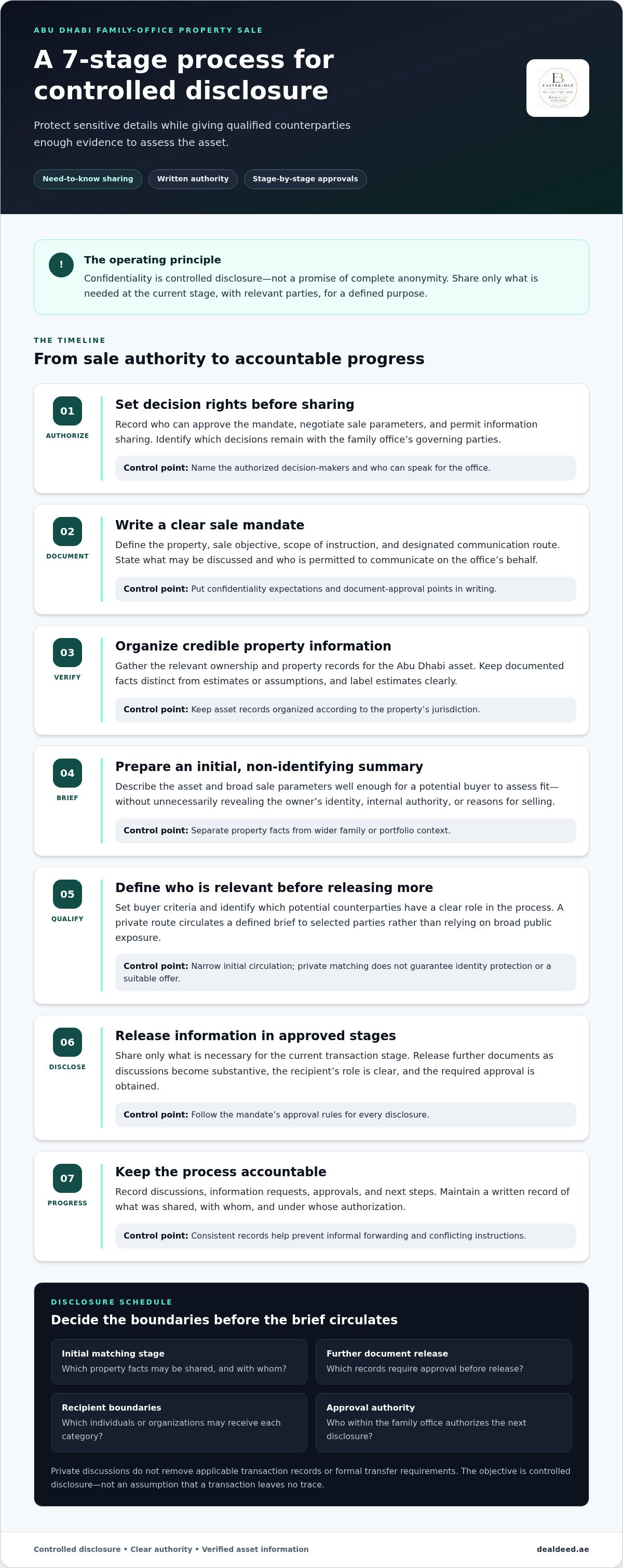
For a confidential property sale for family office Abu Dhabi, process discipline starts before a buyer sees the brief. Agree who can authorize the sale, assemble accurate asset information, and set rules for every disclosure. Assign an owner and approval point to each step.
- Authorize: Record who can approve the mandate, negotiate parameters, and permit information sharing.
- Document: Prepare a written brief that defines the asset, sale objective, scope, and communication route.
- Verify: Organize relevant ownership and property records. Separate documented facts from estimates or assumptions.
- Brief: Create an initial summary that gives a potential buyer enough information to assess fit without unnecessary sensitive detail.
- Qualify: Define what makes a counterparty relevant before releasing more detailed material.
- Disclose: Share information in stages, following the mandate’s approval rules.
- Progress: Record discussions, requests, approvals, and next steps so the process stays accountable.
Staged disclosure means sharing only what is necessary for the current transaction stage, then releasing more as discussions progress and approvals are obtained.
What belongs in a family-office sale mandate?
A useful mandate identifies the property, sale objective, authorized decision-makers, and designated communication route. It should define the scope of the instruction: what can be discussed, who can speak for the office, and which decisions remain with its governing parties.
Include confidentiality expectations and approval points for documents. For example, distinguish an initial, non-identifying asset summary from records that require specific authorization before release. Keep the brief factual: label estimates as estimates, and do not present assumptions as verified property facts. Clear boundaries help maintain a consistent account as discussions progress.
How should property information be verified and shared?
Organize records according to the asset’s jurisdiction. For an Abu Dhabi property, keep the relevant ownership and property documents together and ensure the brief reflects the evidence available for that asset. Dubai Land Department data checks relate to Dubai property and do not verify an Abu Dhabi asset.
Prepare the core evidence before buyer conversations begin. This helps the family office respond consistently and distinguish confirmed details from points that still need clarification. Release supporting material progressively to relevant, qualified counterparties, and log what was shared, with whom, and under whose approval. The aim is not to distribute a complete data file at the outset, but to support credible assessment while keeping disclosure aligned with the mandate.
Once the brief and disclosure boundaries are clear, a family office can submit a property mandate for private buyer matching. The mandate gives the matching process a defined scope from the start.
Private Matching vs Public Listing: Which Sale Route Fits the Mandate?
Public listing and private matching involve different trade-offs. Public marketing can broaden initial exposure and invite responses from a wider audience. Private matching narrows initial circulation to selected potential buyers, changing how buyer interest is gathered. Neither route removes the need for credible asset information or a clear sale mandate.
Choose a route by weighing the mandate’s exposure tolerance against its evidence needs. Compare the options against the priorities that matter to the family office:
| Factor | Public listing | Private matching |
|---|---|---|
| Exposure | Property information is made broadly visible through public marketing. | Initial information is circulated to a narrower group of potential counterparties. |
| Buyer reach | May reach a wider pool, including buyers not identified in advance. | Focuses outreach on selected prospects, so the initial pool is more limited. |
| Control | Public circulation can make it harder to limit who encounters the listing. | The mandate can define who receives the brief and what is shared at each stage. |
| Evidence | Public enquiries can provide market signals, but interest is not proof of a completed transaction value. | Buyer feedback is more targeted. Fewer public signals may mean greater reliance on documented evidence and direct responses. |
| Process visibility | Public availability makes the sale more visible to the market. | Discussion can remain more contained, subject to the agreed disclosure process. |
Does a private sale reduce price discovery?
It can reduce the volume of public signals, making deliberate evidence gathering and careful interpretation of buyer feedback more important. An asking-price strategy is a position set for the sale, not verified evidence from a completed transaction. Enquiries and indicative interest can inform discussion, but neither establishes what a buyer will ultimately pay.
For a confidential property sale for family office Abu Dhabi, discretion alone does not establish market value or buyer demand. A private route does not promise equivalent competition, faster completion, or a particular price. The family office should decide what evidence is sufficient for its approval process and how it will assess responses from qualified prospects.
When might public exposure or selective matching suit the brief?
Consider the mandate’s urgency, privacy threshold, asset profile, and governance requirements together. A family office seeking broad visibility may favor public exposure. An office with tighter disclosure limits may prefer selective matching, provided the narrower circulation fits its buyer-reach and evidence objectives.
Set an exposure boundary before choosing a route. Decide whether the asset may be publicly identified, whether ownership details can be shared, and who can approve wider circulation. For related context on verification in Dubai transactions, see this guide to confidential real estate transactions. Its Dubai-specific verification context should not be treated as verification of Abu Dhabi property.
Abu Dhabi Property-Sale Readiness: A Practical Family-Office Checklist
Before circulating a mandate, confirm that the family office can explain the asset, the sale objective, and the limits of its authority to share information. This preparation keeps the brief accurate and the approval path clear. For a confidential property sale for family office Abu Dhabi, readiness also means keeping Abu Dhabi asset records distinct from Dubai-specific verification references.
Use this checklist to identify gaps before buyer discussions begin:
- Authority: Identify the person or body authorized to approve the mandate, respond to offers, and permit document sharing.
- Asset facts: Assemble the property details and supporting records relevant to the Abu Dhabi asset. Mark estimates and unverified points clearly.
- Sale objective: Define the intended outcome and any timing priorities the brief should communicate.
- Disclosure limits: Specify whether the asset, owner, or sale context may be identified, and what requires separate approval.
- Buyer criteria: Set out the buyer profile and the evidence or level of engagement needed before further information is released.
Keep the checklist practical. It is a control document for the mandate, not a substitute for transaction records or approvals that may apply to the asset.
Which decisions should be settled before sharing a mandate?
Agree on buyer fit, timing priorities, and the outer boundary of disclosure before the brief leaves the family office. Record who can approve the next step, who can authorize document sharing, and how requests or offers should be routed. Then prepare a concise, factual summary. Include enough asset information to support an initial assessment, but leave out sensitive details that are not needed at that stage.
How should Abu Dhabi and Dubai verification stay distinct?
Use records and terminology appropriate to the property’s jurisdiction. Dubai Land Department data checks relate to Dubai property and do not verify Abu Dhabi assets. For Dubai-specific context, the Dubai Land Department verified-deals guide explains this distinction. Do not label an Abu Dhabi document or check using Dubai terminology, and do not imply that Dubai data substantiates an Abu Dhabi property fact.
For an Abu Dhabi asset, organize the relevant ownership and property records without naming a specific authority or record type unless it has been verified for that transaction. Apply the same discipline to every buyer brief: state what the supporting documents establish, and separate those facts from assumptions or information still being assembled.
A family office considering a Dubai asset can review the private real estate matching guide for the Dubai matching model. To put that route into motion for a Dubai property, submit a Dubai property brief with the mandate’s scope and buyer criteria.
How DealDeed’s Private Matching Desk Supports a Discreet Sale Mandate
A clear mandate gives buyer discussions a defined starting point. DealDeed operates a private matching desk that connects motivated sellers with serious, vetted buyers for Dubai real estate. The process begins with a property brief or mandate, then moves to private buyer matching and agent-to-agent discussions. DealDeed is a matching desk, not a public property portal or direct brokerage service.
Transactions are handled confidentially between RERA-licensed agents, without public listings or marketing. This provides a controlled alternative to broad public circulation. Accurate asset facts, appropriate transaction records, and approvals under the family office’s governance process remain important. For an Abu Dhabi property, keep its records and verification separate from Dubai-specific checks.
What happens after a property brief is submitted?
The brief is the starting point for matching. It should explain the property, the seller’s mandate, and the buyer criteria while reflecting the family office’s disclosure boundaries. DealDeed checks details for Dubai properties against Dubai Land Department data. These checks relate to Dubai assets and do not verify Abu Dhabi property.
For an Abu Dhabi asset, keep supporting records and transaction information specific to that jurisdiction. Share evidence that relates to the property and its sale, and distinguish confirmed details from information that remains subject to review. This supports credible discussion without confusing local records with Dubai-specific data checks.
How does the DealDeed model differ from a public property portal?
A public portal circulates listings broadly. DealDeed uses private, agent-to-agent introductions, with discussions handled confidentially between RERA-licensed agents and no public listing or marketing. The aim is to connect a seller’s brief with relevant buyers without placing the asset into general public circulation. A private route can narrow exposure, but it does not guarantee a buyer, sale, price, or completion.
Users have no upfront registration or subscription costs. Participating agents pay a fixed introduction fee only when a matched deal completes. The fee applies to participating agents, not as an upfront user charge.
Family offices and their agents considering a Dubai property mandate can submit a confidential property mandate to start private buyer matching. Set out the asset facts, buyer criteria, and disclosure limits clearly. The brief defines the scope for discussions; the next step depends on the mandate and whether a suitable buyer match emerges.
Set the Mandate’s Next Step With Precision
Turn the family office’s disclosure boundaries into clear instructions that remain practical as buyer discussions develop. Keep the asset’s jurisdiction explicit in every brief. An Abu Dhabi holding requires Abu Dhabi-specific records and transaction handling; DealDeed’s private matching desk connects sellers and buyers for Dubai real estate.
That distinction keeps expectations aligned. If the family office is considering a Dubai property disposal, its brief can set out the asset, buyer criteria, and permitted disclosures as a basis for private matching. For an Abu Dhabi property, use the readiness framework in this guide to structure the mandate and preserve the right approval path. A confidential property sale for family office Abu Dhabi begins with a mandate that is precise about both the asset and the intended route.
For a Dubai property, submit a confidential property mandate to begin private matching. A well-defined brief gives the next conversation a clear purpose while leaving the family office in control of its decisions.
Frequently Asked Questions
Can a confidential property sale guarantee anonymity?
No. A sale process can limit unnecessary exposure, but it should not promise anonymity. An initial discussion might use a property summary without naming the owner, while later transaction steps may require identifying details or formal records. Decide in advance which information can be shared, who can authorize release, and how disclosures will be recorded. Treat privacy as a managed process, not an assurance that no record or disclosure will exist.
How can a seller assess buyer seriousness without a public listing?
Use the mandate to define what a relevant buyer looks like and what evidence is appropriate before discussions deepen. An initial expression of interest is a starting point, not proof of capacity or commitment. For a confidential property sale for family office Abu Dhabi, distinguish a preliminary match from substantive discussions and a completed transaction. Keep those stages separate in internal updates so decision-makers do not mistake interest for an offer or agreed outcome.
What should a family office include in a private property brief?
Include enough accurate information for an initial assessment: the asset’s location and verified characteristics, the sale objective, timing considerations, and the buyer profile sought. Add a clear contact and approval route so questions reach the right person. For example, the brief can state that further documents require internal approval without disclosing sensitive ownership or portfolio details. Keep the first version concise and ensure every stated fact can be supported by relevant records.
Does a private property sale remove the need for price evidence?
No. Privacy controls circulation; it does not establish value. Keep a record of the evidence used to assess proposals, such as relevant documented market information and the terms of any buyer response. Label indicative interest as indicative, and distinguish it from a completed transaction. This gives decision-makers a clearer basis for comparing offers, especially when private discussions provide fewer public signals. Do not treat a confidential process or an asking price as proof of a particular sale value.
Can Dubai Land Department data verify an Abu Dhabi property?
No. Dubai Land Department data checks apply to Dubai property, not Abu Dhabi assets. For an Abu Dhabi property, keep the supporting records and transaction information tied to the asset’s own jurisdiction. Do not cite a Dubai data check as evidence of an Abu Dhabi property’s ownership or status. This distinction matters when a family office holds assets in both emirates and prepares separate briefs or evidence files for each property.
How does DealDeed charge for a completed property match?
DealDeed charges participating real estate agents a fixed, non-percentage introduction fee only when a matched deal completes. Users do not pay upfront registration or subscription costs. The fee applies to participating agents, not as an upfront charge to a seller submitting a brief. It is separate from other expenses that may arise in a property transfer.


