

What if a property sale could stay out of public view without bypassing Abu Dhabi’s formal process? If you’re researching how to sell a property in Abu Dhabi without neighbors knowing, it’s reasonable to be cautious. A public listing can reveal your plans and property details, while repeated enquiries and viewings may attract attention.
A discreet sale can reduce that exposure, but it can’t guarantee that nobody will find out. The goal is to control who receives the opportunity, not to avoid having the eventual transfer documented and officially processed. You can approach serious buyers through private, vetted introductions instead of broad public marketing.
This guide explains how to limit the circulation of property information, manage enquiries and viewings, and understand where documentation and official processing fit. It also covers private buyer matching through participating agents. DealDeed’s confidential agent-to-agent approach connects seller mandates with relevant buyer briefs without public listings or marketing. The aim is a controlled route to a credible buyer, with the required formal steps kept firmly in view.
Key Takeaways
- Learn how to sell a property in Abu Dhabi without neighbors knowing by limiting who sees the opportunity and property details.
- Set privacy boundaries before buyer outreach, including how enquiries, documents and viewings will be handled.
- Compare private buyer matching with public listing to weigh reach, exposure and seller control.
- Follow a clear sequence from seller mandate to buyer match, then progress the sale through the applicable formal steps.
- See how DealDeed’s private matching desk connects seller mandates with serious buyer briefs through participating agents.
What Selling a Property in Abu Dhabi Without Neighbours Knowing Really Means
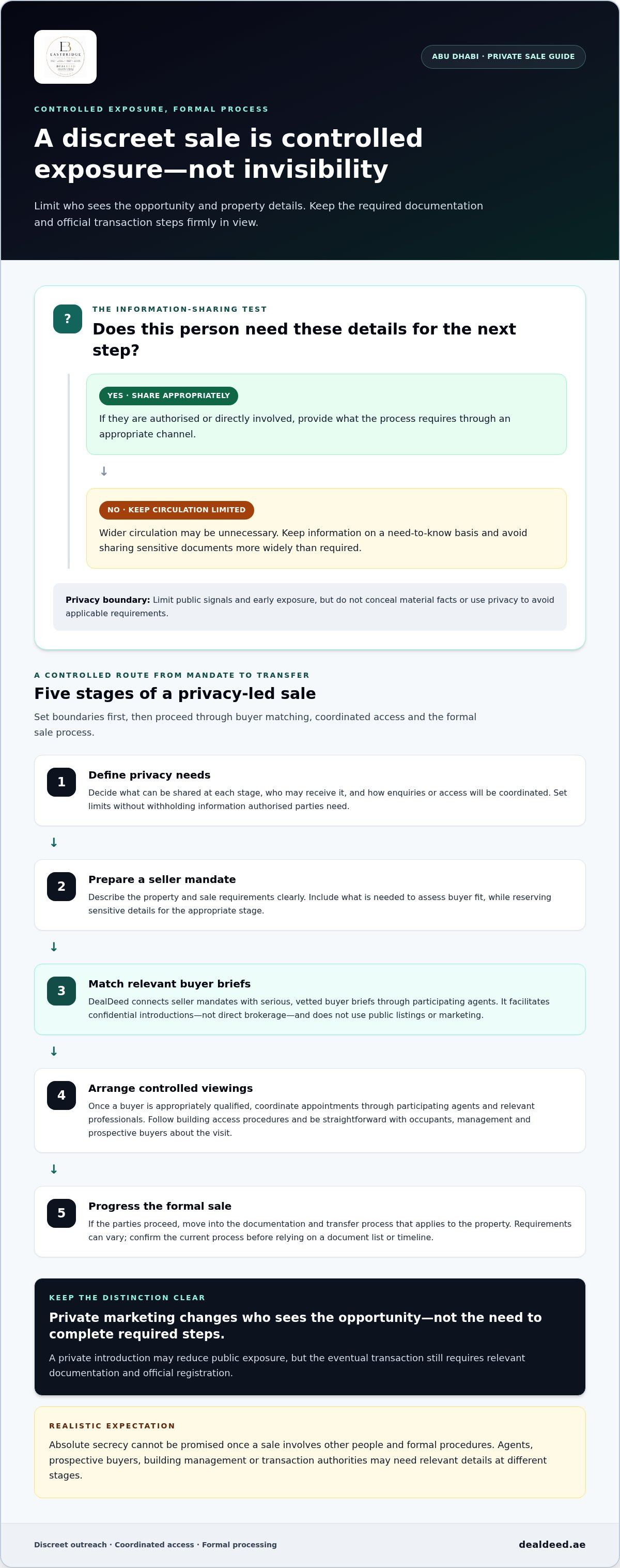
A discreet sale limits how widely the opportunity and property details are shared. It doesn’t make the sale invisible. The practical goal is to avoid unnecessary public signals, such as an open listing or broad advertising, and keep early discussions within a relevant, vetted group. For sellers asking how to sell a property in Abu Dhabi without neighbors knowing, that distinction sets a realistic privacy goal.
Abu Dhabi is the UAE capital, with its own property framework and transaction processes. Confidential buyer sourcing is separate from the formal sale process. A private introduction may reduce public exposure, but the eventual transaction still requires the relevant documentation and official registration. Privacy changes who sees the opportunity, not the need to complete required steps.
Can a private property sale stay completely secret?
No. Absolute secrecy can’t be promised once a sale involves other people and formal procedures. A neighbour may never see a listing, but an agent, prospective buyer, building management or transaction authority may need to know relevant details. Their roles differ, as does the information they handle. Private marketing doesn’t remove disclosure or registration obligations.
Information can surface at several points. A buyer may ask questions or request documents. A viewing may involve visitors checking in with security or arranging access through building management. Later, transaction procedures involve authorised parties and records. Each stage has a different level of visibility, so privacy planning should cover more than whether the property appears on a public website.
For example, a seller might share a limited property summary with a vetted buyer before providing detailed documents through the appropriate process. A viewing can be scheduled and coordinated rather than handled through a stream of unscheduled visits. These choices can reduce unnecessary attention, but they can’t control what every participant notices or shares.
What does “without neighbours knowing” mean in practice?
In practice, the goal is a smaller audience and fewer public signals. Share information on a need-to-know basis, coordinate enquiries and access, and avoid circulating sensitive documents more widely than the process requires. Set communication expectations before outreach begins. This is careful exposure management, not a promise that neighbours or others will never learn of the sale.
A discreet sale is controlled exposure, not invisibility. That definition keeps the objective clear: protect sensitive details where possible while dealing openly with authorised parties and authorities. Don’t conceal material facts that need to be disclosed to a buyer, agent or relevant authority, and don’t use privacy as a reason to avoid applicable Abu Dhabi requirements.
Use a simple test before sharing information: does this person need these details for the next step? If not, wider circulation may be unnecessary. If they are authorised or directly involved, provide what the process requires through an appropriate channel. That balance allows a sale to proceed discreetly without confusing privacy with concealment.
How a Discreet Abu Dhabi Property Sale Can Work, Step by Step
A privacy-led sale depends on a sequence of controlled decisions, not a shortcut around the transaction process. The right route depends on the property, the seller’s circumstances and current Abu Dhabi requirements. Set your boundaries first, then move from a clear mandate to a relevant buyer introduction, coordinated viewings and the applicable formal steps.
- Define your privacy needs. Decide what can be shared at each stage, who may receive it and how enquiries or access will be coordinated. Set practical limits without withholding information authorised parties need.
- Prepare a seller mandate. Describe the property and your sale requirements clearly. Include what is needed to assess buyer fit, while reserving sensitive details for the appropriate stage.
- Match relevant buyer briefs. DealDeed connects seller mandates with serious, vetted buyer briefs through participating agents. It facilitates private introductions, not direct brokerage, and does not use public listings or marketing.
- Arrange controlled viewings. Once a buyer is appropriately qualified, coordinate appointments through participating agents and relevant professionals. Follow building access procedures, and be straightforward with occupants, management and prospective buyers about the visit.
- Progress the formal sale. If the parties proceed, move into the documentation and transfer process that applies to the property. Requirements can vary, so confirm the current process before relying on a document list or timeline.
How do private buyer briefs and seller mandates connect?
A mandate sets out the property and the seller’s requirements, such as the type of buyer sought and the terms that matter. Matching uses this information to identify relevant buyer briefs instead of broadcasting the opportunity widely. Participating agents handle confidential introductions and transaction discussions. For a separate market, the private property matching guide for Dubai explains the approach in its Dubai context, not as guidance on Abu Dhabi rules.
How can viewings be managed with less attention?
Before arranging access, agree who will coordinate the appointment and what information the prospective buyer needs in advance. Share enough to establish genuine interest, then provide further property details as appropriate. Coordinate honestly with occupants and building management, and follow relevant access procedures. A smaller, scheduled viewing process may reduce unnecessary attention, but it can’t guarantee that nobody notices.
Keep the rules in view as the sale progresses. The Abu Dhabi Real Estate Centre (ADREC) Rules & Regulations is an official reference for the applicable framework. Confirm current requirements for the property and intended route. Sellers seeking a controlled introduction can explore DealDeed’s private buyer matching, which connects a mandate with a relevant buyer brief through participating agents.
Private Matching or Public Listing: Which Abu Dhabi Sale Route Fits?
The choice involves a trade-off. Public marketing can put a property in front of a wider audience, but more people may see its details. Private buyer matching narrows circulation and prioritises relevant buyer briefs, though a suitable match depends on buyer demand and property fit. Neither route guarantees a sale, a particular price or a specific timeframe.
For sellers considering how to sell a property in Abu Dhabi without neighbors knowing, compare the routes by their exposure and the control they offer. The table describes general differences, not a guarantee of how a particular sale will perform.
| Factor | Public listing | Private matching |
|---|---|---|
| Public reach | Broad visibility to people who encounter the marketing. | Limited to relevant buyer briefs and participating agents. |
| Exposure | More viewers may see property details and sale information. | Fewer people receive details, shared in stages as appropriate. |
| Buyer qualification | Enquiries may come from a wider mix of prospects. | Introductions focus on buyers whose briefs appear relevant. |
| Seller control | Information circulates more widely once public. | The seller can keep early circulation tighter, while still following applicable requirements. |
When can private buyer matching make sense?
Private matching may suit sellers who value reduced public visibility and controlled introductions. A seller mandate can be matched with relevant buyer briefs through participating agents, rather than relying on broad public reach. Fit still matters: if suitable buyer demand doesn’t exist for the property and its requirements, a private match may not emerge. A preference for privacy doesn’t indicate speed, price or certainty.
Consider your priority before choosing. If reaching a broad audience matters most, public marketing may be a better fit, subject to applicable Abu Dhabi rules. If controlling who receives early details matters more, a private route may suit you. Either way, assess an offer on its terms, not on assumptions about how the buyer was sourced.
What trade-offs come with avoiding public advertising?
A smaller audience can mean fewer immediate enquiries and less broad market exposure. In return, the seller can keep the opportunity within a tighter circle and share details selectively. That is a deliberate exchange, not a shortcut to a better result. A Dubai guide to selling property quietly explores similar considerations in its Dubai-specific context; Abu Dhabi requirements and processes are distinct.
Choose based on your priorities and circumstances. Private matching reduces broad circulation but depends on a suitable buyer; public marketing widens reach and visibility. Neither route removes the need to follow the applicable sale process, and neither guarantees a particular outcome.
Prepare an Abu Dhabi Sale Without Unnecessary Exposure
Before buyer outreach begins, decide what information can be shared, with whom and at which stage. A simple document and communication plan can keep enquiries orderly without interfering with required sale steps. This matters whether the buyer is sourced privately or through another route: reduced public exposure doesn’t remove applicable advertising, documentation or transfer requirements.
For anyone researching how to sell a property in Abu Dhabi without neighbors knowing, preparation means controlling unnecessary circulation, not withholding information from authorised parties. Review current Abu Dhabi guidance before acting. A private approach doesn’t change the rules that apply to the property or transaction.
Which Abu Dhabi sale requirements should be checked first?
Use DARI and the Abu Dhabi Real Estate Centre (ADREC) as starting points for current official guidance. Confirm which requirements apply to your property, intended advertising route and transfer before relying on a document list or validity period. Treat Madhmoun, valuation, title deed, mortgage and lease details as items for case-specific verification, not universal assumptions.
Keep jurisdictions distinct. Dubai RERA and Dubai Land Department procedures shouldn’t be treated as Abu Dhabi requirements. Property type, ownership circumstances and transaction route may affect what needs to be prepared. Verify current conditions before sharing figures or presenting a requirement as applicable to every sale.
A practical pre-outreach checklist can help separate verified requirements from information that should remain restricted:
- Property and ownership: Identify the relevant property records and confirm the applicable title deed details.
- Sale route: Check whether the proposed advertising or private marketing approach has requirements that apply in Abu Dhabi.
- Property status: Establish whether mortgage or lease circumstances affect the steps or documents needed.
- Transaction documents: Confirm current DARI prerequisites and any document validity periods before relying on them.
How can sellers limit unnecessary information sharing?
Share details progressively. An initial summary can help establish whether a buyer brief is relevant; more sensitive property or ownership information can follow when appropriate for the next step. Keep the owner’s personal details, occupancy arrangements and sale plans out of public channels where possible, while communicating accurately with parties who need information for lawful transaction steps.
Set a consistent communication approach before enquiries arrive. Decide who will respond, which channel to use and what can be shared at each stage. Avoid forwarding identity or property documents casually, and don’t mislead occupants, building management, prospective buyers or authorised professionals. Discretion depends on careful handling, not inaccurate answers.
Private matching can keep early buyer outreach focused. DealDeed connects seller mandates with relevant buyer briefs through participating agents, while formal Abu Dhabi requirements remain separate and must still be followed. Prepare a private seller mandate with clear sharing boundaries before buyer introductions begin.
Move from a Private Abu Dhabi Buyer Match to the Sale Process
A private introduction brings a relevant buyer and seller into discussion. It isn’t the sale itself. DealDeed operates as a private matching desk, connecting seller mandates with serious buyer briefs through participating agents. It isn’t a direct brokerage or public property portal. If a buyer is interested, the parties then progress through the applicable Abu Dhabi sale process and its required professionals and formal steps.
For sellers considering how to sell a property in Abu Dhabi without neighbors knowing, this distinction matters. A matching desk can keep early circulation focused, but it can’t promise a buyer, a completed deal or complete secrecy. The eventual transaction remains subject to the requirements that apply to the property and parties.
What happens after a seller submits a private mandate?
The mandate gives participating agents a structured basis for understanding the property and the seller’s requirements. A buyer brief can then be assessed for relevance before an introduction is made. If the interests align, participating agents handle the introduction and discussions confidentially. That step opens a conversation; it doesn’t replace due diligence, agreements or the formal sale process.
The path from introduction to transaction depends on the parties and property. Broadly, it may involve:
- Recording the seller’s requirements in a mandate and the prospective buyer’s interests in a brief.
- Assessing whether the brief and mandate appear relevant to one another.
- Arranging an introduction through participating agents, with appropriate details shared for the discussion.
- If the parties wish to proceed, moving to the applicable documentation and official transaction steps.
A match isn’t guaranteed. Buyer interest, property fit and each party’s decisions shape what happens next. An introduction is not a promise of completion or a timetable.
How does DealDeed’s introduction model work?
DealDeed facilitates connections between participants through participating agents. It doesn’t provide direct brokerage or publish properties for public marketing. Confidential agent-to-agent handling supports focused introductions, while the buyer and seller progress any resulting transaction through the applicable formal process.
The fee model is tied to a completed match: DealDeed charges participating agents a fixed introduction fee only when a matched deal completes. The fee is not seller-paid. Users have no upfront registration or subscription costs. These terms explain the introduction model, not the likely outcome or timing of a sale.
Whether you’re selling or seeking a property, the next step is a clear, appropriately scoped brief. Submit a seller mandate or buyer brief through DealDeed’s private matching desk to put relevant requirements forward for consideration by participating agents. Share accurate information and continue to follow the Abu Dhabi requirements that apply as discussions progress.
Set Your Next Step in Motion
Decide what level of exposure feels acceptable before taking action. If you’re weighing how to sell a property in Abu Dhabi without neighbors knowing, focus on a clear mandate, careful information sharing and a route that keeps early buyer outreach controlled. Privacy comes from deliberate choices, not a promise of invisibility.
DealDeed’s private matching desk connects seller mandates with buyer briefs through participating agents, without public listings or marketing. Participating agents pay a fixed introduction fee only when a matched deal completes. An introduction can open a focused conversation while leaving the formal sale process with the parties and the applicable Abu Dhabi requirements.
Take the next step with a concise brief that accurately describes your property and requirements. Submit a private property mandate to DealDeed for consideration in relevant buyer matching. Share carefully and proceed with the applicable formal steps.
Frequently Asked Questions
Can I sell my Abu Dhabi property without putting it on a public portal?
Yes, a sale can begin with private buyer sourcing rather than a public portal listing, subject to the rules that apply to the property and marketing route. For example, a seller may share a concise property brief with relevant parties instead of publishing the full address and details publicly. Private sourcing doesn’t remove applicable advertising, disclosure or transfer requirements. Confirm the current Abu Dhabi process before circulating sale information.
Will my neighbours find out when I sell my property privately?
They may, but a private sale can reduce public signals that might otherwise draw attention. Neighbours could notice a viewing or hear about the sale from someone involved; no private process can guarantee they won’t learn of it. If discretion matters, consider how visitors enter the building, how appointments are coordinated and what information is shared with occupants or management. Communicate truthfully and follow relevant access procedures.
Do I need a Madhmoun permit for a private property sale in Abu Dhabi?
Whether a Madhmoun permit applies depends on the marketing activity and current Abu Dhabi requirements, so don’t assume a private introduction automatically exempts a sale. Before advertising or sharing property details as a marketed opportunity, review the applicable ADREC or DARI guidance for your property and route. Avoiding a public portal doesn’t remove the need to verify any permit or authorisation requirements that apply to your intended outreach.
Can I sell an Abu Dhabi property that has a mortgage or tenant?
It may be possible, but a mortgage or tenancy can affect the documents, coordination and terms involved. For example, a mortgaged property may require arrangements with the lender as the transaction progresses; a tenanted home may require clear handling of occupancy and viewing access. The steps can differ by case. Establish the property’s current status and verify the applicable requirements before agreeing a sale timetable.
Does a private sale mean the property can be transferred without DARI?
No. Keeping buyer sourcing private doesn’t remove the need to complete the official transfer and registration process. The applicable Abu Dhabi workflow and platform may depend on the transaction and current procedures, so verify the correct route with DARI or the relevant authority before proceeding. A private introduction concerns how a potential buyer is identified; it isn’t a substitute for formal processing or required transaction records.
Does DealDeed charge the seller an upfront fee to find a buyer?
No. DealDeed has no upfront registration or subscription costs for users. Its fixed introduction fee is charged to participating agents only when a matched deal completes, not as an upfront seller-paid buyer-finding fee. A seller can submit a mandate for consideration, but an introduction is not a guaranteed match or completed sale. Any separate costs associated with the property transaction are distinct from DealDeed’s introduction-fee model.


