

What if a commission dispute could be prevented before the first introduction? Avoiding real estate commission disputes in Abu Dhabi starts with agreeing the essentials early: who pays, what work the fee covers, and when it becomes due. Without clear terms, even a completed transaction can leave room for competing claims.
Uncertainty often grows when several agents or intermediaries are involved. One may say they introduced the buyer; another may point to later negotiations. If instructions, introductions, and transaction progress aren’t recorded, it can be difficult to establish who did what and what the parties agreed.
Abu Dhabi has no legally mandated broker commission rate, so clear written terms matter. This guide explains what to agree before substantial work begins, how to document each introduction and role, and how to respond methodically if a fee is disputed. It also covers practical first steps, from reviewing the records and seeking agreement to understanding the role of Taswea if negotiations don’t resolve the issue.
Key Takeaways
- Avoiding real estate commission disputes in Abu Dhabi begins with recording who pays, what the fee covers, and when it becomes due.
- Clarify whether an agent’s role is exclusive, shared, or limited to a specific introduction before work begins.
- Keep evidence that distinguishes the original instruction from introductions, negotiations, and transaction progress.
- If a claim is disputed, organise the agreement and timeline, then respond in writing with the relevant term and evidence.
- DealDeed’s Dubai-focused matching desk uses defined agent-to-agent introductions and a fee linked to completion.
Why real estate commission disputes arise in Abu Dhabi
A commission claim can turn on a small difference in recollection. One party remembers agreeing a percentage; another recalls a fixed fee. An agent may say they introduced the buyer, while the client points to an earlier contact. The dispute may surface only after a transaction progresses, when expectations have become harder to reconcile.
A real estate commission dispute concerns the agreed brokerage remuneration, who is entitled to it, or whether the conditions for payment have been met. Separate the key questions: Was a fee agreed? How much is it? Which party must pay? Was the arrangement exclusive or shared? Did the event that triggers payment occur, such as completion? Treating these as distinct issues helps pinpoint the disagreement.
The commission questions to settle before work begins
Before an agent makes introductions or begins negotiations, establish the parties and roles in writing. Identify who is engaging the agent, whom the agent represents, and who is responsible for the fee. Specify whether the agent represents a buyer, seller, landlord, or tenant, and identify the property or mandate. A real estate broker may connect parties or assist with a transaction, but the scope of that work should be clear in the specific arrangement.
Then distinguish the fee amount from the payment trigger. A percentage or fixed amount explains how remuneration is calculated, not when it becomes payable. Is the fee due when an offer is accepted, when documents are signed, or only after completion? If several agents are involved, state whether the arrangement is exclusive, shared, or limited to a named introduction. This avoids one party assuming exclusivity while another expects to share the role.
Verbal assurances can feel sufficient while everyone is aligned. Later, each person may remember a different conversation, condition, or fee basis. A concise written confirmation, including any later changes, gives everyone a common reference point rather than relying on recollection.
Why emirate-specific rules matter
Abu Dhabi has its own regulatory structure. The Abu Dhabi Real Estate Centre (ADREC), part of the Department of Municipalities and Transport (DMT), is the emirate’s real estate regulator. Dubai operates through a separate framework involving the Real Estate Regulatory Agency (RERA) and Dubai Land Department (DLD). Similar transaction language doesn’t make the processes interchangeable.
That distinction matters when checking licensing, agreements, or the appropriate channel for a concern. Don’t assume a Dubai form, procedure, or account of a commission claim applies in Abu Dhabi. Verify the relevant Abu Dhabi position through official sources before relying on a legal requirement. The practical aim of avoiding real estate commission disputes in Abu Dhabi is to define roles and terms clearly without importing rules from another emirate.
This distinction is especially important in agent-to-agent arrangements. Record an introduction or matching role separately from the brokerage relationship, along with the fee basis and the event that makes it payable. Clear terms give each party a defined starting point if questions arise later.
Put the Abu Dhabi commission agreement in writing before introductions
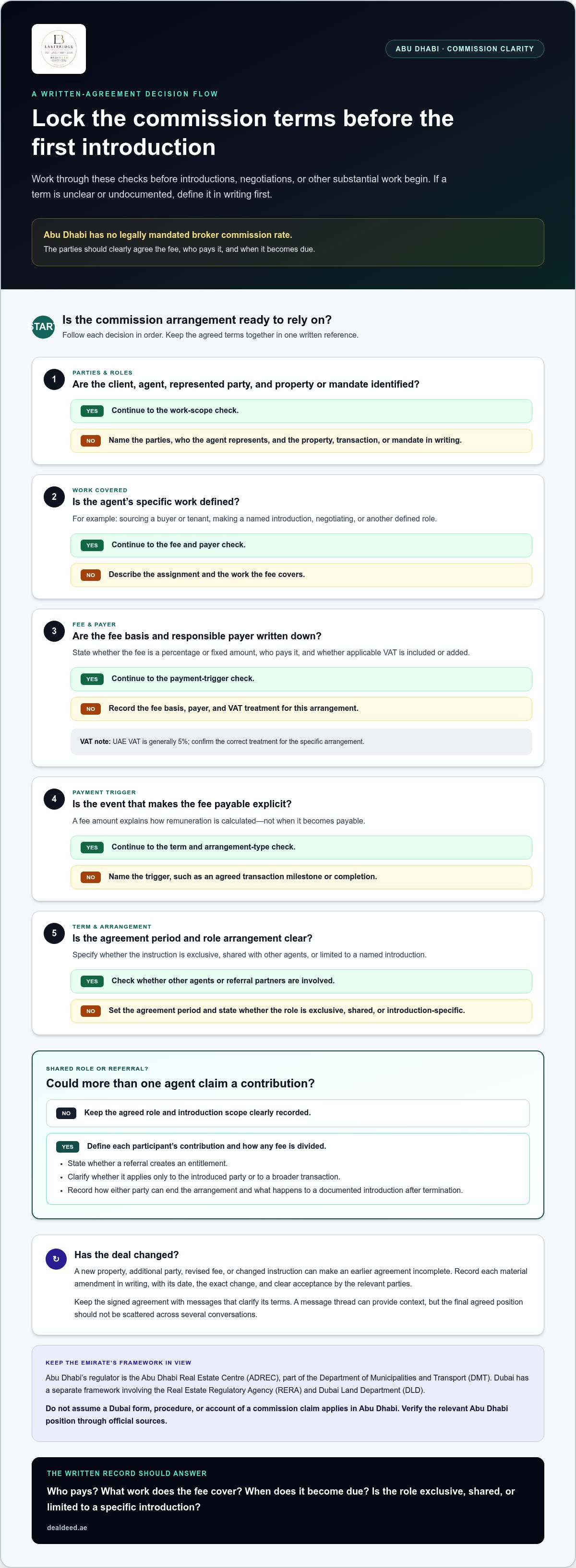
A short written agreement gives each party the same reference point before introductions, negotiations, or other substantial work begin. It should define the assignment, not rely on a general understanding that a commission will be paid. Use this checklist to capture the terms:
- Identify the parties and roles. Name the client and agent, state whom the agent represents, and identify the property, transaction, or mandate covered.
- Define the work. Describe whether the agent is sourcing a buyer or tenant, introducing a specific party, negotiating, or undertaking another defined role.
- Set the fee and payer. State whether remuneration is a percentage or fixed amount, who must pay it, and whether applicable VAT is included or added. UAE VAT is generally 5%; confirm the correct treatment for the specific arrangement.
- Specify the payment trigger. State which event makes the fee payable, such as a defined transaction milestone or completion. Don’t leave “earned” open to interpretation.
- Set the term and arrangement type. Record the agreement period and whether the instruction is exclusive, shared with other agents, or limited to a named introduction.
Make shared roles and exit terms explicit
Where co-broking or referrals are involved, define each participant’s contribution and how any fee is divided. State whether a referral creates an entitlement, and whether that entitlement applies only to the introduced party or to a broader transaction. Include how either party can end the arrangement and what, if anything, happens to a documented introduction after termination. These details prevent assumptions from expanding beyond the agreed scope.
Keep the agreement current as the deal changes
Transactions evolve. A new property, additional party, revised fee, or changed instruction can make an earlier agreement incomplete. Record each material amendment in writing, with its date, the exact change, and clear acceptance by the relevant parties. Keep the signed agreement with messages that clarify its terms. A message thread can provide context, but the final agreed position shouldn’t be scattered across several conversations.
For a Dubai-based example of defined roles and introduction terms, DealDeed’s Dubai agent-to-agent deal desk guide explains a private matching model that works through RERA-licensed agents. It illustrates how clearly specified roles and a completion trigger can reduce ambiguity. Dubai’s framework is distinct from Abu Dhabi’s, so use this as an example of documentation, not as an Abu Dhabi rule. DealDeed’s private agent-to-agent matching is focused on Dubai.
Written terms are a practical safeguard, not a substitute for checking legal requirements. Verify contract enforceability and any mandatory form or content requirements against current Abu Dhabi sources or with qualified legal counsel. For official information about the emirate’s settlement body, consult the Abu Dhabi Real Estate Settlement Centre (Taswea). A clear record is a disciplined first step in avoiding real estate commission disputes in Abu Dhabi.
Prevent overlapping commission claims with clear introduction records
When several agents have contact with the same buyer or seller, a shared name in everyone’s messages doesn’t establish who introduced whom, under what instruction, or what each agent contributed. Keep evidence that shows the sequence of events. An introduction record doesn’t, by itself, prove that an agent caused a transaction or is entitled to a fee. Entitlement still depends on the agreed terms and documented facts.
An introduction log records who introduced whom, when, and under what mandate. Keep it in one consistent deal file alongside dated emails, messages, meeting notes, instructions, and relevant transaction documents. Preserve original communications where possible. A timeline written after a disagreement starts may help organise events, but it isn’t a substitute for records made at the time.
Build a dated chain of evidence
Each record serves a different purpose. Read the evidence as a sequence, not as isolated proof of entitlement:
- Instruction: An engagement email or signed mandate can show who appointed the agent, the scope of the work, and any limits on authority.
- Introduction: A dated email, message, or meeting note can identify the parties introduced and the context. Record the source of the introduction and the property or mandate involved.
- Negotiation: Offer correspondence, follow-up messages, and meeting notes can show an agent’s documented participation in discussions. They don’t, on their own, establish that the agent originated the relationship.
- Completion: Transaction documents or written confirmation of status can help establish whether the agreed payment trigger occurred. A completed deal doesn’t automatically establish which agent, if any, is entitled to a fee.
Use identifiers carefully. Match the property to a reliable reference, and distinguish party names where people have similar names. Keep only the personal details needed to identify the relevant parties and transaction. This supports accurate attribution while limiting unnecessary exposure.
Reduce ambiguity when more than one agent is involved
Before agents share a lead or coordinate work, document each person’s role. State whether the arrangement is a referral, co-brokerage, or another defined contribution, and record any agreed fee allocation. Don’t infer a fee share from a copied email, a handover, or participation in a meeting. If the parties haven’t agreed how remuneration is allocated, record that clearly rather than allowing activity to stand in for consent.
Keep the file chronological and distinguish confirmed events from assumptions. For example, a message may show that an agent sent a buyer’s details to a seller; it doesn’t necessarily prove that the buyer had no prior contact with the property or that the introduction led to completion. Note what the record establishes and what remains unverified. That distinction makes the file more useful if accounts later conflict.
For a Dubai-specific example of property-data verification, DealDeed’s Dubai Land Department deal-verification guide describes a process tied to Dubai data. It’s a Dubai reference, not an Abu Dhabi procedure. For avoiding real estate commission disputes in Abu Dhabi, maintain a clear, dated record of instructions, introductions, contributions, and transaction status.
What to do when an Abu Dhabi commission claim is disputed
A disputed claim calls for a controlled response, not a rapid exchange of accusations. Pause informal escalation. Before replying, assemble the agreement, relevant amendments, introduction records, messages, and latest known transaction status. The immediate aim is to identify the precise disagreement: entitlement, fee calculation, payer, scope, or whether the payment trigger occurred.
Prepare a factual dispute file
Build a chronological record from the original instruction through introductions, negotiations, and the transaction outcome. Keep the signed agreement and dated changes together with original emails, messages, meeting notes, and documents that establish transaction status. Separate what the documents confirm from recollections, assumptions, and statements the other party contests. Don’t fill gaps with speculation.
Keep the file private. Avoid posting correspondence, naming parties publicly, or making allegations the evidence doesn’t support. Broad claims can expose confidential information and distract from the contractual question. If a document is missing, note that clearly rather than presenting an unverified account as fact.
Respond in writing, then assess the route
A concise response can set out the disputed term, the relevant evidence, and the specific resolution sought. Identify the clause or message you rely on, explain how it applies to the introduction or transaction, and state the outcome you propose. Invite a focused reply, keep the tone factual, and retain a copy of what you send.
Next, distinguish the nature of the complaint. A disagreement about whether a fee is payable is a contractual issue. A concern about licensing or professional conduct is different and may require a separate regulatory route. Don’t assume a Dubai process applies in Abu Dhabi. The Abu Dhabi Real Estate Settlement Centre, known as Taswea, is the emirate’s specialised real estate dispute-settlement body. Check current guidance from the Abu Dhabi Real Estate Centre (ADREC) to understand whether the matter fits its remit and how to proceed.
Negotiation may resolve a disagreement without formal proceedings. If it doesn’t, obtain qualified legal advice before filing a complaint or starting court action. Ask counsel to assess the agreement, the appropriate forum, any limitation period, and the required filing steps. These details depend on the claim and should be verified against current Abu Dhabi sources. Don’t let informal discussions delay advice where a deadline may apply.
A disciplined file and a precise written position make the next decision clearer. That is a practical part of avoiding real estate commission disputes in Abu Dhabi, even after a claim has surfaced. DealDeed’s private agent-to-agent matching connects buyers and sellers through RERA-licensed agents in Dubai.
Use clearly defined introduction fees for cleaner agent-to-agent deals
A defined introduction-fee model separates a specific role from a general claim to commission. Written terms can identify which agents are participating, what introduction is being made, and what event triggers payment. Without those boundaries, one agent may assume that making contact establishes entitlement while another understands that further conditions apply.
The principle is useful in Abu Dhabi: define the role, fee basis, and payment trigger before work begins. It doesn’t replace local legal advice or determine commission rights. Abu Dhabi’s regulatory requirements and each agreement must be considered on their own terms.
How a defined introduction-fee model clarifies expectations
DealDeed provides a Dubai-focused example. Its confidential matching desk connects motivated sellers with vetted buyers through RERA-licensed agents. Participating agents pay a fixed introduction fee only when a matched deal completes. The fee is not a percentage of the property price. This structure distinguishes a defined introduction role and completion trigger from an informal expectation that a fee is owed because an agent was involved.
That distinction is practical, not a guarantee of any outcome. A clear arrangement should identify the participating agents, the parties or brief being matched, the nature of the introduction, and what “completion” means for that agreement. A transaction-triggered fee makes the payment condition explicit; it doesn’t answer every question about entitlement unless the parties’ written terms do so.
A practical next step for agents handling private matches
For agents working on a private match, a disciplined sequence keeps the roles and record aligned:
- Define roles. State who is introducing, who is handling the client relationship, and what each participant is expected to do.
- Record fee terms. Identify the fee basis, responsible payer, and precise event that makes payment due.
- Log introductions. Record the date, parties, relevant brief, and mandate connected to each introduction.
- Retain evidence. Keep the agreed terms and dated communications together, then update the record if instructions change.
DealDeed’s Dubai matching process centres on verified briefs and documented introductions. Property details are checked against Dubai Land Department data, while the fee for participating agents is due only when a matched deal completes. These describe DealDeed’s Dubai model, not Abu Dhabi rules. Agents should not rely on a Dubai example to determine local commission rights or dispute procedures.
For avoiding real estate commission disputes in Abu Dhabi, the takeaway is direct: agree the role, fee, and trigger; record the introduction; keep the evidence. Agents interested in how a private, Dubai-focused matching desk structures these elements can explore DealDeed’s private matching desk.
Set the standard before the next introduction
Make clear commission terms part of your routine, not a detail addressed after a buyer or seller has been introduced. Before a new mandate moves forward, confirm that everyone involved understands the scope, attribution, and payment conditions. Keep that discipline consistent as the parties and transaction develop.
A quiet, documented process protects working relationships as well as commercial expectations. If uncertainty arises, return to the written terms and dated record, then address the specific point in dispute. For legal questions about Abu Dhabi requirements or a contested claim, seek advice suited to the facts and the applicable local process.
Avoiding real estate commission disputes in Abu Dhabi depends on deliberate agreements and reliable records. For a Dubai-focused example of confidential buyer-seller matching through RERA-licensed agents, with a fixed introduction fee payable only when a matched deal completes, explore DealDeed’s confidential matching desk.
Frequently Asked Questions
Is a written agreement required for a real estate commission in Abu Dhabi?
A written agreement is the clearest way to establish the commission arrangement, but whether a specific contract form is legally required depends on the applicable Abu Dhabi rules and circumstances. Don’t treat an informal exchange as a substitute for checking those requirements. Before an agent starts work, record the parties, property or mandate, agreed remuneration, and payment condition, then verify any mandatory form requirements through current official guidance or qualified legal advice.
Can an agent claim commission in Abu Dhabi without a signed agreement?
An agent may make a claim, but the absence of a signed agreement doesn’t by itself settle whether the claim succeeds. The relevant evidence and applicable law matter. Emails, messages, instructions, and conduct may be examined alongside any contract or draft terms. If you receive a claim, avoid accepting or rejecting it based only on the missing signature. Ask for the basis of the claim, preserve your records, and obtain legal advice if entitlement is contested.
Who pays the real estate commission in Abu Dhabi?
The responsible payer should be identified in the parties’ agreement; don’t assume it is automatically the buyer or seller. For example, if a seller instructs an agent but a buyer later agrees separately to pay for a defined service, the records should distinguish those arrangements. Abu Dhabi has no legally mandated broker commission rate, so the agreed terms matter. If the payer is unclear, review all relevant instructions and transaction documents before payment or refusal.
What happens if two agents claim commission for the same property deal?
Don’t assume that both agents are automatically entitled to the full fee or that it must be divided equally. Compare each agent’s agreement, scope, introduction records, and documented work against the transaction. Ask each claimant to state the contractual basis and amount claimed. If the claims overlap, keep communications factual and seek legal advice before agreeing to a payment or allocation that could affect your position.
How can I prove that an agent introduced the buyer or property?
Use dated records that connect the agent to the specific buyer or property, such as an email sharing contact details, a message arranging the first meeting, or a contemporaneous note identifying the mandate. Preserve the original exchange and any reply that confirms receipt or next steps. Match names and property references carefully. A record that an introduction occurred is useful, but it may not alone establish that a fee is payable.
Does Dubai RERA handle real estate commission disputes in Abu Dhabi?
No. Dubai’s RERA framework is distinct from Abu Dhabi’s real estate regulatory system, so don’t assume a Dubai procedure or authority handles an Abu Dhabi dispute. For a property matter in Abu Dhabi, check current guidance from the Abu Dhabi Real Estate Centre and confirm which channel fits the issue. A contractual fee claim may require a different route from a licensing or professional-conduct complaint.
When is a real estate commission usually payable in Abu Dhabi?
There is no single payment point to assume for every arrangement. The agreement should state the event that makes the fee due, which could be a specified transaction milestone or completion, depending on the terms. For example, signing a sale agreement and completing a transfer may be separate events. Check the wording and transaction status together; if the trigger is disputed, get advice before treating the fee as overdue or not yet payable.


