

A handshake alone does not protect a Dubai co-brokered deal. A secure co-brokerage process for Dubai agents starts by checking the partner’s RERA status in the Dubai REST app using their BRN, then recording the commission split in Form I before any viewing or introduction. Escrow provides a separate safeguard: a neutral third party holds funds until the contractual conditions are met.
That structure matters because the risk isn’t limited to a missed commission. Unclear responsibilities, premature payments and incomplete paperwork can create friction from the first introduction through closing. A 50/50 split is common, but the agreed division should be explicit rather than assumed.
This article explains how agent verification, written terms, escrow and coordinated paperwork fit together in Dubai. You’ll see what each measure can help protect, how Form F follows an accepted offer, and why clear communication and timely documents matter through payment and closing. The goal is a controlled process with fewer assumptions, clearer records and a more orderly transaction.
Key Takeaways
- Allow 3 to 9 weeks from first contact to commission payout, with viewing and closing coordination often taking 2 to 6 weeks.
- Keep transaction funds and agent commission arrangements distinct; escrow holds funds until contractual conditions are fulfilled.
- Record responsibilities, introductions and partner communications clearly to reduce room for disputes as the deal progresses.
- After an offer is accepted, Form F sets out the sale terms and secures the deposit, so keep paperwork aligned through closing.
Closing paperwork and payment timelines
A Dubai co-brokered deal typically takes 3 to 9 weeks from first contact to commission payout. Viewing, offer and closing coordination may account for 2 to 6 weeks of that period. Commission payout and closing paperwork can take another 1 to 2 weeks after closing. Treat these as separate phases, not a single deadline: buyer decisions, document readiness and transaction coordination affect how the stages progress.
Keep one transaction record for the property, buyer, seller and both agents. Log each offer, agreed term, document handover and follow-up, including the date and responsible person. For example, note when an offer is accepted and when the parties receive the next documents. This gives both agents a shared reference if a document or payment question comes up near closing.
Before completion, reconcile the agreed commission arrangement against the final transaction record. Dubai resale-property broker commission is commonly 2% of the sale price, while the actual co-brokerage split should follow the agents’ written agreement. Commission invoices are subject to 5% VAT, regardless of how the commission is split between agents. Keep the invoice and supporting agreement aligned, so the amount requested and the allocation between agents are clear.
After closing, track paperwork and payment as separate actions. Note which closing documents remain outstanding, who is responsible for each, and when the commission invoice was issued and received. If payment is delayed, compare its status with the transaction record and agreed commission terms. This narrows the discussion to a specific document, amount or handover instead of conflicting recollections. A dated record also helps both agents close their files consistently once the paperwork and commission are complete.
Combining agent verification with escrow protection
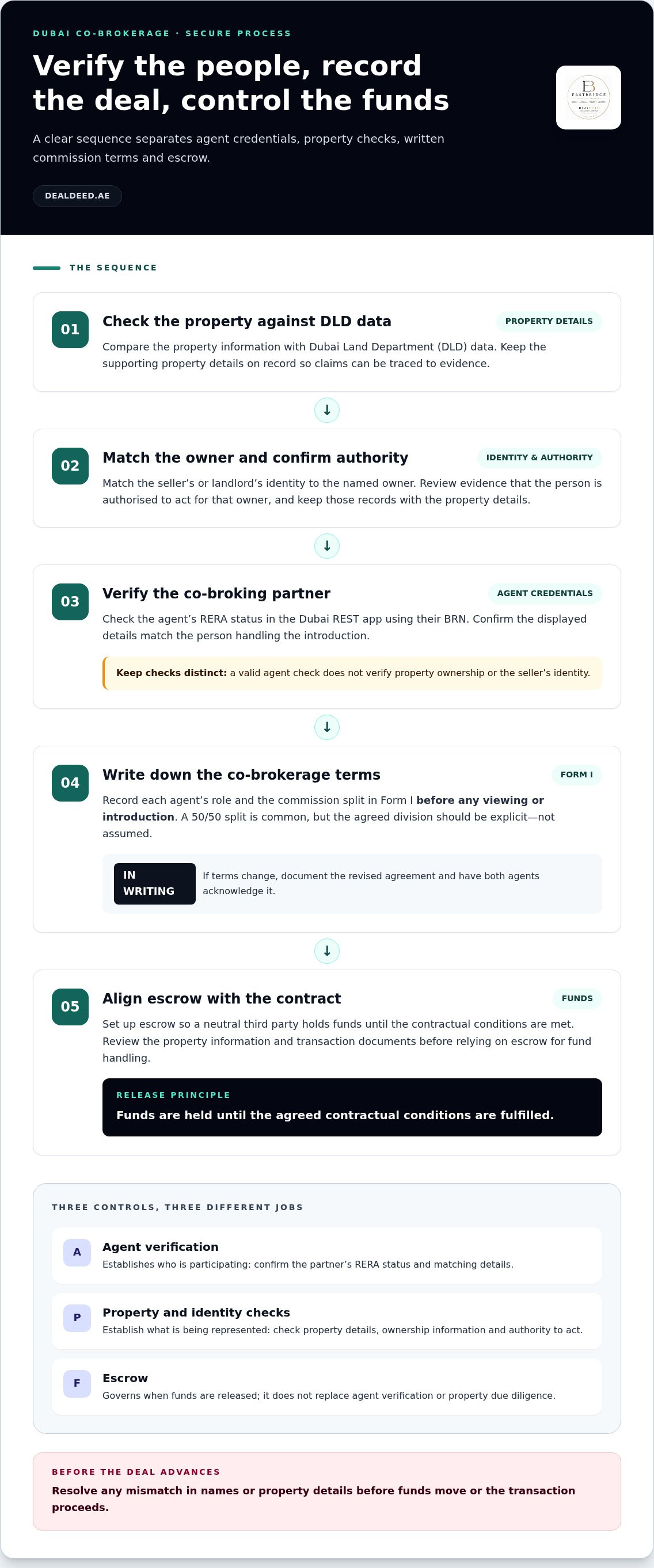
Dubai agents can compare property details with Dubai Land Department (DLD) data, match the seller’s or landlord’s identity to the named owner, and review evidence that the person is authorised to act for that owner. Keep identity and authority records with the property details so each claim can be traced to supporting evidence.
Verify the co-broking partner separately. In Dubai, agents can check an agent’s RERA status in the Dubai REST app using their BRN. Confirm that the displayed details match the person handling the introduction. A valid agent check does not verify property ownership or the seller’s identity. Those checks address different risks.
Escrow provides a separate control over funds: a neutral third party holds money until the contractual conditions are met. This can help prevent premature payments, give sellers assurance of committed funds, and reduce the risk of fraud and payment disputes. It does not replace agent verification or property due diligence. Review the property information and transaction documents before relying on escrow for fund handling.
Keep the checks in a clear sequence. First, compare property details with DLD data. Next, match the seller or landlord to the ownership information and review their authority to act. Then confirm the partner’s identity and RERA status in the Dubai REST app using their BRN. Finally, align escrow arrangements with the transaction’s contractual conditions. Resolve any mismatch in names or property details before funds move or the deal advances.
That separation matters. Agent credentials establish who is participating; property and identity checks establish what is being represented; escrow governs when funds are released. For discreet coordination between agents, DealDeed’s Agent-to-Agent Deal Desk is a relevant next step.
Co-broking disputes and partner communication
In Dubai, clear records can help resolve disagreements about commission, buyer introductions and each agent’s role. Agree on what evidence to keep before a dispute arises.
Commission Split Documentation
A commission split is the written agreement describing how co-brokers allocate commission from a completed deal. The split is commonly 50/50 between the listing agent and buyer’s agent, but partners can negotiate another arrangement. Record the agreed division in Form I before any viewing or introduction, so both agents have a shared reference when commission is due.
State each party’s role and the agreed split plainly. If the arrangement changes, document the revised terms and have both agents acknowledge them. A conversation alone can lead to different recollections; a dated written record ties the agreement to the specific transaction.
Partner Communication
Partner communication means dated exchanges of transaction updates, decisions and responsibilities between co-brokers. It matters because an undocumented change, such as a revised viewing arrangement or offer, can later create disagreement about each agent’s contribution or entitlement. Keep messages direct, factual and tied to the property and deal.
To register a buyer or tenant lead, create a dated written record naming the lead, relevant property and introducing agent. Keep evidence of the initial introduction and ask the partner to acknowledge receipt in writing. This gives both agents a clear timeline if another party later claims the same lead.
Use one shared transaction thread or log for offer updates, viewing outcomes and agreed next actions. For example, note who delivered an offer and when the other agent received it. Dubai agents can maintain a shortlist of 3 to 5 trusted co-broking partners in each specialist community, then keep communication consistent across those relationships.
After closing, request a partner debrief within the first 30 days. Review the lead record, handovers and any communication gaps while details remain accessible. Record agreed improvements for future transactions. This turns a disagreement into a specific process change, rather than leaving the same uncertainty to surface in another co-brokered deal.
Structured real estate transaction processes
A secure co-brokerage process for Dubai agents relies on recorded terms, defined roles and transaction-specific documents. The core partner arrangements apply across sale types, while each transaction’s paperwork and milestones depend on its structure.
RERA Rules for Co-Brokerage
Form I records the commission arrangement between co-broking agents. Sign it before a viewing or introduction, and state the split explicitly. It gives both parties a shared written reference tied to the deal, distinguishing agreed terms from later assumptions about each agent’s role or commission entitlement.
Co-Brokerage Agreement Terms
A co-brokerage agreement should identify the agents, relevant property, responsibilities and commission split. Record the terms in Form I before any viewing or introduction. The written record clarifies the arrangement. An informal conversation is not a substitute for documenting the split and roles.
For off-plan and secondary-market transactions, keep co-broker terms distinct from the property’s sale documents and milestones. After an offer is accepted, the buyer and seller sign Form F, also called the MOU, to set the sale terms and secure the deposit.
Sharing Client Data and Property Documents
Share only the client details and property documents needed for the specific transaction. Record what was shared, with whom and for what purpose. For a secure co-brokerage process for Dubai agents, use transaction-specific files and limit access to the agents handling that deal. This makes document handovers easier to trace and reduces unnecessary exposure of client information.
Keep current property records separate from earlier versions, so partners can identify which document applies. Use a structured agent-to-agent workflow to support clear coordination.
DealDeed: Private Buyer Brief Matching
DealDeed’s Private Buyer Brief Matching connects motivated sellers with serious, vetted buyers through confidential coordination between RERA-licensed agents. It suits sellers seeking a discreet route to qualified buyer interest without public listings or marketing. Property details are verified against Dubai Land Department data, and shared only after an NDA is signed.
For sellers seeking a confidential disposal route, DealDeed’s Quiet Disposal Mandates may be relevant. Agents coordinating a transaction can use the Agent-to-Agent Deal Desk. Each offering serves a distinct need: matching a buyer brief, supporting a quiet disposal, or coordinating agent-to-agent. All participating agents must hold valid RERA ORN and BRN credentials.
If this approach fits your transaction, visit dealdeed.ae.
Make the next transaction easier to govern
A secure co-brokerage process for Dubai agents is more dependable when treated as an operating standard, not a one-off response to a particular deal. Carry the same expectations into each partnership: who owns each decision, how confidential information is handled, and how concerns are escalated. Consistency reduces avoidable ambiguity without making transactions impersonal.
Use the next transaction to assess whether internal handoffs are clear from first introduction through final file closure. If a responsibility falls between agents, assign ownership before the next opportunity arises. Keep the process discreet but visible to the people who need to act. A shared standard supports clear decisions and professional trust. Review it as your team and transaction mix evolve.
For a private discussion about applying this approach to your work, contact DealDeed to discuss your process. A deliberate next step can help make your future partnerships more orderly and confident.
Frequently Asked Questions
What Can Really Go Wrong?
A deal can stall when agents disagree about who introduced the buyer, what commission split they accepted, or who must handle a pending task. For example, an unrecorded change to the viewing plan may lead to competing accounts of each agent’s contribution. Missing documents can also delay completion. Clear records tied to the specific property and buyer help identify the source of disagreement quickly.
How should Dubai agents verify each other's broker cards and agency licences?
Use the Dubai REST app to check an agent’s RERA status with their BRN, then compare the displayed details with the person handling the deal. For agency credentials, match the brokerage’s ORN to its official business identity and the agent’s affiliation. DealDeed’s matching desk requires participating agents to hold valid RERA ORN and BRN credentials, so verify both the agent and brokerage details.
When is Dubai real estate commission payable in a co-brokerage transaction?
Commission is payable according to the transaction terms and the agents’ documented arrangement, not simply because a buyer viewed the property. Distinguish a completed sale from the later invoicing and payout process. Keep the commission terms, invoice details and transaction status aligned. If payment is disputed, compare the written agreement with the completed transaction record rather than relying on informal messages.
What are the steps to co-broker a Dubai property sale or rental securely?
Use a consistent sequence: verify both agents, confirm the property and the other party’s authority, and document the lead and agreed roles. Record commission terms before arranging access or making an introduction. For a sale, the buyer and seller sign Form F, also called the MOU, after accepting an offer. Keep transaction-specific records together and coordinate funds through agreed contractual safeguards.
What risks and common fraud schemes affect Dubai co-brokerage deals?
Risks include impersonation, misleading property or authority documents, altered payment instructions, and competing claims over a buyer introduction. Treat an unexpected change to payment details as a reason to pause and compare it with the verified transaction record. Limit client information to what the deal requires, and confirm important instructions through an established communication channel. Agent checks, property evidence and fund handling are separate safeguards; none replaces the others.
How do Dubai co-brokerage rules differ for off-plan and secondary-market transactions?
The core co-broker arrangements apply to both, but property paperwork and milestones depend on the transaction structure. Keep co-broker terms separate from the sale documents. After an offer is accepted, the buyer and seller sign Form F, or the MOU, to set the sale terms and secure the deposit.


