

A private transfer can simplify a restructuring, but it doesn’t by itself remove corporate tax from a property gain. Private real estate disposal for corporate restructuring in the UAE can support divestiture or the liquidation of a non-core entity. UAE companies pay 0% corporate tax on their first AED 375,000 of taxable income and 9% on taxable income above that threshold.
Moving property within a corporate group may appear straightforward, but the outcome depends on how the property is held, how the transfer is structured, and which approvals and tax rules apply. A private process can limit public exposure, but still requires sound documentation and careful sequencing.
This article explains how property disposal fits into UAE restructuring, when relief may apply to qualifying transfers, and which transfer fees and approvals can affect the decision. It also outlines how discreet buyer matching may support a sale when disposal, rather than an internal transfer, is the intended outcome.
Key Takeaways
- Distinguish a property sale from an internal transfer when planning a divestiture or winding down a non-core entity; the tax and restructuring consequences can differ.
- Related-party transfers may qualify for relief under Article 27, but the transaction structure and eligibility conditions matter.
- Identify the relevant DED or free-zone approvals and account for property registration requirements before a corporate disposal proceeds.
- In Dubai, factor the 4% DLD transfer fee separately from corporate tax; a discreet buyer-matching route may suit a planned market sale.
Divestitures and liquidation of non-core entities
A company may dispose of property to separate a non-core entity from its operating business. According to UAE Federal Tax Authority, the UAE corporate tax regime applies to financial years beginning on or after 01 June 2023.
Private Sales, Auctions, and Open-Market Sales
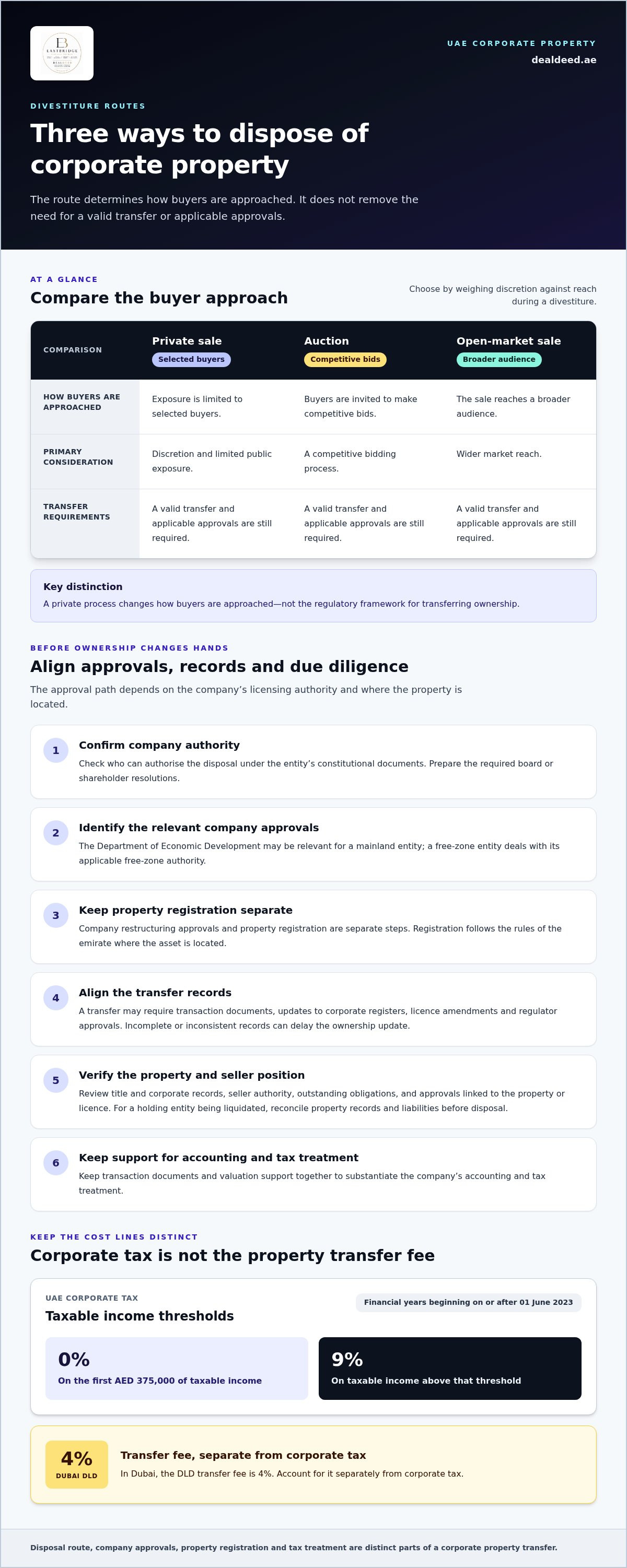
A private sale limits exposure to selected buyers, while auctions invite competitive bids and open-market sales reach a broader audience. The choice matters when investors weigh discretion against reach during a divestiture. Each route still requires a valid transfer and applicable approvals. Private disposal changes how buyers are approached, not the regulatory framework for transferring ownership.
Disposal Approvals and Transfer Costs
Approval means securing the relevant corporate and regulatory permissions before the property changes hands. The Department of Economic Development or the applicable free zone may be relevant to company restructuring approvals. Processes differ by emirate and free zone; a free-zone licence does not replace property registration requirements. In Dubai, the DLD transfer fee is 4%, separate from corporate tax.
Transfer Steps and Required Documents
A corporate property transfer may require transfer documents, updates to corporate registers, licence amendments, and regulator approvals. The sequence matters: incomplete records can delay the ownership update or leave the entity’s legal position inconsistent. For example, a mainland company disposing of property may need its transaction documents and company register changes aligned with the transfer.
Due Diligence and Disposal Safeguards
Due diligence confirms the property’s ownership, the seller entity’s authority, and the transaction’s financial and regulatory position. Review title and corporate records, outstanding obligations, and approvals linked to the property or licence. If a holding entity is being liquidated, reconcile its property records and liabilities before disposal. Keep transaction documents and valuation support together to substantiate the company’s accounting and tax treatment.
Can a UAE company transfer real estate privately to a related party or affiliate?
Yes. A UAE company can transfer property privately to a related party or affiliate, but confidentiality does not itself qualify the transaction for corporate tax relief. The tax outcome depends on the structure, the parties’ relationship, and whether the transfer meets the applicable relief conditions. Transferring property alone is not necessarily equivalent to transferring an entire business.
Article 27 Business Restructuring Relief may apply when an entire business, or an independent part of one, moves between taxable persons. It can cover related-party restructurings and transactions between third parties. The transferor must elect for the relief; it isn’t automatic. If applicable, assets and liabilities transfer at net book value, so the transferor recognises no taxable gain or loss at that point.
Consideration and ownership also matter. Under the relief rules, consideration may be received by a person holding at least 50% direct or indirect ownership in the transferor. Separately, qualifying group relief for an intra-group transfer requires at least 75% common ownership and carries a two-year clawback. These are distinct tests, not interchangeable thresholds.
For example, a property-holding company transferring an asset to an affiliate should establish whether the asset transfer forms part of a qualifying business restructuring or instead falls under group relief. Article 34 of the UAE Corporate Tax Law requires related-party transactions to meet the arm’s-length standard. Keep the valuation basis, ownership records, transfer documents, and relief election aligned with the actual transaction.
Relief can be clawed back if specified ownership disposals or later business transfers occur within two years. Articles 26 and 27 relief is unavailable if a party is a Qualifying Free Zone Person or an exempt person. A private transfer may suit a documented internal reorganisation; if the property is instead being sold, a private buyer brief can support a discreet route to external buyers.
What approvals are required for a UAE corporate real estate disposal?
The approval route depends on the company’s licensing authority and the property’s location. For a mainland entity, the Department of Economic Development may be relevant; a free-zone entity deals with its applicable free-zone authority. These approvals concern the company’s restructuring. Property registration is a separate step governed by the rules of the emirate where the asset is located.
At company level, confirm who can authorise the disposal under the entity’s constitutional documents. Prepare the required board or shareholder resolutions, then update corporate registers and amend the licence if the restructuring changes the company’s registered activities or details. If a holding entity is being liquidated, its corporate records may need to reflect the transfer before the entity can be closed.
Approval thresholds and creditor procedures depend on the transaction and applicable law. Don’t assume that every company division requires 75 percent approval or a 60-day creditor objection period. The relevant company form, constitutional documents, regulator practice, and restructuring method affect the route. Map those requirements before fixing a transfer date.
If the restructuring includes a merger, the UAE Commercial Companies Law places merger provisions in Article 285, with following articles addressing the merger contract, creditor objection, and merger effects. A property disposal alone isn’t automatically a merger. Separate the property transfer approvals from any approvals required for a wider merger or liquidation.
- Confirm jurisdiction: identify the licensing authority and the emirate’s property registration process.
- Record corporate authority: align resolutions, constitutional documents, registers, and licence amendments.
- Separate transaction types: distinguish an asset disposal from a merger, division, or entity liquidation.
For example, a free-zone company disposing of property in Dubai may need to address its free-zone corporate approvals and Dubai property registration separately. A controlled sequence helps keep the entity’s corporate position and property records aligned.
What are the UAE property transfer fees, registration costs, and taxes for a corporate disposal?
Budget separately for property registration and corporate tax. In Dubai, the Dubai Land Department (DLD) transfer fee is 4% of the transaction, separate from corporate tax. A private sale does not remove this fee. The asset’s location matters: the Dubai figure should not be assumed to apply to property registered in another emirate.
Registration charges and required documents depend on the property and transaction category. Before agreeing on a completion date, identify the registering authority, confirm the transfer route, and account for the charges tied to registration. Keep signed transfer documents and company approvals together so the ownership update matches the corporate record. For private real estate disposal for corporate restructuring in the UAE, separating these costs helps distinguish transfer expenses from tax treatment.
For tax purposes, a UAE company includes gains from selling real estate in its corporate tax base. The taxable result depends on the company’s tax position and the transaction’s treatment under applicable rules. Qualifying restructuring relief may affect when a gain is recognised, but it is not a property registration fee or an automatic exemption. Consider tax implications alongside registration costs when planning private real estate disposal for corporate restructuring in the UAE.
A separate DLD rate may apply to a company’s gift transfer to shareholders. The DLD can apply a 0.125% gift rate in that situation. This is a specific transfer category, not a general substitute for the 4% transfer fee on property transactions. Classify the transaction correctly before estimating its total cost.
- Property registration: identify the emirate and applicable registration charges.
- Corporate tax: assess how the property gain enters the company’s tax base.
- Shareholder gifts: distinguish a qualifying gift transfer from a sale.
For example, a Dubai company selling property should budget for the DLD transfer fee and assess the gain separately for corporate tax. A company transferring property to shareholders should consider the DLD gift-rate category instead. The legal form and purpose of the transaction shape the cost assessment.
Planning a discreet sale? Discuss a Quiet Disposal Mandate for a controlled buyer-matching process.
Qualifying restructuring relief may change when a property gain is recognised for corporate tax, but it does not automatically exempt the gain.
DealDeed: Private Buyer Brief Matching
DealDeed’s Private Buyer Brief Matching connects motivated sellers with serious, vetted buyers for UAE real estate across Dubai and Abu Dhabi. It may suit a company that has completed its tax and approval assessment and is preparing to dispose of a non-core property discreetly, without public listings or marketing.
For a confidential disposal, DealDeed’s Quiet Disposal Mandate offers a discreet route to a buyer match. DealDeed facilitates introductions between licensed agents and verifies property details against official UAE land department data. This supports controlled introductions, but does not replace corporate approvals, tax analysis, or property registration.
Where agents are already involved, DealDeed’s Agent-to-Agent Deal Desk provides a focused channel for coordinating the transaction for private real estate disposal for corporate restructuring UAE. Choose the route that fits the disposal stage and existing agent relationships. To discuss a private property disposal, visit dealdeed.ae.
Set the Disposal in Motion with Control
The decision is not simply whether to sell, but how to align the disposal with the company’s wider restructuring plan, internal responsibilities, and intended buyer profile. A clear mandate helps keep the process focused, preserve confidentiality, and give relevant parties a defined basis for discussions.
For private real estate disposal as part of corporate restructuring in the UAE, DealDeed supports the buyer-matching stage through Private Buyer Brief Matching or a Quiet Disposal Mandate. Where agents are already involved, its Agent-to-Agent Deal Desk can help coordinate the discussion. The aim is a controlled introduction, while your company retains responsibility for its legal, tax, and approval workstreams.
Decide what information can be shared, which buyers fit the transaction, and how the disposal sits within the restructuring timetable. Then move forward with a discreet, deliberate process. Discuss your options with DealDeed and take the next step with clarity.
Frequently Asked Questions
What does private real estate disposal mean in a UAE corporate restructuring?
It means arranging a property sale or transfer through a controlled process rather than broad public exposure. In a Dubai restructuring, for example, a company could sell a non-core asset to a selected buyer while keeping the transaction separate from its operating business. The key distinction is whether ownership of the property itself changes or the restructuring instead changes ownership of the company that holds it.
Which UAE laws and regulations govern corporate real estate disposals and restructurings?
The applicable framework depends on the transaction and the company’s jurisdiction. Federal Decree-Law No. 47 of 2022 establishes the UAE Corporate Tax framework, while Federal Decree-Law No. 32 of 2021 is the UAE Commercial Companies Law. Federal Decree-Law No. 51 of 2023 is the UAE Bankruptcy Law. For tax treatment, Articles 26 and 27 address specified restructuring relief, and Article 34 addresses the arm’s-length requirement for transactions.
What creditor, insolvency, clawback, and director-liability risks apply to UAE property disposals?
Creditor rights and insolvency procedures can affect a disposal, particularly if it forms part of a merger or distressed restructuring. The UAE Bankruptcy Law, Federal Decree-Law No. 51 of 2023, is relevant to insolvency matters. If a company claims Business Restructuring Relief, specified ownership disposals or later business transfers within two years can trigger a clawback. Directors should document the commercial rationale, approvals, valuation basis, and treatment of creditor interests.
What are the UAE corporate tax and VAT implications of transferring real estate during restructuring?
A company generally includes gains from selling real estate in its corporate tax base; a property transfer alone does not automatically qualify for relief. Article 27 relief may apply to a qualifying transfer of an entire business or independent part, if elected and conditions are met, with assets and liabilities transferred at net book value. VAT implications are not addressed.


