

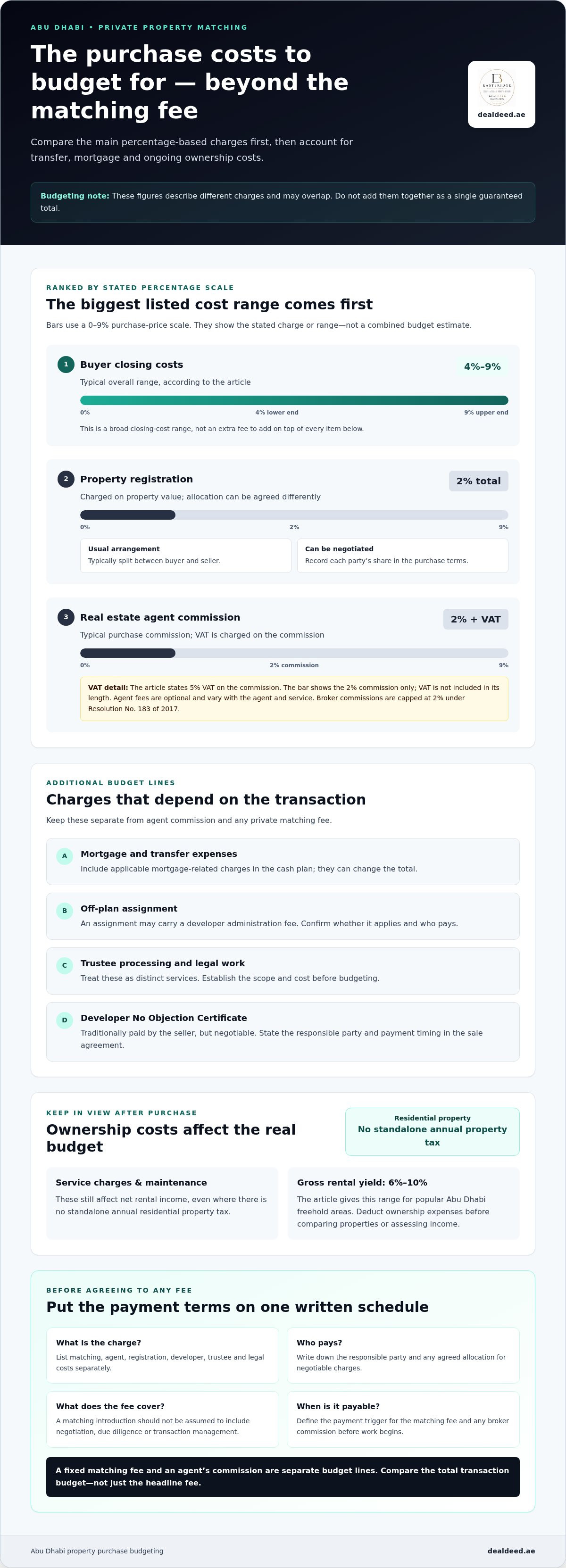
The matching fee is only one line in the budget. Budgeting for fixed-fee private property matching in Abu Dhabi means separating that agreed fee from purchase costs: buyer closing costs typically range from 4% to 9% of the purchase price. A typical agent fee is 2% of the purchase price, plus 5% VAT on the commission.
It’s reasonable to want a clear figure before you commit. The challenge is knowing which charges sit alongside the matching fee, which may be negotiable, and who is expected to pay them.
This guide shows how to build a practical budget, distinguish agent commission from other transaction costs, and discuss fee terms and payer arrangements before they become a source of friction. You’ll also see how mortgage-related charges can change the total, and when a private matching approach may suit a purchase where discretion and a clearly defined introduction matter.
Key Takeaways
- Build your budget by separating the matching fee, agent commission, registration charges and any mortgage-related costs.
- Agree in writing who pays each negotiable charge, and clarify what the fee covers before moving forward.
- Compare private matching with a traditional broker by looking at the role performed, fee structure and level of market exposure.
- Understand how property brokerage regulation differs from private matching before deciding which route fits your transaction.
Agent commission and other purchase costs
- Yes. Overseas buyers can use property matching to identify Abu Dhabi purchase opportunities. Under Law No. 13 of 2019, non-UAE nationals may own freehold property and land in designated investment zones. Eligibility depends on the zone, property and ownership structure.
- Separate matching and agent fees from official transaction charges. Abu Dhabi property registration costs 2% of the property value and is typically split between buyer and seller. The parties can agree to a different allocation. Record who pays each charge in the purchase terms.
- Include mortgage and transfer expenses in your cash plan. For off-plan property, an assignment may also carry a developer administration fee. Compare the applicable charges before setting your purchase limit.
- Distinguish purchase costs from ownership costs and investment returns. Abu Dhabi has no standalone annual property tax on residential owners. Service charges and maintenance still affect net rental income. Gross rental yields in popular Abu Dhabi freehold areas range from 6% to 10%, but deduct ownership expenses before comparing properties on Saadiyat Island or Reem Island.
- Private matching has limits. An introduction does not replace due diligence: verify the registered owner, title and encumbrances before proceeding. Assess the property, payment terms and ownership structure independently. Treat a match as a way to identify an opportunity, not as proof that the purchase is suitable.
- Coverage depends on the matching brief and available property opportunities. Specify the Abu Dhabi area, property type and intended use, such as a luxury apartment on an island or a rental investment. Providers do not necessarily cover every area or property type, so define the required criteria before comparing matches.
- Before committing, compare the total transaction budget, not just the agent commission. List registration, mortgage, developer and recurring ownership costs separately. Then assess whether expected rental income can support the purchase after expenses, rather than relying on headline yields alone.
Negotiating fees and payer arrangements
- Separate the charges. Write each professional and administrative cost on its own line: agent commission, developer administration, trustee processing and legal work. Label each as fixed, percentage-based or negotiable. This makes the payment responsibilities visible before signing, rather than leaving buyers to resolve them during transfer.
- Set the agent terms in writing. Real estate agent fees are optional and vary with the agent and service. A typical Abu Dhabi purchase commission is 2% of the purchase price, plus 5% VAT on the commission. State the service covered, fee basis, payer and payment trigger in the agreement.
- Clarify off-plan transfer charges. Identify whether the charge applies to your transfer and who pays. Treat the assignment payment separately from any agent or matching fee.
- Allocate seller-side paperwork costs. A developer’s No Objection Certificate is traditionally paid by the seller, but that arrangement is negotiable. Put any change in the sale agreement, with the responsible party and payment timing stated clearly. This is especially useful when a foreign buyer and seller are coordinating across districts.
- Compare trustee and legal costs. These are distinct service descriptions, so establish the scope before budgeting.
- Negotiate the payer arrangement, not only the amount. Registration charges may be allocated differently from the usual 50/50 split when both parties agree. Record the agreed shares, deadlines and payment method. For a purchase involving Saadiyat Island or Yas Island apartments, use one written schedule for every transfer-related charge.
- Keep introduction terms distinct. A private matching fee and an agent’s commission are separate budget lines; don’t assume one replaces the other. Define when each becomes payable and by whom. Buyers considering a discreet introduction can review private buyer brief matching as one route to structured property introductions.
How does private property matching differ from using an Abu Dhabi real estate broker?
- Compare the role first. A broker typically supports a property transaction through brokerage activity. Private matching focuses on introducing a buyer brief to a relevant opportunity. The distinction is the work performed, not simply whether the service is described as private.
- Read the fee basis. Abu Dhabi real estate broker commissions are capped at 2% under Resolution No. 183 of 2017. A fixed-fee matching arrangement uses a set fee structure rather than calculating the fee as a percentage of the purchase price. Neither format alone proves which option costs less.
- Identify the payment trigger. Check whether the matching fee becomes payable for an introduction, an accepted offer or a completed transaction. For brokerage, confirm the commission trigger and the services covered. Put both triggers in writing before sharing a brief or authorising work.
- Define the service boundary. Ask what each fee includes. A matching introduction should not be assumed to cover negotiation, due diligence or transaction management. A broker’s commission should not be treated as covering separate legal, registration or mortgage expenses unless the agreement expressly says so.
- Assess exposure and access. A public-facing brokerage process may involve marketed property and broader buyer outreach. Private matching can suit a buyer seeking a targeted introduction with limited public exposure. Clarify how the brief and property details will be shared.
- Compare the total cost. Compare this with the matching fee and any separate services, not with the headline fee alone.
- Choose by transaction need. Use brokerage when you need the broker’s agreed transaction services. Consider a matching route when the priority is a discreet, criteria-led introduction. In either case, verify the property and document each party’s role before proceeding.
Are property matching providers in Abu Dhabi licensed or regulated by DMT?
- Separate the label from the activity. Calling a service “property matching” does not by itself explain its regulatory status. The relevant question is what the provider actually does: introduce parties, advertise property, negotiate terms, or act in a brokerage capacity. Ask for the role to be described precisely in writing.
- Identify the authority named in the agreement. DMT is the Department of Municipalities and Transport. Abu Dhabi’s real estate framework also uses ADREC. Don’t treat a reference to either authority as proof of a particular licence. Record the provider’s legal name, stated activity and any registration details supplied.
- Distinguish introductions from brokerage work. A private introduction and a broker’s transaction services are different functions. Abu Dhabi broker commissions are capped at 2% under Resolution No. 183 of 2017. That commission rule concerns brokerage, so don’t assume it defines every private matching fee.
- Map each task to the responsible party. Write down who sources the opportunity, communicates with the seller, negotiates, and supports the transaction. If one provider performs several roles, identify each role and its fee separately. This makes the arrangement easier to assess than relying on a broad service label.
- Keep the sale process independently documented. Confirm the registered owner, title and encumbrances before proceeding. Put the payment schedule, handover terms and default consequences in the purchase agreement. A matching introduction does not replace these transaction safeguards.
- Use specific questions before sharing a brief. Ask what information will be shared, with whom, and for what purpose. Request the provider’s written scope and payment trigger. Compare those terms with the actual work performed, not just the words “licensed,” “regulated” or “private.”
- Choose the route that fits your need. If you want a discreet buyer introduction, submit a private buyer brief with your criteria and preferred level of confidentiality. For brokerage activity, assess the broker’s stated role and applicable authorisation separately.
DealDeed: Private Buyer Brief Matching
DealDeed’s Private Buyer Brief Matching is designed for buyers who prefer a discreet, criteria-led introduction over public listings. Share the property criteria and priorities that shape your search, then use the matching process to focus on relevant opportunities. The service suits buyers who value confidentiality and a clear distinction between an introduction and the separate work involved in completing a purchase.
For sellers seeking a confidential route, DealDeed offers quiet disposals through agent-to-agent introductions. Its Agent-to-Agent Deal Desk supports property professionals coordinating opportunities. These services serve different needs: buying, selling, or facilitating an agent-to-agent discussion.
To discuss a private buyer brief, visit dealdeed.ae.
Make the next move on your terms
Before taking a property discussion further, define what a suitable introduction must achieve. Consider your preferred property profile, ownership requirements, budget and how much information you are comfortable sharing. Clear criteria help you assess whether an opportunity fits your plans.
If you’re considering fixed-fee private property matching in Abu Dhabi, bring those priorities together in a concise buyer brief. State your essential requirements, deal-breakers and confidentiality preferences. This gives agents a practical basis for assessing opportunities without committing you to a purchase.
Treat an introduction as the start of a conversation, not a commitment to buy. You decide whether to proceed after reviewing the opportunity and considering your requirements.
When you’re ready to discuss your options, contact DealDeed. A clear brief is a considered first step.
Frequently Asked Questions
What is fixed-fee private property matching in Abu Dhabi?
It’s an introduction service that connects a buyer’s stated requirements with relevant property opportunities for a set fee, rather than a percentage-based charge. In Abu Dhabi, clarify who pays the fee, what triggers payment and whether the service covers introductions only. Matching is not the same as brokerage or transaction due diligence, so define the provider’s role before sharing sensitive details.
Which Abu Dhabi companies offer fixed-fee property matching services?
DealDeed offers Private Buyer Brief Matching for property introductions in its Dubai and Abu Dhabi focus. It is an introducer, not a licensed real-estate broker; transactions involve RERA-licensed agents with valid ORN and BRN registrations. Its matching desk is private, and property details are shared only after an NDA. Ask what role the service plays in your specific Abu Dhabi transaction.
How much do fixed-fee property matching services cost in Abu Dhabi?
DealDeed does not charge buyers or sellers for matching. Each participating agent pays a fixed introduction fee when a match completes; the amount is set out in onboarding documents. Buyers should distinguish this agent-paid fee from their own purchase budget and transaction expenses, such as agency commission and DLD fees. Review your purchase and agent agreements to understand which costs you will pay.
What services are included in a fixed-fee property matching package?
There isn’t one standard package across providers. DealDeed’s Private Buyer Brief Matching connects a buyer brief with relevant opportunities through a private, human-led process. The service does not mean DealDeed represents the buyer or seller; each match involves agents on both sides. Before submitting a brief, clarify what information is needed and how confidentiality is handled.
What are the steps to use a property matching service in Abu Dhabi?
Start by defining your preferred property type, location, ownership requirements and budget. Submit a buyer brief, then assess each introduction against those criteria. Ask what credentials participating agents hold and whether confidentiality terms apply before property details are shared. Declining a match carries no penalty or cost. Keep your purchase checks and written terms in place before committing.


