

A full building is within reach for foreign buyers, but location determines the ownership route. Under Regulation No. 3 of 2006, according to the Government of Dubai Legislation Portal, foreign nationals may acquire freehold property in designated areas. A private mandate for a full building acquisition in Dubai therefore begins with the building’s location and the buyer’s intended ownership structure.
Buying an entire building differs from acquiring a selection of units, property assets or an operating business. A whole-building purchase centres on the building itself, including its management, leases and tenancy profile. An asset or business acquisition can involve different assets, contracts and obligations.
This guide explains who can buy, how full-building and bulk-unit purchases differ, and what to review before a transaction. It also distinguishes a property acquisition from a business transfer, helping you assess the right structure before beginning a discreet search or negotiation.
Key Takeaways
- Assess whether control of one building or the flexibility of bulk units better fits your leasing and management objectives.
- Separate a property asset purchase from a business transfer, which can involve employee contracts, accrued leave and end-of-service entitlements.
- Evaluate whole-building pricing against net rental income, and test bulk pricing against current developer prices and recent resale comparisons.
- Build due diligence around title, mortgages or disputes, tenancy and Ejari records, and the building’s structure and systems.
Acquisition of buildings and structures
A foreign buyer can acquire a full building in Dubai if the location and ownership structure allow foreign ownership. First, confirm whether the property is in an area open to foreign ownership. A private mandate for a full building acquisition in Dubai should define the target area, title type and building profile before discussions begin.
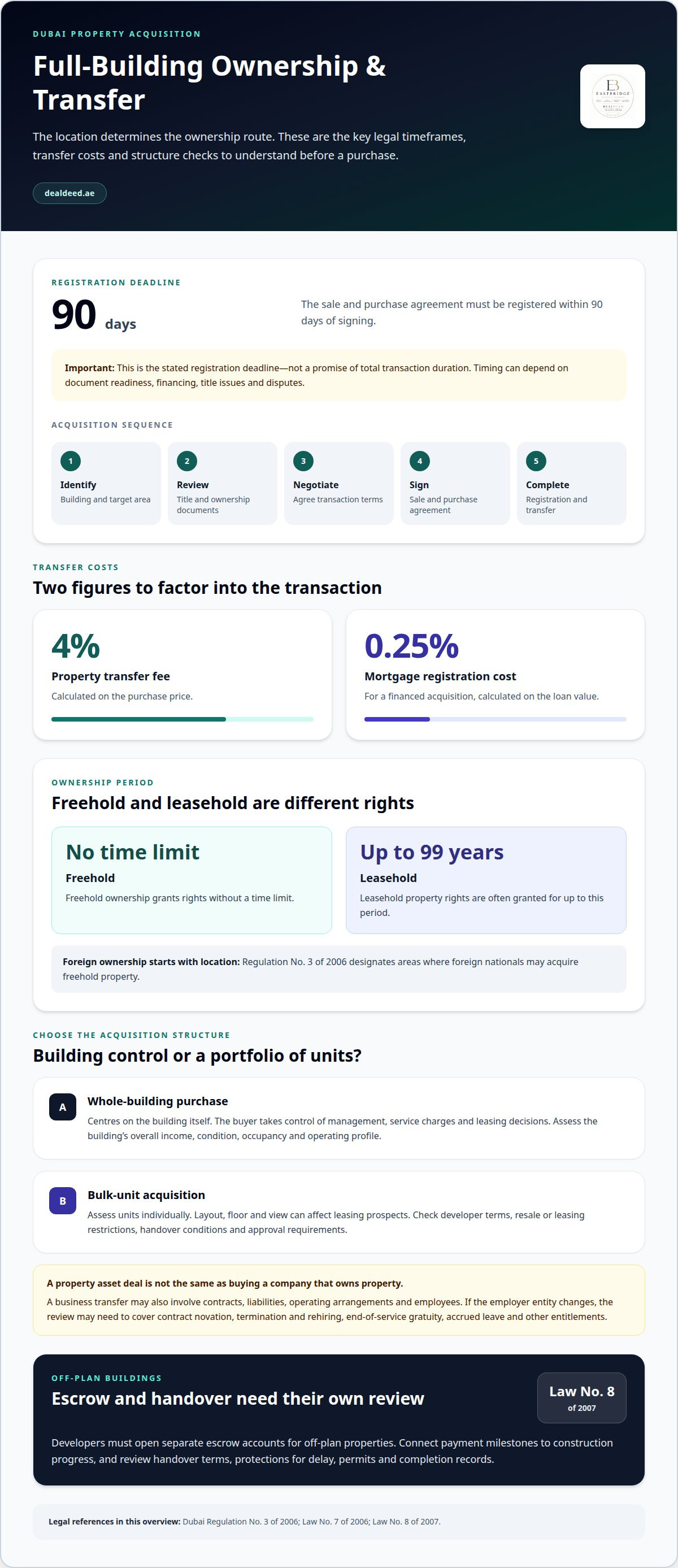
Dubai Regulation No. 3 of 2006 designates the areas where foreign nationals may acquire freehold property, according to the Government of Dubai Legislation Portal. Freehold ownership under Law No. 7 of 2006 grants rights without a time limit. Leasehold property rights in Dubai are often granted for up to 99 years, according to the Dubai Land Department. The distinction affects the ownership period and what the buyer acquires.
Title transfer requires a sale and purchase agreement, followed by registration with the Dubai Land Department. The SPA must be registered within 90 days of signing. The property transfer fee is 4% of the purchase price. For financed acquisitions, mortgage registration costs 0.25% of the loan value. Ownership may be held directly or through a purchasing entity, but the intended structure should align with the registered title and transaction documents.
The acquisition sequence is clear: identify the building, review title and ownership documents, negotiate terms, sign the SPA, then complete registration and transfer. The 90-day registration deadline is the stated legal timeframe; it is not a promise of total transaction duration. Timing depends on document readiness, financing, title issues and any disputes that need resolution. A direct purchase also requires clarity on vacant possession or existing tenancies.
Buildings under construction require separate attention. Dubai Law No. 8 of 2007 requires developers to open separate escrow accounts for off-plan properties. Buyers should connect payment milestones to construction progress, handover terms and protections for delay. A permit and completion records also matter when assessing the building’s legal and physical status.
Distinguish a private acquisition from a statutory acquisition for public benefit, which follows specific legal procedures and compensation rules. For a private building purchase, the key considerations are the seller’s title, agreed terms, registration and the buyer’s chosen ownership structure.
Asset purchases and business acquisitions in Dubai
A whole-building purchase centres on the real estate itself. The buyer takes control of management, service charges and leasing decisions. A bulk-unit acquisition can offer a different balance of execution and exposure across units. Compare the level of control, operating workload and expected return before choosing a structure. An official valuation should account for the assets included, not just the headline price.
In a bulk purchase, assess the units individually. Layout, floor and view can affect leasing prospects, while developer terms may restrict resale or leasing. These conditions can change a package’s practical value, even when its initial price looks attractive. Check restrictions, handover conditions and approval requirements in the transaction documents.
An asset deal is different from buying a company that owns property. A business transfer may include contracts, liabilities, operating arrangements and employees, not only land or buildings. If the transaction changes the employer entity, planning may need to address termination and rehiring, contract novation, end-of-service gratuity, accrued leave and other entitlements. Federal Decree-Law No. 33 of 2021 governs private-sector employment relationships in the UAE, as amended. Governance and employee obligations therefore belong in the acquisition review alongside property records held by the Dubai Land Department.
Portfolio purchases can be negotiated and closed in tranches, aligning acquisition timing with an investor’s capital plan. A staged structure can also allow separate valuation and due diligence for each asset group. Buyers might assess developer inventory and privately held portfolios in parallel, then prioritise assets that fit their leasing strategy and available capital. This differs from acquiring an operating business, where transferring the employer entity can introduce additional obligations.
For a discreet sourcing process, a private acquisition brief can help clarify the target asset profile before discussions begin.
What are current prices and yields for full-building acquisitions in Dubai?
There is no single price or yield for every building in Dubai. Location, condition, occupancy, tenancy profile and income all shape valuation. A useful starting point is comparing net rental income with the asking price, then checking whether the income supports the proposed purchase value.
That yield is only as reliable as the income and expense figures behind it. Review tenancy records, rent collection, vacancies and operating costs together. A fully leased building and one with vacant units can have very different income profiles, even at similar asking prices.
Assess bulk pricing separately. For developer stock, compare the offer with the developer’s current retail price list and recent resale comparables. A package discount alone does not establish value. Unit mix, floor and view affect leasing prospects, while resale or leasing restrictions can influence future income. For a whole building, focus instead on overall income, condition and operating profile.
Developer bulk deals may offer more favourable pricing or payment terms, including payments linked to construction milestones and escrow arrangements. These can affect capital deployment, but make handover protections important. Purchase terms should specify the handover date and consequences of delay. Weigh those conditions against expected income and the concentration risk of holding one large asset.
Transaction costs also affect the acquisition budget. Treat this as an example, not a universal amount. For a sound comparison, consider the purchase price, applicable costs, verified net income, building condition and payment schedule together. This gives a clearer view of value than a headline price or projected yield alone.
What due diligence is required before buying an entire building in Dubai?
Start by verifying ownership. The Dubai Land Department title deed and ownership records should match the seller and the building being offered. Review registered mortgages, restrictions and disputes, as each can affect transfer or control. Reconcile the legal description with the building’s plots and units. Resolve any mismatch before making the purchase terms unconditional.
Next, examine income and occupancy for every unit. Review each tenancy contract and its Ejari registration, then compare rent schedules with payment records and vacancy details. This shows whether stated rental income reflects current leases or projected occupancy. Check lease expiry dates too: several leases ending around the same time can create near-term leasing work and affect cash flow.
- Title and liabilities: verify ownership, mortgages and disputes against Dubai Land Department records.
- Tenancies: reconcile contracts, Ejari registrations, rent schedules and unit occupancy.
- Physical condition: commission a technical survey covering structure, lifts, fire safety and building systems.
The technical survey should connect visible defects with maintenance history and future operating needs. Dubai regulations require developers to guarantee major structural construction defects for 10 years from completion. Mechanical, electrical and sanitary installations carry a one-year guarantee from completion. Completion records help establish the relevant dates and whether these periods remain applicable.
For an off-plan building, review construction status, payment milestones and escrow arrangements. Dubai Law No. 8 of 2007 requires developers to open separate escrow accounts for off-plan properties. Handover protections and delay consequences belong in the transaction review. For a completed building, focus instead on current condition, tenancy obligations and documented repairs. Together, these checks show what the buyer acquires, what income supports the valuation, and which issues need contractual treatment before transfer.
For a discreet search aligned with these checks, submit a building acquisition brief.
DealDeed: Private Buyer Brief Matching
DealDeed’s Private Buyer Brief Matching connects a defined acquisition requirement with serious, vetted buyers and relevant Dubai property opportunities. Use it when the building criteria are clear, but a suitable transaction needs to be sourced discreetly rather than through public listings.
Set out the preferred location, ownership structure, building condition, tenancy profile and investment priorities in the brief. DealDeed matches confidentially through RERA-licensed agents. Property details are verified against Dubai Land Department data, keeping the process focused on evidence-led opportunities rather than public listings.
For owners considering a sale, Quiet Disposal Mandates support confidential matching with qualified buyers. The Agent-to-Agent Deal Desk gives agents a private channel to coordinate relevant transactions. These routes serve different needs: acquiring a building, arranging a confidential disposal or making an agent-led introduction.
To begin a discreet acquisition search, contact DealDeed with your building brief.
Set a Clear Direction for Your Acquisition
Before starting a search, define what makes an opportunity worth pursuing. Separate essential criteria from preferences, and clarify who has authority to approve a decision. This creates a clear framework for discussions and keeps attention on buildings that fit your investment strategy.
A private mandate for a full building acquisition in Dubai can turn those priorities into a focused brief. Clearly state your intended ownership structure, operating goals and acceptable trade-offs. This makes opportunities easier to assess consistently and supports a discreet response when a suitable fit emerges.
Use the next conversation to establish your acquisition priorities and the boundaries of your search. Discuss your acquisition with DealDeed and take the next step with a clear brief.
Frequently Asked Questions
What are the main risks?
Key risks include concentrated exposure, income shortfalls, unexpected operating needs and handover delays. If a building’s largest tenancy ends soon after transfer, for example, leasing performance may weaken while ongoing costs continue. A delay in an off-plan acquisition can also disrupt the buyer’s capital plan. Assess these scenarios against the purchase strategy and contract protections before committing.
What does a private mandate for a full-building acquisition in Dubai include?
A buyer brief should set out the criteria that will guide sourcing and evaluation. Specify preferred locations, freehold or leasehold preference, building condition, tenancy profile, intended use and investment priorities. Separate firm requirements from negotiable preferences. For DealDeed matching, the brief helps identify relevant opportunities; DealDeed does not represent the buyer or replace the licensed agents involved.
How do buyers obtain an exclusive off-market mandate for a Dubai building?
Buyers can submit a private brief for matching through RERA-licensed agents. DealDeed does not hold mandates or grant an exclusive right to acquire a building. Buyers can consider agreeing confidentiality terms before property details are shared and checking the credentials of participating agents. The matching desk connects relevant parties confidentially; negotiations and representation remain with the agents on each side.
What legal, tenancy, service-charge, and vacancy risks should buyers assess?
Check that title records, sale documents and any registered financing align, and identify disputes that could affect transfer. For every unit, compare lease terms, renewal dates and rent collection with the occupancy schedule. Review service-charge budgets, unpaid balances and planned building expenses against the owner’s records. A vacant unit may bring in no current rent while still requiring maintenance and preparation before reletting.


