

Disposing of a full-floor office in Business Bay involves both a property transaction and a carefully planned handover. A private disposal works best when the plan accounts for the space and its contents: desks, chairs, cabinets and IT equipment can all affect the clearance sequence.
Owners often focus first on finding a suitable buyer and agreeing terms. Practical details matter too: tower access, loading-bay arrangements and building rules shape how a floor can be cleared. Coordinating these elements helps limit disruption and unnecessary exposure.
This guide explains how Business Bay’s office towers and full-floor layouts affect disposal, what to consider when planning clearance, and how investment factors fit into the decision. It also covers how confidential buyer matching can support a controlled transaction without public listings or broad marketing.
Key Takeaways
- Compare Business Bay towers by floor configuration and usable area before treating full-floor offices as equivalent.
- Plan clearance around the office contents, loading access and building security to keep the handover orderly.
- Keep advertised rental figures separate from sale-value analysis; rent listings alone don’t establish completed sale prices.
- When confidentiality matters, a vetted private buyer-matching process can limit exposure while connecting a seller with serious buyers.
Business Bay office properties and towers
Business Bay is a mixed-use district, with corporate offices alongside residential towers. Office stock varies by building, floor configuration and unit size, so a full-floor opportunity in one tower may differ sharply from another. The building name alone does not establish usable area, layout or suitability for a buyer. These distinctions matter when preparing a private disposal and matching the property to a relevant buyer brief.
Several towers illustrate the range. The Oberoi Centre has 33 floors, with office units ranging from 1,500 to 12,000 sq. ft. The Binary Tower’s two towers have 21 and 24 floors, and offices start at 900 sq. ft. Burlington Tower has 40 floors, with offices from 800 sq. ft. Bay Square has up to 16 floors, and office units start at 700 sq. ft. Executive Towers contain 39 floors of office stock. These figures describe different building scales, not interchangeable floor areas.
For a full-floor assessment, identify the exact property and distinguish an entire floor from a large unit or partial-floor space. Advertised examples show the range: Sobha Sapphire has a full-floor headquarters measuring 12,528 sq. ft.; The Court Tower has a full-floor commercial space measuring 12,506 sq. ft.; and Blue Bay Tower has a full-floor commercial space measuring 18,351 sq. ft. These are advertised spaces, not evidence of completed sales.
- Building: Record the tower name and its floor configuration, such as The Oberoi Centre’s 33 floors.
- Area: State the office size precisely; unit ranges differ between buildings.
- Configuration: Describe whether the space covers a full floor, as advertised at Sobha Sapphire.
A clear property profile makes a private disposal of a full-floor office in Business Bay easier for serious buyers to assess. It describes the asset accurately rather than treating every Business Bay office as equivalent, and distinguishes a whole-floor opportunity from smaller units in the same district.
Full office-floor clearance
Owners planning a private disposal of a full-floor commercial property in Dubai should account for confidentiality, building access and clearance timing. Poor coordination can expose sensitive office material, disrupt building operations or delay vacant handover, particularly when furniture and electronics need to be removed together.
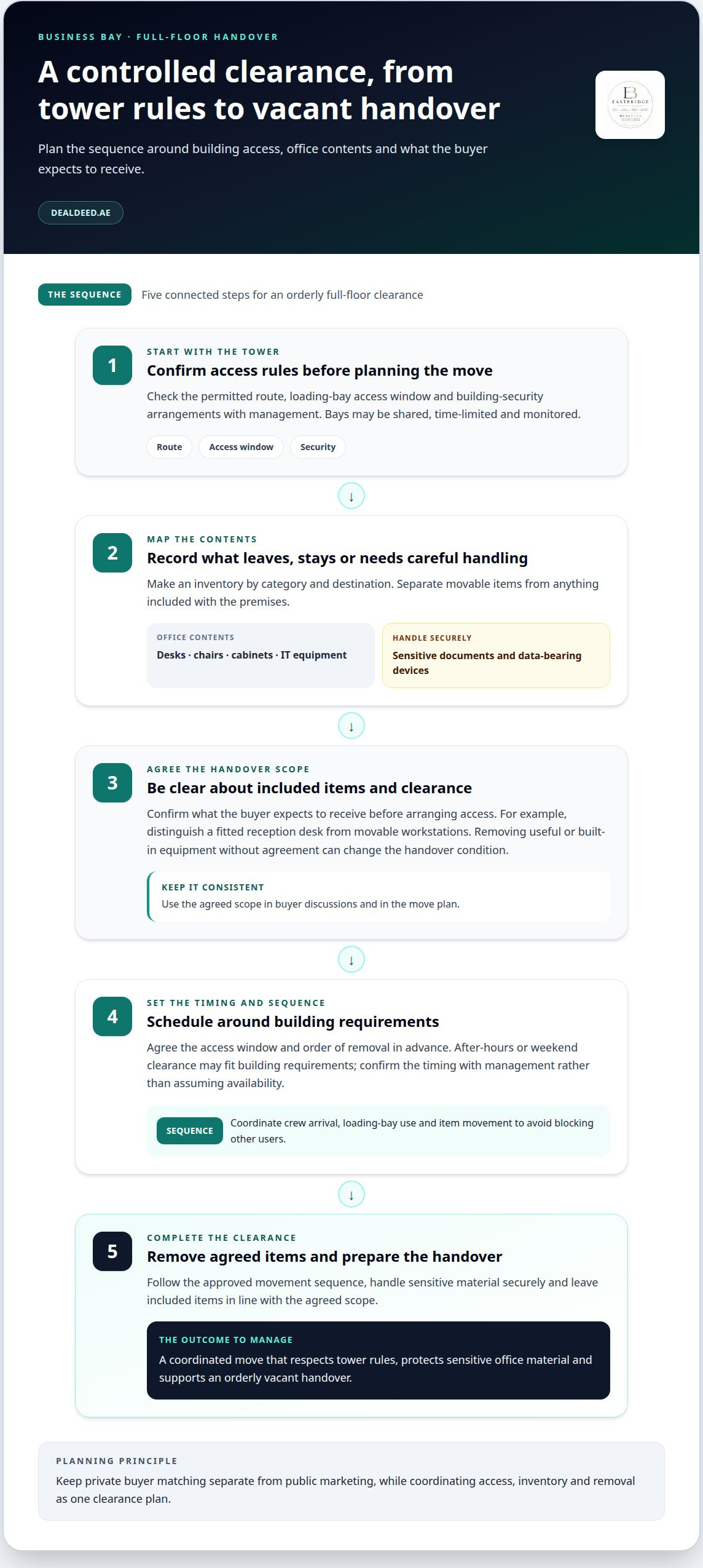
In Business Bay, start the clearance plan with the tower’s access rules. Loading bays may be shared, time-limited and monitored by building security. Confirming the permitted route, access window and order of removal helps prevent crews from blocking other users or arriving when the bay is unavailable. Build the schedule around the building’s rules rather than assumptions.
Next, map the contents by category and destination. An office decommission may include desks, chairs, cabinets and IT equipment. Separate items to be removed from anything staying with the premises. An agreed inventory, for example, can distinguish a fitted reception desk from movable workstations and reduce handover disputes. Handle sensitive documents and data-bearing devices securely rather than as ordinary furniture.
- Access: Coordinate the loading bay and security arrangements with building management.
- Timing: Schedule the move after hours or at weekends when that fits building requirements.
- Inventory: Record what leaves, what remains and which items need specialist handling.
A premium fit-out can make a floor more attractive, but clearance decisions should reflect what the buyer expects to receive. Removing useful or built-in equipment without agreement can change the handover condition. Set out included items and clearance scope before arranging access, then keep the description consistent in buyer discussions and the move plan.
For a discreet transaction, private disposal planning can keep buyer matching separate from public marketing. A clear scope, controlled access and coordinated removal make the handover easier to manage, without treating a full floor like a routine small-office move.
Coordinate clearance with building security and loading-bay rules in Business Bay. Desk, chair and electronics removal may need to take place after hours or at weekends, depending on building management. Agree the access window and movement sequence in advance to keep the clearance aligned with tower requirements.
Office buying and investment
For an office acquisition, distinguish rental evidence from sale value. The building, floor area, occupancy and ongoing charges all shape the investment case.
Current Full-Floor Pricing
Rental listings provide context, not a sale-price benchmark. Compare like-for-like space, fit-out, occupancy and building charges when assessing a full-floor offer. A rent figure alone does not establish capital value.
For a commercial sale, prepare a file identifying ownership evidence, exact floor area, property configuration, and any lease or occupancy terms. Required documents and approvals depend on the ownership structure and transaction. Consistent property details and sale terms give buyers a clearer basis for review.
Keep Dubai Land Department registration or transfer charges separate from building service charges and other transaction expenses. Costs depend on the transaction and the property’s account position, so rental listings and unrelated office costs are not reliable sale-fee estimates.
Tax treatment depends on the transaction and the parties involved. Reconcile service charges and other outstanding property liabilities too, since unpaid balances can affect net proceeds and handover arrangements.
Existing Tenants and Leases
A full-floor office may be sold with an existing tenant or lease, provided occupancy terms are made clear to prospective buyers. The remaining lease term, rent, payment status and relevant obligations affect how buyers assess income and future use. Presenting these details accurately helps buyers understand what transfers and what the handover involves.
Recent Full-Floor Office Sale Prices in Business Bay
The rental listings cited here do not establish recent full-floor sale prices or sale prices per square foot. They show asking rents, not completed sales. Using them as sale comparables would confuse rental evidence with transaction value.
Each figure is an annual rental amount, not a sale price.
That distinction matters when assessing price per square foot. Dividing annual rent by area gives an annual rent-per-square-foot measure, not a sale price per square foot. A sound sale comparison requires completed transactions involving a similar property type, floor configuration and area. Fit-out, occupancy and building condition also affect how closely two offices compare.
For a private valuation discussion, prepare a comparable-property record that separates sale evidence from rental listings. Include the tower, floor area, configuration, occupancy status and transaction type, and use a consistent measurement basis. A half-floor office, serviced workspace and entire commercial floor are not direct substitutes. Clear records help explain an asking position without presenting advertised rents as achieved values.
- Label each figure: distinguish annual rent from sale consideration.
- Match the asset: compare full floors with full floors, using consistent area measures.
- Record context: note fit-out, occupancy and building details alongside each comparable.
For a discreet route to vetted buyers, discuss a private disposal with the property details and supporting evidence ready.
DealDeed: Private Buyer Brief Matching
DealDeed’s Private Buyer Brief Matching connects motivated sellers with serious, vetted buyers. For a full-floor office in Business Bay, this offers a confidential route to relevant buyer interest without public listings or marketing. Property details are verified against Dubai Land Department data, and every match involves RERA-licensed agents.
DealDeed’s Quiet Disposal service supports owners seeking a confidential sale process, while the Agent-to-Agent Deal Desk helps agents coordinate a suitable opportunity. These routes suit owners who have defined their disposal terms and prefer qualified introductions over broad public exposure.
To discuss a private office disposal, contact DealDeed with a brief outlining the property and your preferred approach.
Set the Terms for a Discreet Next Step
The next decision is how much visibility and coordination the sale requires. Before discussions begin, define what information may be shared, the buyer profile that fits and the handover conditions that matter. A clear brief keeps the process focused on the asset and your priorities rather than generating broad, unqualified interest.
For a private disposal of a full-floor office in Business Bay, DealDeed’s Private Buyer Brief Matching, Quiet Disposals and Agent-to-Agent Deal Desk provide distinct ways to arrange introductions. The right route depends on whether you need buyer matching, a discreet disposal process or coordination between agents. DealDeed introduces motivated sellers to vetted buyers confidentially; it does not create public exposure.
Bring the property details and your preferred terms into the first conversation. That gives the discussion a practical starting point and lets you consider a controlled next step without committing to unnecessary visibility. Contact DealDeed about your office floor to discuss your preferred approach. Move forward with clarity, on terms that suit the asset.
Frequently Asked Questions
What does private disposal of a full-floor office in Business Bay mean?
A private disposal means arranging a sale discreetly, with property information shared selectively rather than through public listings. Prepare a clear asset brief, define what details may be disclosed and focus introductions on relevant, vetted buyers. DealDeed’s matching is agent-to-agent, and property details are shared only after an NDA is signed.
Which Business Bay buildings offer full-floor office units for sale?
Full-floor commercial spaces have been advertised in Sobha Sapphire, Blue Bay Tower and The Court Tower. These are rental listings, so they illustrate full-floor space in those buildings, not current availability for purchase. For a specific acquisition, distinguish a whole-floor property from a partial floor or large office unit, then assess the building and configuration as separate factors.
How can an owner privately market and sell a full-floor office in Business Bay?
Prepare the property details and sale terms, then use a controlled introduction process instead of public promotion. DealDeed matches sellers with serious buyers through participating agents, each of whom must hold valid RERA ORN and BRN credentials. An NDA is required before property details are shared. This approach suits owners who want to limit exposure while reaching buyers whose requirements fit the office.


