

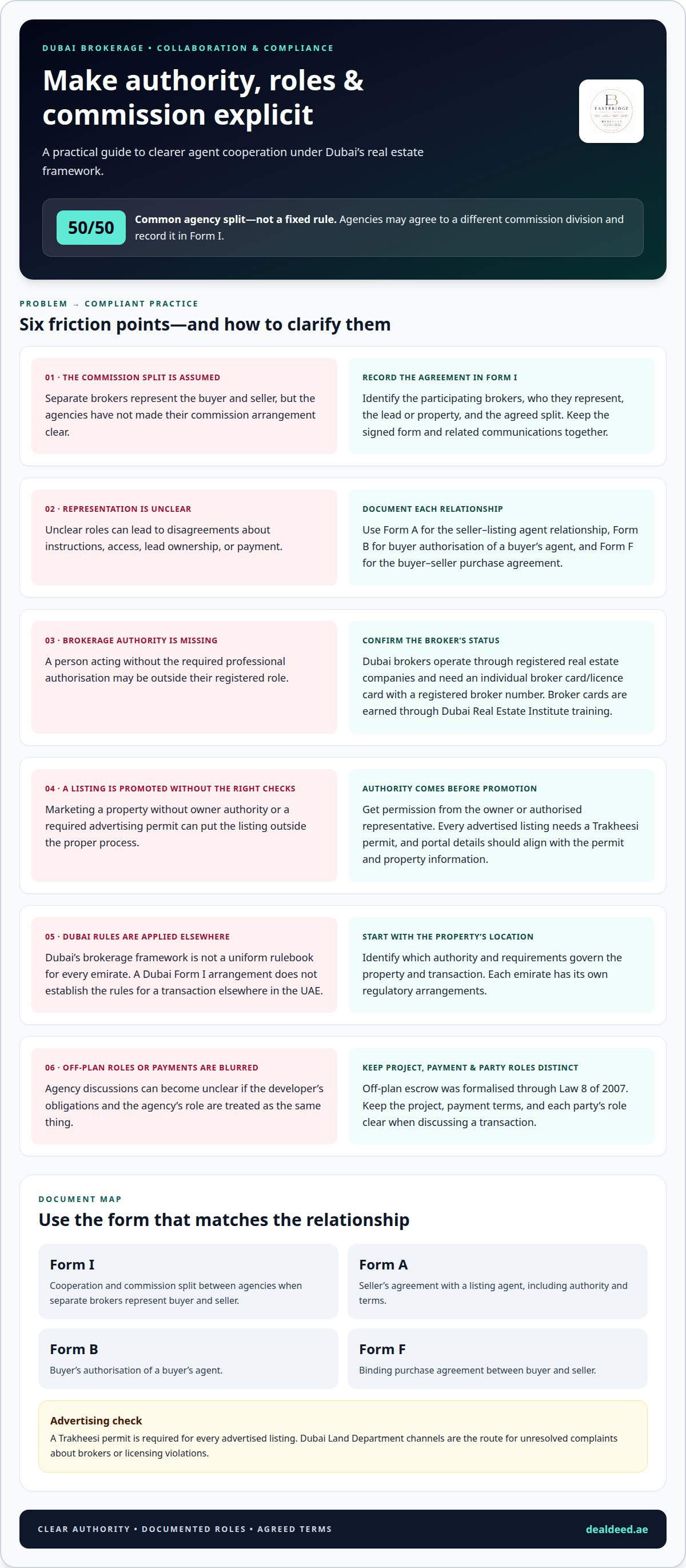
In Dubai, cooperation between agents is governed by documented authority and agreed terms. For transactions where separate brokers represent the buyer and seller, Form I sets out cooperation and commission splits; a 50/50 division between agencies is common, but another split can be agreed. Agents also need proper authorisation to carry out brokerage activity.
For professionals seeking clarity on agent collaboration rules under RERA in 2026, the key is to distinguish a common practice from a fixed requirement. This guide explains how cooperation works, which professional standards shape agent conduct, and how RERA compliance affects representation and property advertising. It also outlines where careful, confidential agent-to-agent matching can support a transaction without adding public exposure.
Key Takeaways
- Understand how Form I records cooperation and commission arrangements when separate brokers represent the buyer and seller.
- Distinguish the commonly used 50/50 agency split from a fixed rule: collaborating agencies can agree on another division.
- See how broker authorisation, client representation and advertising permissions shape compliant practice in Dubai.
- Learn when a discreet agent-to-agent matching desk can support a transaction without public listings or marketing.
What Are the Official Agent Cooperation Rules in Dubai Real Estate?
Dubai’s cooperation framework combines broker authorisation, written transaction documents and agreed commission terms. The agent collaboration rules under RERA in 2026 apply to Dubai; they should not be treated as a uniform UAE-wide rulebook.
Dubai RERA’s Regulatory Role
Established in 2007, Dubai’s Real Estate Regulatory Agency (RERA) operates under the Dubai Land Department and regulates real estate activity, including brokerage. Dubai Land Department Law No. 85 of 2006 is a primary framework for broker cooperation. These rules matter because an agent’s authority and role should be clear before representing owners or buyers.
Form I governs cooperation and commission splits when separate brokers represent the buyer and seller. Agencies commonly divide commission 50/50, but they can agree to another split. Dubai Land Department lists Circular No (3/2014) to all Real Estate Agencies, dated 06 April 2014, among its circulars. Clear terms help prevent disagreements over a lead or transaction.
Regional Differences in Collaboration Rules
RERA regulates Dubai’s real estate sector, so Dubai’s brokerage framework should not automatically be applied to Abu Dhabi or other emirates. Each emirate has its own regulatory arrangements. Agents working across emirate boundaries should identify which authority and requirements govern each property and transaction. The property’s location matters, not simply the agent’s office or the buyer’s address.
For a Dubai property, follow Dubai’s regulatory framework and use the relevant documents. A Dubai Form I arrangement does not, by itself, establish the rules for a transaction elsewhere in the UAE.
Written Agreements and Agent Approvals
Document agency cooperation through Form I, which records the arrangement and commission split between agencies. Specify the participating brokers, the parties they represent, the lead or property, and the agreed division. Keep the signed agreement and related communications together so both agencies have a clear record if a commission or lead dispute arises.
Agents also need proper authorisation for brokerage activity. Dubai brokers work through registered real estate companies and hold individual broker cards; the cards are earned through Dubai Real Estate Institute training. Every advertised listing needs a Trakheesi permit. Forms A and B document seller-agent and buyer-agent relationships, while Form F records the buyer-seller purchase agreement. For unresolved complaints about brokers or licensing violations, Dubai Land Department channels provide the relevant route.
Professional standards in the agency market
In Dubai, professional conduct means more than completing transactions. The Dubai Real Estate Regulatory Agency operates under the Dubai Land Department, and agents are expected to respect clients, other agents, and proper negotiation practices. For an agency, this means clearly identifying representation, providing accurate property information, and communicating directly when another broker is involved. These standards matter in sales and rentals, where unclear roles can lead to disputes over instructions, access, or payment.
Authority comes before promotion. Agents should have permission from an owner or authorised representative before advertising, and should market only properties they are authorised to represent. Dubai Land Department’s circular dated 02 August 2022 links real estate permits with the real estate e-marketing contract, Form A. Its circular dated 11 April 2023 addresses a QR code system for real estate advertisements. A portal listing therefore needs to align with the relevant permit and property details, not merely an agency’s marketing schedule.
Professional standards also protect transaction integrity. Dubai’s off-plan escrow regulation was formalized through Law 8 of 2007. Escrow arrangements matter because payments connected with an off-plan property are handled within a regulated framework, rather than treated as ordinary agency receipts. Agents discussing an off-plan transaction should keep the project, payment terms and parties’ roles distinct, avoiding claims that blur the developer’s obligations with the agency’s role.
Recordkeeping helps when a negotiation changes direction. A written trail of owner authority, property details, buyer interest and agreed next steps can clarify who introduced a lead and what each agency handled. If a disagreement concerns broker conduct or licensing, complaints run through Dubai Land Department channels. For confidential coordination between verified agents, private agent-to-agent transaction coordination can keep the discussion focused and away from public portal exposure.
RERA compliance rules in 2026
Dubai compliance depends on authorised brokerage, properly documented representation, and permitted advertising. The practical distinction for agents is between maintaining a valid transaction record and acting outside their registered role.
RERA Compliance Requirements
Dubai’s Real Estate Regulatory Agency regulates brokerage, and brokers operate through registered real estate companies. Each practising broker needs an individual licence card with a registered broker number. These requirements identify who may act in a transaction and tie professional activity to an agency’s licensed operations.
Documentation defines each party’s role. Form A records the seller’s agreement with a listing agent, including authority and terms. Form B records a buyer’s authorisation of a buyer’s agent. Form F is the binding buyer-seller purchase agreement. For advertising, every listing needs a Trakheesi permit. Dubai Land Department lists a circular titled “Regulations Governing Communication with Property Owners and the Prohibition of Cold Callings,” dated 27 February 2026.
These controls also matter beyond sales. A tenant, property management company, or developer may be involved in separate activities, but that does not replace broker licensing and advertising requirements. Off-plan project advertising is also subject to RERA approval and monitoring. Developers must use approved marketing materials and sales agreements.
Penalties for Collaboration Rule Violations
Broker and licensing complaints can be raised through Dubai Land Department channels. Distinguish a collaboration disagreement over a lead or commission from unlicensed brokerage or another licensing violation. The conduct at issue determines the type of complaint.
Do not assume a single fine or suspension applies to every disagreement between brokers. Keep the relevant agreements, messages, lead records, and transaction documents together to show each agent’s role and the issue in dispute. If the concern involves a developer’s advertisement or a registered broker’s conduct, identify that activity when describing the complaint. This keeps the record focused on the relevant regulatory framework instead of treating every commercial disagreement as the same breach.
Do Dubai RERA rules require a written agreement between collaborating agents?
For a Dubai transaction where separate brokers represent the buyer and seller, Form I documents their cooperation and commission split. The arrangement gives both agencies a reference point for their commercial understanding. Do not confuse it with Forms A, B, or F, which document other relationships in the transaction.
Form I addresses cooperation between agencies. Form A records a seller’s agreement with a listing agent, and Form B formalises a buyer’s authorisation of an agent. Form F is the purchase agreement between buyer and seller. Keeping these documents distinct helps prevent a client representation contract from being mistaken for an agency-to-agency split agreement.
For clarity, collaborating agencies can record the property or transaction, each agency’s role, the agreed commission division and how the introduction is being handled. These details make the arrangement easier to interpret if a lead later becomes a completed sale. A 50/50 agency division is common in Dubai, but agencies can agree to another split.
Keep supporting records with the Form I arrangement. These may include messages confirming the introduction, notes identifying the represented parties, and communications recording any agreed changes. For example, if one agency introduces a buyer and another manages the seller relationship, written records can clarify each agency’s contribution and the agreed division.
If a dispute arises, start with the signed terms and transaction record. Separate a disagreement about commission or lead ownership from a complaint about broker conduct or licensing. Complaints concerning Dubai brokers and licensing violations go through Dubai Land Department channels. Clear documentation makes the issue easier to describe and assess.
For discreet coordination between agents on a transaction, arrange private agent-to-agent coordination.
DealDeed: Agent-to-Agent Deal Desk
DealDeed’s Agent-to-Agent Deal Desk supports confidential coordination between RERA-licensed agents seeking a suitable buyer or seller connection. Its private matching desk connects motivated sellers with serious, vetted buyers without public listings or marketing. Property details are verified against Dubai Land Department data, and details are shared only after an NDA is signed.
Use Private Buyer Brief Matching when a buyer’s requirements need a discreet match. Quiet Disposal Mandates support sellers seeking a confidential sale. These services suit situations where controlled introductions matter more than public exposure; they do not replace agents’ regulatory duties or written transaction agreements.
For a confidential agent-to-agent introduction, contact DealDeed.
Make the next introduction deliberate
Use the agent collaboration rules under RERA in 2026 as a framework for disciplined decisions, not as a substitute for clear communication between agencies. Before a private introduction moves forward, align on the purpose of the match, the parties involved and how the discussion will be handled. That gives each agent a defined next step and keeps the process focused.
For sellers seeking discretion or agents matching a serious buyer with a suitable property, the right approach depends on the transaction’s needs. Private coordination may suit situations where confidentiality matters more than public exposure. DealDeed’s matching desk connects participating agents through confidential introductions.
Contact DealDeed to discuss your needs. A measured next step can keep the opportunity clear, private and moving forward.
Frequently Asked Questions
How Are Digital Platforms Changing Agent Cooperation in Dubai's 2026 Market?
Digital platforms can organise briefs, property evidence, and agent introductions in a controlled workflow. DealDeed’s matching desk connects agents privately. Every participating agent must hold a valid RERA Office Registration Number (ORN) and Broker Registration Number (BRN). The desk supports coordination but does not replace an agent’s authorisation, an advertising permit, or the documents required for a Dubai property transaction.
What Are the Common Pitfalls in Dubai Agent Cooperation Deals?
Common problems include unclear lead ownership, an undocumented commission split, and advertising a property without the required authority. Another risk is confusing a seller-agent agreement with an agency-to-agency cooperation arrangement. For example, if one broker introduces a buyer while another agency represents the seller, unclear records can complicate later discussions. Keep each party’s role and the agreed terms distinct.
Which RERA Forms Govern Agent Collaboration Guidelines in Dubai?
Form I covers cooperation and commission splits between agencies representing opposite sides of a deal. Form A documents the seller’s arrangement with a listing agent, and Form B records a buyer’s authorisation of an agent. Form F is the buyer-seller purchase agreement. These forms address different relationships, so using the right document keeps agency cooperation separate from client representation and the sale contract.
What are the UAE RERA rules for real estate agent collaboration in 2026?
The RERA brokerage framework discussed here applies to Dubai, not automatically to every UAE emirate. For a Dubai transaction, agents need proper authorisation and must follow the relevant Dubai requirements. Agents handling property in another emirate should treat that emirate’s rules separately rather than assume a Dubai form or process applies.
How are commissions split between collaborating real estate agents in Dubai?
Agencies may agree to divide commission equally when separate brokers represent the buyer and seller, or set another split. The division between agencies is separate from any arrangement between an agency and its individual broker. Record the split and each agency’s role clearly so a later disagreement does not depend on differing recollections.
Can agents from different brokerages collaborate under RERA rules?
Yes. Separate brokerages can cooperate in a Dubai transaction, for example, when one represents the buyer and another represents the seller. Each agent must be properly authorised through the relevant registered real estate company. The agencies should document their cooperation and agreed commission terms, keeping that arrangement distinct from each agent’s authority to represent their client.


