

An institutional mandate should reduce noise, not add to it. Private real estate matching for institutional investors in Abu Dhabi connects a defined investment brief with relevant UAE property opportunities. The brief sets the parameters for a match, including asset type, location, investment horizon, and transaction requirements.
Investors need more than a list of available assets. They need a focused way to identify opportunities that fit their mandate and keep discussions controlled. Clear criteria also help distinguish a relevant introduction from a lead that only appears promising.
This article explains how to frame mandates, what information supports a useful match, and how to assess whether an opportunity fits your objectives. It also outlines when private matching can be a practical route into Abu Dhabi real estate and what to expect from a structured introduction.
Key Takeaways
- Define a mandate around the asset, location, investment objectives and transaction requirements to make opportunity matching more relevant.
- Assess UAE property opportunities against your institution’s criteria and the information available for each asset.
- Understand how private matching differs from brokers, funds and direct sourcing, and where each route fits.
- See how DealDeed’s Private Buyer Brief Matching can connect a defined buyer brief with relevant property opportunities.
Abu Dhabi real estate mandates
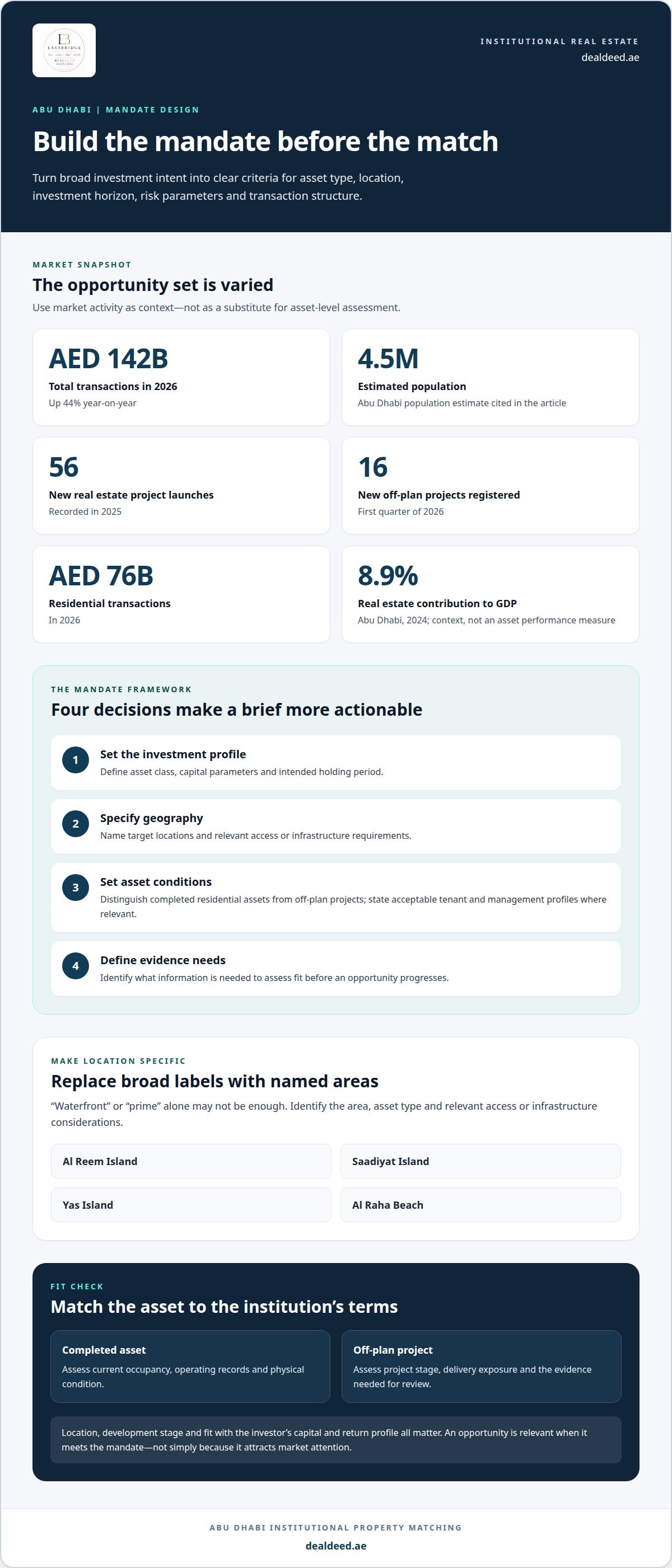
Abu Dhabi’s opportunities are shaped by transaction activity, new projects, and distinct island and mainland locations. In 2026, transactions totalled AED 142 billion, up 44% year-on-year, while the population was estimated to reach 4.5 million. For private real estate matching for institutional investors in Abu Dhabi, asset location, access, development stage, and fit with the investor’s capital and return profile matter.
A mandate turns broad investment intent into criteria that guide opportunity matching. It should state the preferred asset class, target locations, investment horizon, risk parameters, and transaction structure. For a residential mandate, an investor might specify established, income-producing assets or new projects, then define acceptable tenant and management profiles. A development-focused mandate may instead prioritise project stage, delivery exposure, and the evidence needed to assess a proposed acquisition.
Abu Dhabi’s pipeline adds another consideration. The emirate recorded 56 new real estate project launches in 2025, and 16 new off-plan projects were registered in the first quarter of 2026. Residential transactions reached AED 76 billion in 2026. These figures point to a varied opportunity set, not a single investment case. A mandate should distinguish completed assets from off-plan projects and assess how each aligns with capital deployment plans, due diligence requirements, and expected returns.
Location criteria should be precise. Al Reem Island, Saadiyat Island, Yas Island, and Al Raha Beach are distinct locations to assess against an institution’s strategy. Rather than treating “waterfront” or “prime” as sufficient descriptions, a brief can identify the specific area, asset type, and relevant access or infrastructure considerations. Assess infrastructure as part of the individual location’s investment case, rather than assuming it from an emirate-wide trend.
Abu Dhabi’s economic context also informs mandate design: real estate contributed 8.9% to the emirate’s GDP in 2024. That figure provides context, but it does not determine an asset’s performance. The mandate still needs a clear position on liquidity, operating requirements, holding period, and acceptable exposure. For private real estate matching for institutional investors in Abu Dhabi, an exceptional opportunity only matters when it meets those terms.
A focused brief can be built through a sequence of decisions:
- Set the investment profile: define asset class, capital parameters, and intended holding period.
- Specify geography: select target locations and relevant access or infrastructure requirements.
- Set asset conditions: distinguish completed residential property from off-plan projects.
- Define evidence needs: identify the information required to assess fit before progressing.
This structure keeps Abu Dhabi real estate mandates tied to an institution’s objectives, rather than broad market attention.
Institutional investor access to UAE real estate opportunities
Institutional access starts with a defined acquisition route, not a broad search across properties. A portfolio mandate can set the preferred asset class, ownership structure, investment horizon, and information required before an opportunity advances. In UAE real estate, location and title framework also matter. Non-residents can buy in designated freehold areas, including Yas Island, according to the market information available for this article.
Geography can shape the type of assets considered. Abu Dhabi examples include Al Ghadeer, Masdar City, and Al Reef, where reported gross apartment yields vary by community. Al Ghadeer apartments have reported gross yields of 8% to 8.69%; Masdar City apartments reach up to 8.5%. These figures describe gross yield, not net portfolio returns. Operating costs, vacancy, asset condition, and holding period affect the investment assessment.
Property type matters just as much. Assess a completed residential asset through its current occupancy, operating records, and physical condition. For an off-plan property, consider the developer, project approvals, construction progress, and payment structure. Abu Dhabi buyers can check developer registration and project approvals through ADREC. Off-plan projects use escrow accounts, with milestone-based fund releases described as safeguards for buyers.
For a real estate developer or institutional asset manager, access should proceed through controlled stages. First, screen opportunities against the mandate. Then establish whether the asset’s location, ownership route, and development status align with the investor’s requirements. Review supporting property information before moving to commercial and legal due diligence. Hospitality assets may require additional scrutiny of operating arrangements and the relationship between property ownership and hospitality operations.
A practical access workflow can keep the review disciplined:
- Define scope: specify target property types, locations, ownership conditions, and holding period.
- Screen assets: remove properties that fall outside those parameters before allocating deeper review resources.
- Review evidence: assess title information, project status, developer details, and available operating records.
- Advance selectively: progress only opportunities that satisfy the institution’s criteria for further diligence.
This approach suits investors seeking a focused pipeline rather than unrestricted exposure to listings. For a more discreet way to explore relevant UAE property opportunities, consider private property matching as one access route.
Abu Dhabi Real Estate: Matching vs Brokers & Funds
These routes address different acquisition needs. A broker facilitates a property transaction between parties. A fund provides an investment structure and portfolio strategy. Direct sourcing puts the search and initial relationship-building in the investor’s own team’s hands. Private matching focuses on connecting a defined buyer brief with a relevant property opportunity. It can complement diligence and transaction support, but it doesn’t replace them.
In Abu Dhabi, a broker may be useful when an institution already knows the asset type and needs help progressing a transaction. Distinguish that role from mandate-led matching: a broker’s involvement centres on a deal, while matching starts with the buyer’s criteria and filters potential introductions against them. Neither route removes the need to assess ownership, asset condition, project status, or commercial terms.
A fund suits institutions seeking exposure through a managed investment vehicle rather than selecting individual properties themselves. The fund’s mandate, governance, asset mix, and holding approach shape that exposure. By contrast, an investor acquiring a specific property retains direct responsibility for its selection and subsequent asset-level decisions. A fund and a matched introduction are therefore not interchangeable routes.
Direct sourcing offers greater control over the search process. An investment team can approach owners, developers, or other market participants itself. That route also requires internal capacity to identify prospects, establish access, screen fit, and coordinate follow-up. Matching can narrow the initial field against a buyer brief, while direct sourcing may suit teams with established local networks and dedicated acquisition resources.
Consider an institution seeking a completed residential asset on Al Reem Island. A broker may support a specific transaction; a fund may offer pooled exposure to a wider portfolio; direct sourcing depends on the institution’s own relationships. A private match can focus introductions on properties aligned with the stated location, asset type, and investment parameters. The institution still conducts its own commercial and legal review before committing.
Compare routes against the work your team needs done:
- Choose a broker when transaction facilitation is the primary requirement.
- Consider a fund when managed, pooled exposure fits the investment structure.
- Use direct sourcing when internal teams can lead outreach and screening.
- Consider private matching when a defined acquisition brief needs relevant, controlled introductions.
For a focused introduction process, submit an institutional property brief describing the asset and acquisition criteria.
DealDeed: Private Buyer Brief Matching
DealDeed’s Private Buyer Brief Matching connects serious, vetted buyers with relevant Dubai real estate opportunities. For an institutional investor whose UAE mandate also includes Dubai assets, it offers a private route from a defined brief to a focused introduction. Property details are checked against Dubai Land Department data, and transactions are handled confidentially between RERA-licensed agents.
For sellers, Quiet Disposal Mandates support confidential introductions without public listings or marketing. The Agent-to-Agent Deal Desk provides another route for agents coordinating opportunities. These options suit investors and market participants who value controlled access over public exposure; they don’t replace an institution’s own investment, legal, or commercial due diligence.
If your UAE investment brief includes relevant Dubai property opportunities, contact DealDeed to discuss the mandate.
Set Your Next Acquisition in Motion
The next step is to turn investment priorities into a brief that can guide a disciplined search. Define the assets your institution would consider, the evidence needed to assess them, and the conditions that would move an opportunity forward. That preparation gives private real estate matching for institutional investors in Abu Dhabi a practical starting point: a clear mandate, not an open-ended search.
Keep the brief focused on decisions your investment committee can act on. Separate essential criteria from preferences, and identify who will review an introduction and decide its next stage. This creates a more controlled path from initial interest to internal assessment, while leaving investment judgment with your team.
When you’re ready to discuss how a private mandate could support your property search, contact DealDeed to discuss your investment brief. A well-defined starting point helps make the next conversation direct, relevant, and aligned with your objectives.
Frequently Asked Questions
What does private real estate matching mean for institutional investors in Abu Dhabi?
Private real estate matching uses an investor’s acquisition criteria to identify relevant property introductions without relying on a broad, public-facing search. A practical brief might specify residential assets, preferred ownership conditions, location, and required investment documentation. The match is a starting point, not an investment decision: the institution evaluates the opportunity, authorises further diligence, and determines whether it fits its approval process.
Which Abu Dhabi firms and platforms match institutional investors with private real estate opportunities?
DealDeed offers private matching for UAE property opportunities, with its matching desk focused on Dubai real estate and local targeting that includes Abu Dhabi. Participation is through licensed agents: every match must involve agents with valid RERA Office Registration Numbers and Broker Registration Numbers. DealDeed acts as an introducer, not a broker, and does not represent buyers or sellers directly.
What asset types and investment strategies are available in Abu Dhabi private real estate?
Investors can assess residential properties, completed assets, and off-plan projects, then align selection with strategies such as income generation, longer-term holding, or development exposure. For example, an institution prioritising rental income may focus on operating performance and tenant profile. A development-led strategy may weigh project stage, delivery risk, and capital deployment timing. Strategy should determine asset selection, not the reverse.
What is the process for matching, due diligence, negotiating, and closing a private property investment in Abu Dhabi?
The process generally moves from an investment brief to a suitable introduction, initial screening, due diligence, negotiation, and transfer. After selecting a property, parties can document agreed terms in a memorandum of understanding, arrange the deposit, obtain a developer no-objection certificate where applicable, and complete ownership transfer through the relevant land authority. Before completion, due diligence should cover title, project approvals, condition, liabilities, and transaction documents.


