

A public portal is not the only way to sell property in Dubai. Selling property in Dubai without public portal listings is possible through a private buyer process, while the ownership transfer still requires the relevant sale documents. Prepare the Title Deed, valid passport and Emirates ID, and mortgage documents if applicable.
A quieter sale can limit public exposure, but it still depends on clear ownership records, organized paperwork and a properly managed transaction. This guide covers the documents to gather, key steps such as the No Objection Certificate and sale agreement, and how to approach buyer introductions confidentially. You’ll learn how to keep the process orderly, from confirming ownership details to reaching serious buyers without a public listing.
Key Takeaways
- Gather your Title Deed and identity documents first; if the title deed hasn’t been issued, prepare the relevant sales agreement and developer or previous-owner documents.
- For a mortgaged property, organize the lender documents and plan for the clearances needed before ownership can transfer.
- Private sale processes still require clear terms and the relevant transaction documents, even when the property isn’t publicly listed.
- Vetted buyer matching and agent-to-agent coordination can help keep buyer introductions discreet and focused.
- Include official transfer costs in your planning: Dubai Land Department charges AED 250 for title deed issuance.
Seller identity and ownership documents
For a private sale, prepare documents that establish who owns the property and who can sign. Check that every name and property detail matches before sharing a buyer brief or beginning transfer steps.
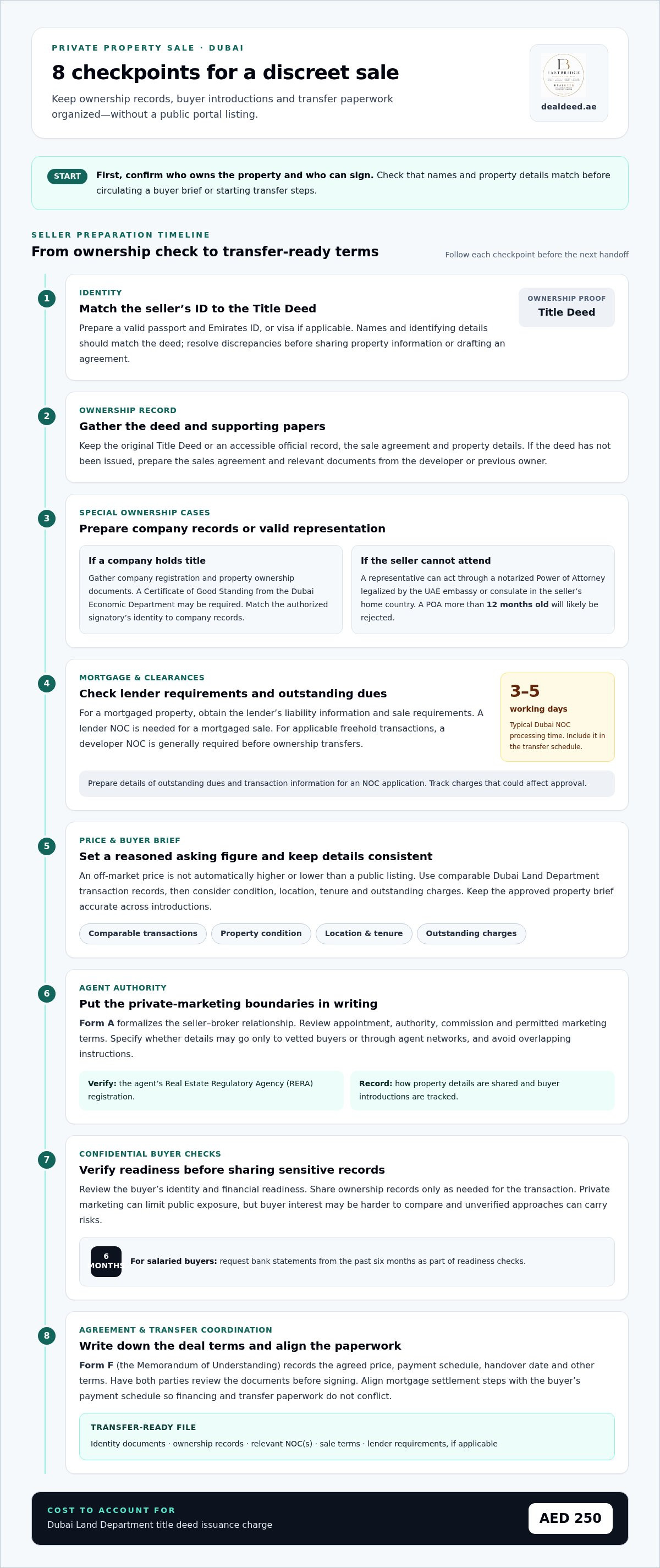
- Match your identity documents to the title deed. The Dubai Land Department issues the title deed, the primary legal proof of property ownership. Prepare a valid passport and Emirates ID, or visa if applicable. Names and identifying details should match the deed. Resolve any discrepancy before agents circulate property information or draft an agreement.
- Gather the ownership record and supporting papers. Keep the original title deed or an accessible official record, along with the sale agreement and property details. If the title deed has not yet been issued, prepare the sales agreement and relevant documents from the developer or previous owner. These records help validate ownership and the property’s transaction history.
- Organize mortgage and property clearance documents. For a mortgaged property, obtain the lender’s liability information and its No Objection Certificate (NOC) for the sale. Prepare details of outstanding dues and transaction information for any NOC application. A Dubai NOC typically takes three to five working days to process, so include it in your transfer schedule.
- Prepare company ownership records when a business holds title. Gather the company’s registration and property ownership documents. A Certificate of Good Standing from the Dubai Economic Department may be required to confirm registration and compliance. Match the authorized signatory’s identity to the company records, and keep the certificate with the title deed and sale agreement for application review.
- Arrange valid representation if you cannot attend. A seller who cannot attend in person can appoint a representative through a Power of Attorney (POA). The POA must be notarized and legalized by the UAE embassy or consulate in the seller’s home country. A POA more than 12 months old will likely be rejected, so prepare a current document before authorizing signatures.
- Compare private-sale pricing with public listings carefully. An off-market price isn’t automatically higher or lower than a publicly listed price. Set an asking figure using comparable Dubai Land Department transaction records, then consider the property’s condition, location, tenure and outstanding charges.
- Keep private circulation controlled and documented. Private discussions through agent networks avoid a public portal listing, but still require accurate property details and clear sale terms. If you appoint an agent, Form A formalizes the seller-agent relationship. Keep the approved brief consistent across every introduction.
- Limit exposure and verify buyer readiness before sharing sensitive records. A private sale can limit public reach, but may also make buyer interest harder to compare. Unverified approaches can create risks around identity documents and misleading offers. Review the buyer’s identity and financial readiness, and share ownership records only as needed for the transaction. Salaried buyers should provide bank statements from the past six months.
Legal and professional support for sellers
Use written authority, verified agent credentials and clear transfer terms to manage a private sale. Record the scope and limits of any exclusive off-market arrangement in writing.
Consider an exclusive agency agreement
Set the arrangement’s boundaries before an agent approaches buyers. In Dubai, Form A formalizes the seller-broker relationship; read its terms for the appointment, authority, commission and permitted marketing. State whether the agent may share details only with vetted buyers or within agent networks. Keep a signed copy, and avoid overlapping instructions that could cause confusion about who introduced a buyer.
Identify agents specializing in off-market listings
Choose an agent whose work includes private buyer introductions and off-market deals. Confirm the agent’s Real Estate Regulatory Agency (RERA) registration, then agree how property details will be shared and how buyer introductions will be recorded. An agent can help connect sellers with exclusive listings and off-market opportunities. Keep the brief consistent, so buyers receive accurate terms without unnecessary public exposure.
- Record the sale terms with the buyer. Use Form F, the Memorandum of Understanding, to confirm the agreed price, payment schedule, handover date and other terms. Have both parties review the documents before signing. A precise agreement gives the transfer process a clear reference point and reduces ambiguity around payment or handover.
- Coordinate the required No Objection Certificate. For applicable freehold transactions, a developer NOC is generally required before ownership transfers. The NOC confirms that no dues are outstanding on the property. Submit supporting identity, ownership and transaction documents through the owner or an authorized representative, and track any outstanding charges that could affect approval.
- Address mortgage conditions early. If the property has a mortgage, ask the lender for its liability information and sale requirements. A mortgage lender’s NOC is needed for a mortgaged property sale. Align the settlement steps with the buyer’s payment schedule so financing and transfer paperwork do not conflict.
- Document decisions for jointly owned property. Have all owners agree on sale terms and proceeds distribution in a Seller’s Agreement. Confirm who can sign and whether a representative will act for any owner. Matching the agreement to the ownership record helps prevent conflicting instructions during the transaction.
- Prepare for the final transfer. Keep signed agreements, identity documents, NOC records, and payment details organized for the Dubai Land Department transfer. For a controlled introduction process, private buyer matching can connect a seller’s brief with vetted buyer interest.
What are the rules for off-market property sales in Dubai?
Off-market describes how buyers hear about a property, not a separate ownership-transfer process. Keep the buyer introduction private, then complete the sale using the required agreements, clearances and transfer paperwork.
- Define what “off-market” means for your sale. Decide whether details will go only to named buyers or through a limited agent network. Record what information may be shared, with whom and for what purpose. A private approach changes exposure; it does not replace the documents needed to transfer ownership in Dubai.
- Keep the property brief accurate and controlled. Prepare a concise description covering the property’s location, ownership details, condition, occupancy status and asking terms. Share supporting records only as needed for a genuine transaction. Inconsistent details between an agent’s brief and the eventual agreement can create avoidable disputes over what the buyer was offered.
- Use written terms before accepting an offer. Dubai sellers are advised to use Form F, the Memorandum of Understanding, to record the agreed purchase price, payment schedule, handover date and other conditions. Have the buyer and seller review the same terms before signing. Private discussions do not make verbal assumptions a substitute for a clear agreement.
- Formalize any agent appointment. Form A generally formalizes the seller-broker relationship in Dubai. State the appointment’s scope and permitted circulation clearly, particularly if the agent may approach other agents or only selected buyers. This makes the intended privacy level explicit and reduces conflicting instructions about who may share the property brief.
- Arrange property clearances before transfer. For applicable freehold transactions, a developer-issued No Objection Certificate is generally required before ownership can transfer. It confirms that no dues are outstanding on the property. The NOC review may include checks for dues, disputes, litigation and violations, so resolve outstanding items before the buyer’s transfer date.
- Plan around any mortgage and payment conditions. A mortgaged sale involves the lender’s requirements as well as the buyer’s payment schedule. The seller usually starts by requesting a liability letter to establish the outstanding loan amount and settlement conditions. Align these steps with the signed sale terms so the mortgage release does not conflict with the planned transfer.
- Complete registration through the formal transfer process. Ownership registration is typically completed through an authorized Real Estate Registration Trustee Centre. The buyer and seller submit the required documents and pay applicable fees for the transfer. After a successful Dubai Land Department transfer, the buyer receives a new electronic title deed confirming ownership.
- Keep a record of every private introduction. Log when a buyer received the brief, which terms were shared and which agent made the introduction. Keep that record with the signed Form F and transfer documents. A clear trail helps distinguish a serious negotiated offer from an informal expression of interest.
Which Dubai real estate agents specialize in off-market listings?
Look for agents who can connect sellers with exclusive listings and off-market deals in Dubai. Evaluate their registration, buyer access, and process for controlling property information, not simply their public advertising presence.
- Start with RERA registration. Confirm the agent is registered with the Real Estate Regulatory Agency (RERA), as advised for Dubai property transactions. Record the agent’s name and registration details with your property file. This establishes who is handling introductions and ties communications to a verifiable real estate professional.
- Ask for a clear off-market process. Establish how the agent identifies potential buyers and circulates the property brief. An agent can help sellers access exclusive listings and off-market deals in Dubai. Agree whether details go to selected buyers directly or through other agents, and document which property information may be shared at each stage.
- Assess the buyer network by relevance. A useful network is not simply a large contact list. It should connect the property’s location, type, condition and price expectations with buyers who have a reason to consider it. Ask the agent to describe the matching approach without disclosing another seller’s confidential information or promising a sale.
- Set the appointment and boundaries in writing. Form A generally formalizes the seller-broker relationship in Dubai. Read the appointment terms and define the agent’s authority, permitted circulation and commission arrangements before signing. If more than one agent may be involved, document how introductions will be tracked to reduce disputes about buyer origin.
- Agree on a controlled information sequence. Provide a concise property brief first, then share further ownership or financial documents as the transaction advances. An initial introduction can establish buyer interest before detailed records are disclosed. Keep the same approved description across agent communications so the buyer receives consistent facts.
- Clarify how agent-to-agent introductions work. Some off-market opportunities move through professional agent networks rather than public exposure. Before circulation, agree who may introduce the property, how the originating agent is recorded and how buyer responses return to you. A defined process makes private introductions traceable without turning them into a public portal listing.
- Keep the sale process aligned with Dubai requirements. Private buyer access does not remove formal transaction steps. The buyer and seller still need clear agreed terms, and applicable NOC and transfer documents remain part of completing the sale. Use the agent’s role for introductions and coordination, while keeping signed sale terms and official transfer paperwork organized separately.
Look for RERA-registered agents with a clear off-market process, relevant buyer networks, and a way to control and track property introductions.
What fees and costs apply to a private property sale in Dubai?
Private introductions do not remove Dubai’s transfer charges or property-related costs. Map each item to the sale agreement, mortgage status and property type.
- Set out who pays the transfer fee. Dubai Land Department transfer fees are 4% of the sale price and are usually shared with the buyer. Put the agreed allocation in the sale terms rather than relying on assumptions. The amount is linked to the sale price, so confirm the agreed figure and payment responsibility before signing.
- Include title deed and registration charges. Dubai Land Department charges AED 250 for title deed issuance. Property registration fees are AED 2,000 for properties under AED 500,000 and AED 4,000 above that threshold. Identify the property’s value band and include the relevant registration amount in the transfer budget.
- Account for the agent’s commission and VAT. Real estate agents charge around 2% of the sale price as commission in Dubai. VAT on an agent’s commission is 5% of that commission. Review the signed agency terms to establish the agreed commission basis, who pays it, and how VAT appears on the transaction paperwork.
- Budget for the developer’s NOC. The certificate confirms that no dues are outstanding on the property. Ask for the applicable amount during transaction planning, then account for outstanding service charges or other property dues separately.
- Calculate mortgage-related costs using the lender’s figures. A seller with an existing mortgage may face an early settlement fee of 1% of the remaining mortgage or AED 10,000, whichever is lower. The outstanding loan and settlement conditions affect the amount due. Obtain the liability information and include the settlement in the payment schedule.
- Separate official charges from private-sale terms. A private sale changes how buyers are introduced, not the costs tied to registration, the NOC, or an outstanding mortgage. List each cost, its payer, and its payment point in the agreement. For controlled buyer introductions, request private buyer matching as part of your sale planning.
The No Objection Certificate fee for selling property in Dubai is 0.25% of the property value.
DealDeed: Private Buyer Brief Matching
DealDeed’s Private Buyer Brief Matching connects motivated Dubai sellers with serious, vetted buyers without public listings. It suits owners who want a controlled introduction process rather than broad public exposure. Property details are verified against Dubai Land Department data, and introductions take place confidentially between RERA-licensed agents.
For a more structured private sale, Quiet Disposal Mandates support discreet handling of a property brief. The Agent-to-Agent Deal Desk facilitates introductions through professional networks. These options focus on matching and coordination; the seller still completes the required sale agreements, clearances and ownership transfer steps.
If a private buyer process fits your sale, visit dealdeed.ae to discuss the next step.
Set the terms of a quieter sale
The next decision is not how widely to advertise, but how much control you want over the first conversation. Before approaching buyers, decide which property details can be shared, who may receive them and what would make an introduction worth pursuing. Those boundaries give your agent a clear brief and keep each discussion purposeful.
Selling property in Dubai without public portal listings works best when privacy is deliberate, not improvised. Treat the buyer brief as a controlled invitation: precise enough to establish genuine interest, limited enough to protect sensitive information until discussions progress. You remain in control of what moves forward.
If a discreet route fits your plans, contact DealDeed about your private sale. A focused conversation can help you consider the right next step for your property and preferred level of exposure. Move at your pace, with clarity from the outset.
Frequently Asked Questions
Can you sell a property in Dubai without listing it on public portals?
Yes. Selling property in Dubai without public portal listings is possible through private introductions to potential buyers or agent networks. A private route changes how the property is presented, not the formal steps required to complete a sale. For example, a seller can circulate an approved brief privately, then proceed with signed terms and the required ownership transfer documents once a buyer is selected.
How can sellers find buyers for a Dubai property privately?
Sellers can use a private matching desk or agent network to reach buyers without public listings. DealDeed’s Private Buyer Brief Matching connects motivated sellers with serious buyers through RERA-licensed agents. Participating agents must hold a valid RERA Office Registration Number (ORN) and Broker Registration Number (BRN). Property details are shared only after an NDA is signed, keeping introductions controlled and confidential.
What documents are required to sell a property privately in Dubai?
Prepare the title deed, seller identity documents and any mortgage or representative paperwork relevant to your situation. A company-owned property may also require company registration records and a Certificate of Good Standing. For jointly owned property, align all owners on the sale terms and proceeds distribution. If someone signs for you, organize the applicable Power of Attorney and supporting identity documents alongside the property file.
What are the steps to transfer an off-market property at the Dubai Land Department?
First, buyer and seller agree and sign the sale terms, then assemble the transfer documents and required clearances. Settle applicable payments and submit the paperwork through an authorized Real Estate Registration Trustee Centre. The buyer pays the remaining balance as ownership transfers. After a successful Dubai Land Department transfer, the buyer receives a new electronic title deed. Submitting documents early can support same-day completion.


