

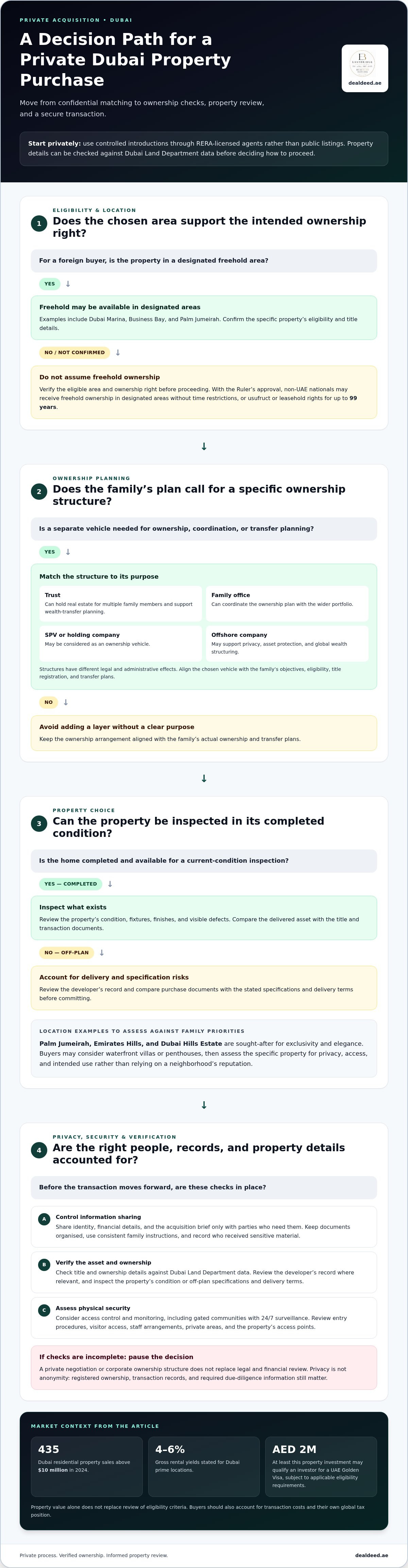
Privacy should be built into the acquisition process from the outset. A private real estate acquisition for UHNWI in Dubai can proceed through confidential introductions between RERA-licensed agents, without public listings or marketing. Property details can be verified against Dubai Land Department data before a buyer decides how to proceed.
For Middle Eastern families, discretion can protect more than a name. It can limit unnecessary exposure, keep negotiations focused, and ensure that only relevant, vetted parties are involved. Privacy must still go hand in hand with due diligence, clear ownership arrangements, and a secure transaction process.
This article explains how off-market acquisitions work in Dubai, the privacy and security considerations to weigh, and how buyers assess locations, ownership options, and transaction steps. It covers where confidential matching can reduce public exposure, why it cannot replace legal and financial review, and how a family can define its property needs without putting the search on display.
Key Takeaways
- Off-market discussions can reduce public exposure while keeping buyer and seller negotiations focused through vetted channels.
- Protect privacy by considering who can access transaction details, how ownership will be structured, and what security features matter to the family.
- Compare Dubai neighborhoods and property types against practical priorities such as discretion, access, and intended use.
- Confirm that the chosen area and ownership structure match the buyer’s eligibility and long-term plans before proceeding.
- Prepare for due diligence by organizing buyer and property records, reviewing transaction terms, and accounting for the Dubai Land Department transfer process.
Off-market acquisitions by Middle Eastern families
Middle Eastern families often pursue Dubai property through controlled introductions rather than public listings. This can limit exposure while keeping verification, ownership planning, and family priorities central to the process.
Foreign Ownership Eligibility and Locations
Foreign nationals can own freehold property in designated Dubai areas, including Dubai Marina, Business Bay, and Palm Jumeirah. This matters because location determines the ownership rights available to a buyer. With the Ruler’s approval, non-UAE nationals may receive freehold ownership in designated areas without time restrictions, or usufruct or leasehold rights for up to 99 years, according to the Government of Dubai Legal Affairs Department.
Some UHNW investors use private investment or holding companies to own property, including when managing assets through family offices or global portfolios. Choose a structure that fits the family’s ownership and transfer plans, rather than adding a layer without a clear purpose. For an international buyer, eligibility, title registration, and the intended ownership vehicle should all be part of due diligence.
Popular Neighborhoods and Property Types
Palm Jumeirah, Emirates Hills, and Dubai Hills Estate are sought-after for exclusivity and elegance. These locations matter because each offers a different balance of privacy, access, and living environment. UHNWI buyers may consider waterfront villas or penthouses, then assess the specific property rather than relying on a neighborhood’s reputation.
Dubai recorded 435 residential property sales above $10 million in 2024, indicating demand at the top end of the market. In the UAE, financial planning should also account for residency objectives. According to the Federal Authority for Identity, Citizenship, Customs & Port Security, real-estate investors who put at least AED 2 million into property can qualify for a UAE Golden Visa. Property value alone does not replace review of the applicable eligibility criteria.
Off-plan versus completed property: Off-plan purchases involve delivery and specification risks before the home is completed. With a completed property, buyers can inspect its current condition and compare the delivered asset with the title and transaction documents.
Yields and prices: Dubai prime locations deliver gross rental yields of 4 to 6 percent. London, Monaco, and Singapore comparisons require like-for-like assets and gross-versus-net yield distinctions; a citywide ranking can obscure property type, operating costs, and purchase conditions.
Tax implications: The article states that Dubai has no annual property tax or capital gains tax. Buyers should still account for transaction costs and their own global tax position when planning ownership and a future sale.
Golden Visa qualification: A property investment of at least AED 2 million can qualify an investor for a UAE Golden Visa, according to the Federal Authority for Identity, Citizenship, Customs & Port Security. The property and applicant must meet the relevant eligibility requirements.
Due diligence: Review the developer’s record, verify title and ownership details against Dubai Land Department data, and inspect the property’s condition. For off-plan assets, compare the purchase documents with the stated specifications and delivery terms before committing. For completed homes, assess fixtures, finishes, and visible defects alongside the title review.
Privacy and security
For luxury real estate buyers, privacy means controlling how purchase details are shared. Security means assessing the property, its access points, and the people involved. These considerations apply whether a family is considering Palm Jumeirah or another exclusive location in Dubai. A private negotiation or corporate ownership structure does not remove the need for careful verification.
Start by controlling information. Share the buyer’s identity, financial details, and acquisition brief only with parties who need them to progress the transaction. Keep documents organised, give family representatives consistent instructions, and record who has received sensitive material. For example, a family office coordinating several advisers can maintain one approved set of property criteria rather than circulate conflicting versions.
Then assess physical security at the property level. Dubai gated communities with 24/7 surveillance are one option for buyers considering access control and monitoring. The specific location still matters: review entry procedures, visitor access, staff arrangements, and the home’s private areas. In a villa, consider sightlines and boundary access; in a penthouse, assess building entry and shared facilities.
Trusts can hold real estate on behalf of multiple family members and support wealth-transfer planning. A family office can coordinate the ownership plan with the wider portfolio. An SPV or holding company may be considered as an ownership vehicle, while an offshore company may support privacy, asset protection, and global wealth structuring. These structures have different legal and administrative effects, so select a vehicle that fits the family’s objectives and applicable requirements.
Privacy is not the same as anonymity. The registered owner, transaction records, and required due-diligence information still matter. For an international family with assets across Europe, Africa, and the Middle East, align the Dubai purchase file with existing governance and recordkeeping. Keep approved identity and ownership documents current, and clarify authorised representatives’ roles before negotiations begin.
Plan beyond the purchase. A luxury home intended for family use requires different access and household arrangements from an investment held within a wider portfolio. Consider who will occupy the property, who can authorise access, and how information about the home is shared. These decisions can help protect family privacy as priorities change over time, without assuming any single address is automatically secure.
For buyers seeking a discreet route to suitable properties, confidential buyer-property matching can keep an acquisition brief focused among relevant parties. The structure should support the family’s privacy requirements while leaving title review, ownership planning, and property security under direct scrutiny.
Which Dubai neighborhoods and property types are most popular with UHNWI buyers?
Palm Jumeirah, Emirates Hills, and Dubai Hills Estate attract buyers seeking exclusivity and a high-end residential setting. The right choice depends on how the property will be used, the family’s preferred environment, and its priorities for privacy and access. Compare individual homes, not just neighbourhood names. A sought-after address cannot replace an assessment of the property, its title, and its fit with the family’s plans.
Palm Jumeirah is associated with waterfront homes and prime residential property. These figures provide market context, not a valuation of a specific villa or apartment. Compare the precise location, size, condition, and features before assessing an asking price.
Emirates Hills offers another option for buyers focused on substantial private residences. One exceptional sale does not establish a standard price. Assess the home’s condition, usable space, setting, and ownership records separately, then compare them with the family’s intended use.
Dubai Hills Estate belongs on a shortlist for buyers considering an established residential environment rather than a waterfront address. Property type matters as much as location: a villa may suit a family seeking a standalone home, while a penthouse may better match a preference for apartment living. Compare privacy, shared facilities, access arrangements, and ongoing responsibilities against the household’s requirements.
Waterfront villas and penthouses are among the property types sought by UHNWI buyers in Dubai. Treat that transaction as an example, not a benchmark for every property on the island. Distinguish a completed residence from a development opportunity, and examine the asset’s title, condition, and transaction terms.
Use the same criteria to compare each candidate. Record the neighbourhood, property type, intended use, asking terms, title details, and inspection findings. Then weigh the priorities that matter most: seclusion, living requirements, location, or portfolio fit. A private acquisition brief can define acceptable areas and property features before introductions begin, keeping attention on suitable homes rather than public-market noise.
For each candidate, compare the asking terms with the home’s precise position, condition, usable space, and features, and verify the title and transaction terms independently. A waterfront setting may be compelling, but weigh its appeal against the household’s privacy needs, access preferences, and intended use.
Record why each property advances or falls short, so location does not overshadow practical suitability. The final comparison can then focus on how each home supports family life and whether its ownership obligations are understood.
Can foreign nationals and offshore companies own property in Dubai, and where?
Foreign nationals can own freehold property in designated areas of Dubai, including Dubai Marina, Business Bay, and Palm Jumeirah. For international buyers, ownership rights depend on the property’s location and legal form. Dubai freehold ownership allows owners to buy, sell, lease, or transfer their property. Identify the area and title before settling on an ownership structure.
With the Ruler’s approval, non-UAE nationals may receive freehold ownership in designated areas without time restrictions, or usufruct or leasehold rights for up to 99 years, according to the Government of Dubai Legal Affairs Department. These are distinct rights, not interchangeable labels. A buyer should establish which right applies to the property and what it permits before proceeding. The approved area and registered title shape the buyer’s control of the asset.
UHNW investors may use offshore companies or private investment or holding companies to own property, including families managing international assets through family offices or global portfolios. A company structure does not, by itself, establish the rights attached to a particular Dubai property. Align the entity’s purpose with the property’s location and title. For example, a family office holding a home for several relatives may have different succession and governance priorities from an investment vehicle holding a rental asset.
Before an entity makes an offer, align its legal name and authority to act with the transaction documents. Identify who can approve the purchase and sign on the entity’s behalf. Keep ownership records, corporate documents, buyer identity information, and property details consistent throughout the file. For a family office, this clarifies the decision trail and helps distinguish personal ownership from portfolio assets.
Then verify the specific property against Dubai Land Department data. Confirm the registered owner, title details, location, and any recorded interests relevant to the transaction. A Palm Jumeirah freehold property, for example, should not be treated as equivalent to a leasehold interest elsewhere. Review the sale terms against the registered right, and ensure the named purchaser matches the intended ownership vehicle.
The practical question is not simply whether a foreign buyer can purchase in Dubai. It is whether the selected property, ownership right, and purchasing entity fit together. Compare Dubai Marina, Business Bay, and Palm Jumeirah against the family’s intended use, then confirm the title route and the entity’s authority. This gives buyers a clearer basis for maintaining control, planning transfers, and managing property within a wider portfolio.
The page lists Dubai Marina, Business Bay, and Palm Jumeirah as areas where foreign buyers can purchase freehold property with full ownership rights. For buyers weighing these locations, the list is a starting point for checking whether the intended purchase is freehold, not a substitute for confirming the specific property’s title.
Keep the selected area, registered right, and intended ownership vehicle aligned in the transaction file. Resolve any mismatch before proceeding with an offer.
What are the steps and documents required to buy Dubai real estate privately?
A private purchase still needs a clear transaction file. Keep the buyer’s identity, ownership structure, property details, and signed terms consistent from initial review through registration. Dubai Land Department data can help verify property details, while confidential discussions between RERA-licensed agents keep negotiations away from public listings.
- Define the acquisition brief. Record the preferred area, property type, intended use, ownership vehicle, and decision-makers. A family office buying a residence, for example, may need different criteria from an entity acquiring an investment asset.
- Prepare buyer records. Gather identity documents for the purchaser and authorized representatives. If a company will acquire the property, organize its formation and ownership records, plus evidence of who can approve and sign for it. Keep names consistent across documents.
- Review the property file. Match the property’s identifying details against Dubai Land Department data. Review available title information, ownership details, and transaction terms. For a completed home, add inspection notes on condition and fixtures; for off-plan property, compare the stated specifications with the purchase documents.
- Set out the offer terms. Confirm the agreed price, payment arrangements, transfer conditions, and any items included in the sale. Keep written versions of changes. A controlled record helps family representatives and transaction parties work from the same terms.
- Coordinate signing and transfer. Confirm that the named buyer matches the intended owner and that signatories have authority to act. Keep signed agreements, payment records, and transfer documents together for the registration process.
Budget for the transfer charge. Dubai Land Department charges a one-time 4% transfer fee at purchase. Include this amount in the acquisition plan alongside the agreed purchase price, rather than treating it as a later administrative detail.
In a private transaction, document control matters as much as document collection. Share sensitive buyer and property information only with relevant participants, keep a clear record of document versions, and use one agreed brief for family representatives. If an entity is purchasing, align its authority records with the buyer named in the sale documents before signing.
For a more focused introduction process, set out your private buyer brief around the property, ownership structure, and transaction requirements you’ve established.
DealDeed: Private Buyer Brief Matching
DealDeed’s Private Buyer Brief Matching connects serious, vetted buyers with motivated sellers through confidential introductions between RERA-licensed agents. It suits families who have defined their preferred property, location, ownership structure, and acquisition criteria, but want to avoid public listings and marketing. Property details are checked against Dubai Land Department data, keeping verification central to the process.
For sellers seeking a discreet route to disposal, Quiet Disposal Mandates support confidential introductions. The Agent-to-Agent Deal Desk gives agents a channel to coordinate relevant opportunities. These services focus on matching and introductions, not replacing the buyer’s legal, financial, or property due diligence.
Visit DealDeed to discuss a private buyer brief or confidential disposal mandate.
Set the Terms for a Discreet Next Move
The next step is to turn family priorities into a clear decision framework. Before reviewing another property, agree on its intended use, acceptable ownership structure, privacy requirements, and who is authorised to speak for the family. This reduces conflicting instructions and keeps sensitive details within a defined circle.
A private real estate acquisition for UHNWI in Dubai works best when discretion and decision-making are planned together. Define what would make a property unsuitable, which trade-offs are acceptable, and what evidence must be reviewed before proceeding. A concise brief gives each introduction a purpose and keeps the process aligned with the family’s long-term plans.
When you’re ready to discuss the acquisition, contact DealDeed about your private purchase. A considered brief is a measured place to begin, with the family’s priorities in view.
Frequently Asked Questions
How can a UHNWI acquire private real estate in Dubai?
A UHNWI can pursue an off-market purchase through a confidential introduction between RERA-licensed agents. For a private real estate acquisition for UHNWI in Dubai, define the location, property type, ownership structure, and intended use before reviewing opportunities shared after an NDA. DealDeed’s Private Buyer Brief Matching connects vetted buyers with motivated sellers through licensed agents. The specific property and transaction documents still require careful review before proceeding.


