

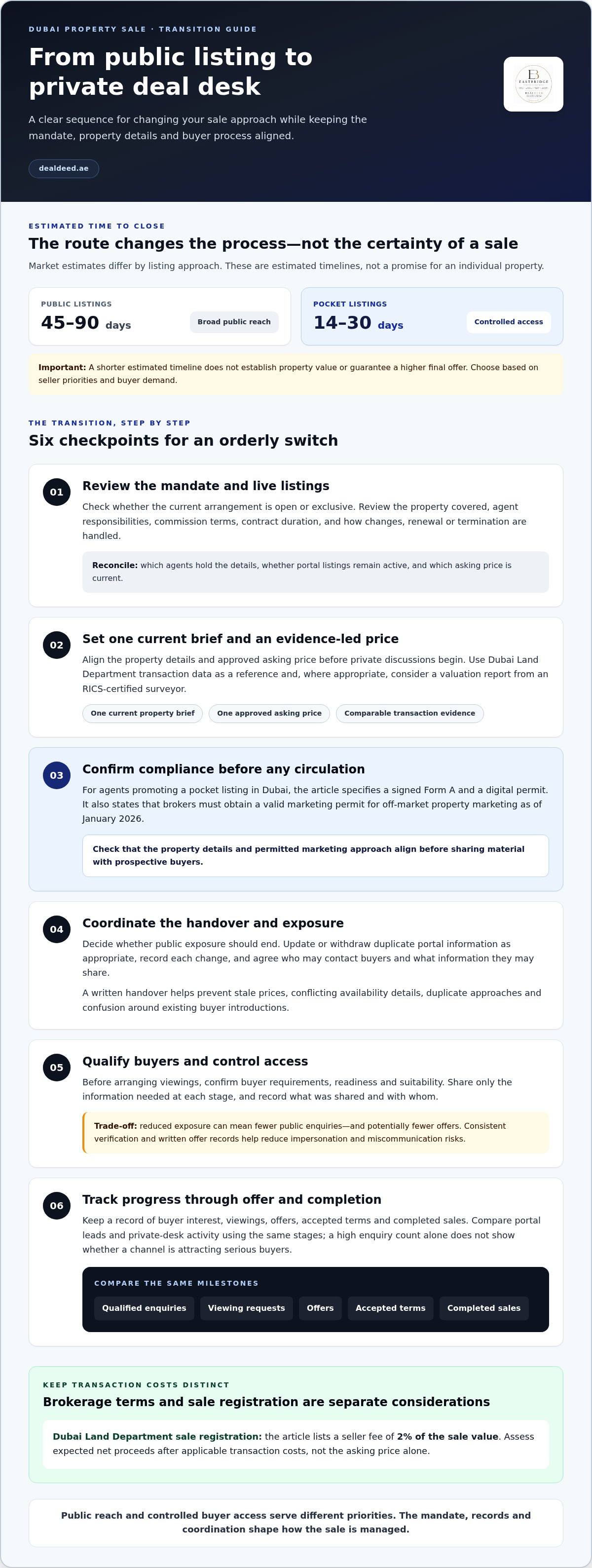
The listing with the widest reach isn’t automatically the one that sells better. For sellers switching from open portal listings to a private deal desk in Dubai, the choice is a trade-off between public exposure and a more controlled buyer approach. Market estimates put public listings at 45-90 days to close and pocket listings at 14-30 days.
An open listing can attract broad public attention, but that reach is not always the priority. A private deal desk in Dubai may suit sellers who value discretion, relevant buyer introductions, or control over viewings more than public visibility. The mandate and its terms shape how the approach works.
This guide compares the decisions that shape the sale process: listing type, mandate, public exposure, and how viewings, negotiation, and completion are handled. It explains what changes when a property moves off-market, which trade-offs to weigh, and how to keep the process orderly from buyer interest to completion.
Key Takeaways
- Choose between public reach and controlled buyer access based on your priorities, not visibility alone.
- Set the mandate’s scope and duration clearly so you understand the commitment before changing your listing approach.
- Review portal status and coordinate any listing changes to avoid stale or conflicting property information.
- Agree how buyer vetting, viewing access, negotiation and sale execution will be managed before sharing property details.
- Separate broker commission from sale-registration costs when assessing the net proceeds of a Dubai property sale.
1. Exclusive vs Open Listing Dubai: Which Sells Better?
Neither listing type sells every Dubai property better. Public exposure can bring a wider range of enquiries; a private deal desk prioritizes controlled access and direct matching. Market estimates put public property listings at 45-90 days to close, compared with 14-30 days for pocket listings. These are estimated timelines, not a promise for an individual sale.
A private sale still needs clear coordination. Keep one current property brief, one approved asking price, and a record of buyer interest, viewings, offers, and agreed changes. This helps prevent duplication and conflicting information when agents discuss the same property. With an open listing, commission is generally payable to the broker who completes the transaction, subject to the agreed terms.
Compliance comes before circulation. In Dubai, agents promoting a pocket listing must have a signed Form A and a digital permit. Brokers must obtain a valid marketing permit for off-market property marketing as of January 2026. Confirm that the property details and permitted marketing approach align before sharing material with prospective buyers.
Pricing should be evidence-led, not based on discretion alone. Compare the property with Dubai Land Department transaction data and, where appropriate, consider a valuation report from an RICS-certified surveyor. These references can help establish a defensible asking price before private discussions begin. An estimated sale timeline does not establish value or show that the final offer will be higher.
Compare private-desk activity with portal leads using the same stages: qualified enquiries, viewing requests, offers, accepted terms, and completed sales. Track each source consistently, then compare conversion and progress. A high enquiry count alone does not show whether a channel is attracting serious buyers.
To transition, review the current mandate and listing details, decide whether public exposure should end, and align the property brief and asking price. Confirm the required Form A and marketing permit before any permitted circulation. Update or withdraw duplicate portal information as appropriate, and record each change so outdated price or availability details do not resurface.
Qualify buyers by confirming their requirements, readiness, and suitability before arranging access. Share only the information needed at each stage, and record what was shared and with whom. Reduced exposure also has a trade-off: fewer public enquiries can mean fewer potential offers. Consistent verification and written offer records help reduce impersonation and miscommunication risks.
Private matching can suit distinctive or high-value homes where owners prioritize confidentiality. Off-market deals account for over 35% of luxury transactions in prime Dubai areas such as Palm Jebel Ali and Emirates Hills. That figure doesn’t establish the best route for every property; buyer demand, comparable sales, and the seller’s priorities still matter.
Budget for registration separately from brokerage arrangements. Dubai Land Department’s sale registration fees include a seller fee of 2% of the sale value. Compare the expected net proceeds after applicable transaction costs, not the asking price alone.
2. Exclusive listing mandate and duration
An exclusive mandate gives one appointed agent responsibility for the agreed sale activity during the contract period. An open arrangement may involve multiple agents, with commission generally payable to the broker who completes the transaction, subject to the agreement. The choice affects who manages buyer communication, records activity, and reports progress. Before switching from open portal listings to a private deal desk in Dubai, clarify these responsibilities.
In Dubai, the Contract A workflow ties the broker-created contract to the property’s title deed and includes commission and contract-duration details. Read those terms before changing channels. Confirm the property covered, the appointed agent’s responsibilities, the agreed commission arrangement, and how the contract period begins and ends. Clear wording helps owners understand what they have authorized and which agent can act on their behalf.
Choose a mandate period that reflects the work involved, rather than an arbitrary calendar target. A seller can set a review point after the property brief has circulated and buyer responses are available. At that review, assess qualified interest, viewing requests, pricing feedback, and agreed next steps with the agent. The contract should explain how changes, renewal, or termination are handled.
Use a written handover when moving from open listings to an exclusive arrangement. First reconcile the live inventory: identify which agents hold property details, whether portal listings remain active, and which asking price is current. Then record who may contact buyers and what information they may share. When switching from open portal listings to a private deal desk in Dubai, this record helps prevent conflicting approaches to the same buyer.
Consider commission alongside the agent’s scope and accountability. One appointed agent can make reporting and negotiation more coordinated, while an open arrangement can involve more agents. Either way, define how introductions are recorded and how existing buyer conversations are treated. Set this out before the mandate begins, especially if an agent has already introduced a prospect.
For a portfolio or a large volume of inventory, consider whether every property needs the same mandate. A seller might choose exclusive handling for one distinctive property and an open arrangement for other units. The practical test is whether the appointed agent can maintain accurate pricing, timely updates, and orderly buyer access across the assigned properties.
A private route works best when the mandate sets boundaries as clearly as it sets responsibility. A seller considering controlled circulation can use a private mandate structure to define access, reporting, and the agent’s role before buyer discussions begin. Review the signed terms against actual activity at each agreed checkpoint.
3. Outdated or inactive portal listings
A listing can remain visible after a seller changes strategy, accepts an offer, or revises the asking price. In Dubai, this can leave buyers seeing conflicting details for the same property, such as an old portal price alongside a newer agent brief. Before changing channels, compare every listing with the seller’s current instructions.
Start with a property-level inventory. Record each portal, listing reference, responsible agent, displayed price, availability status, and last update. Compare the entries with the title deed details and approved property brief. Mark each listing as active, under offer, withdrawn, or needing correction. A single working record is more reliable than separate agent messages.
Next, ask the agents managing the listings for documented status updates. If an apartment is no longer authorized for public marketing, record the instruction and when each listing is removed or amended. Keep the confirmations. Without a written record, it is harder to track where the property remains visible.
Advertising permits need the same attention. Build reminders into Dubai’s permit-expiry workflow, including alerts seven days and one day before expiry. Use them to review whether the listing remains authorized and accurate. Reminders are an operational safeguard, not a substitute for confirming permit status before further marketing.
Coordinate the transition in sequence. First, reconcile the listing inventory and agree which public entries need updating or withdrawal. Next, prepare one current property brief with a single approved price and availability status. Then share that version only through the agreed channels. This reduces the risk of buyers receiving outdated information.
Track buyer activity during the change. Record whether an enquiry came from an active portal listing, an earlier agent introduction, or a private approach. If the same buyer appears through two channels, the record helps clarify the original introduction and avoid duplicate follow-up. Keep contact details and property discussions within the authorized transaction process.
After the change, review the inventory at meaningful points, such as a price adjustment, offer, withdrawal, or permit expiry. Update the central record first, then share the approved change with the responsible agents. A private buyer brief is useful only when its availability and price reflect the seller’s current position. Accurate records support buyer confidence and give the owner a clear account of activity.
4. Viewings, negotiation, and sale execution
A private viewing should follow a clear sequence: confirm the buyer’s interest, agree access with the owner, and record feedback. Keep the approved property brief consistent throughout. If a buyer asks about service charges, condition, or availability, provide the same verified information through the agreed channel. This creates a traceable record while limiting unnecessary sharing of sensitive details.
Before a viewing, agree who will attend, which areas are accessible, and how the visit will be managed. A buyer interested in a Dubai apartment may need access to the unit and relevant building information, while the owner may prefer a named attendee and set time. Record attendance and follow-up points. A controlled process protects privacy without making access unnecessarily difficult.
Negotiation becomes clearer when each offer is written as a complete proposal. Record the proposed price, deposit arrangements, timing, included items, and any conditions. Then compare the offer against the seller’s priorities, not only the headline amount. Deal Desk shared visibility into deal attributes can help buyers and sellers see which terms attract interest and where adjustments may unlock demand.
Keep counteroffers equally precise. If a buyer changes the proposed completion timing, for example, record that alongside the price and other conditions. Confirm the seller’s response in writing before describing terms as agreed. A shared record reduces mismatched versions and preserves the negotiation history for the agents involved.
At the contract stage, Dubai Land Department’s Contract A workflow links the broker-created contract to the property’s title deed and includes commission and contract-duration details. Review those details against the signed mandate and negotiated terms. Before proceeding, ensure both parties’ identities are verified, as Dubai sale registration requires identity verification for both parties.
Administrative preparation matters. In freehold areas, Dubai sale registration requires an e-NOC from the developer. Coordinate that step with the transaction documents and keep a record of its status. Once the sale is ready for registration, Dubai Land Department’s process takes about 20 minutes. That registration step is distinct from the earlier work of agreeing terms and preparing the transaction.
After completion, close the communication loop. Update the property status, stop further viewing arrangements, and record the final terms and completion in the deal file. This gives the seller and participating agents a consistent account of the outcome, which is especially important when several agents have handled enquiries or negotiations.
5. What fees and commissions do Dubai brokers charge for private deal desk transactions?
A private sale does not automatically carry a different brokerage commission. A typical Dubai property-sale commission is 2% for both public and off-market sales. The amount and payment terms should appear in the written agreement, not be inferred from the listing method.
Keep broker commission separate from other transaction costs. Commission pays for brokerage work under the agreed terms; sale-registration charges, service-partner fees, and other applicable costs are separate. Listing each item individually helps the seller compare expected net proceeds without treating every deduction as one fee.
Before appointing an agent, read the commission clause alongside the mandate. Confirm what transaction triggers payment, how commission is calculated, and who pays it. Dubai Land Department’s Contract A workflow includes commission and contract-duration details. Align these terms with the signed agreement and intended sale process.
Open listings can involve several agents, while an exclusive mandate assigns responsibility to one appointed agent. With an open listing in Dubai, commission is generally payable to the broker who completes the transaction, subject to the agreed terms. In either arrangement, record buyer introductions and agent communications. This helps establish which agent handled a successful transaction if several were involved.
With a private deal desk, distinguish any introduction fee from sale commission and understand when it is payable. DealDeed charges a fixed introduction fee to each participating agent only when an introduced match completes. Buyers and sellers do not pay DealDeed directly, and the fee is not a percentage of agency commission.
Calculate commission using the agreed sale value and rate, then list separate costs, including registration expenses and agreed administrative charges. Compare offers on the same basis: do not weigh a public listing’s gross offer against a private offer’s net proceeds without accounting for the same items.
Rental commission is a different calculation. Dubai agents commonly charge tenants 5% of annual rent for office rentals. This example concerns office leasing, not a property sale, so it shouldn’t be used to estimate a seller’s sale commission.
For a private buyer introduction, review the written fee trigger and sale terms before proceeding. Discuss private buyer matching when you want qualified buyer introductions without public listings.
DealDeed: Private Buyer Brief Matching
DealDeed’s Private Buyer Brief Matching connects motivated Dubai property sellers with serious, vetted buyers through RERA-licensed agents. Property details are verified against Dubai Land Department data and shared confidentially after an NDA, without public listings or marketing. Consider this route when you want to explore relevant buyer interest without returning to public portal exposure.
DealDeed’s Quiet Disposals support a discreet sale approach, while its Agent-to-Agent Deal Desk helps coordinate the agents involved in a transaction. The Private Matching Desk connects buyer requirements with seller briefs. Each service addresses a different need: quiet disposal, buyer matching, or agent coordination.
To discuss a private route for your Dubai property, register or submit a brief at dealdeed.ae.
Set the terms for your next move
Switching from open portal listings to a private deal desk in Dubai is also a decision about how the next stage will be managed. Before changing course, define what should remain confidential, who can receive property details, and how buyer interest will be assessed. These instructions give the process a clear starting point.
DealDeed’s Private Buyer Brief Matching is designed for sellers seeking relevant buyer introductions. Quiet Disposals support discreet handling, while the Agent-to-Agent Deal Desk helps agents coordinate around a transaction. The right next step depends on whether your priority is buyer matching, confidential handling, or agent coordination.
Choose the outcome you want before you change the process. A focused brief can make that decision easier and keep the next conversation practical. Contact DealDeed to discuss your listing and consider a private route for your Dubai property.
Frequently Asked Questions
Exclusive vs Open Listing Dubai: Which Sells Better?
Neither approach is automatically better. The right fit depends on the property, intended audience, and seller’s preferred level of exposure. When switching from open portal listings to a private deal desk in Dubai, weigh controlled introductions against broader public discovery. A distinctive home may suit discreet circulation; a property needing wider reach may benefit from public exposure. Compare qualified buyer interest, viewing activity, and completed offers, not enquiry volume alone.
What is Deal Desk?
A deal desk coordinates introductions between a seller’s property brief and a buyer’s requirements. DealDeed’s matching process is agent-to-agent, and participating agents must hold valid RERA Office Registration Numbers (ORN) and Broker Registration Numbers (BRN). DealDeed acts as an introducer, not as a broker representing either party. Property details are disclosed privately after an NDA, and the licensed agents handle the transaction with their respective clients.
What are open portal listings and private deal desk listings in Dubai real estate?
Open portal listings make property information publicly available through real estate advertising platforms. A private deal desk uses selective introductions rather than public property displays. For example, an owner may share a brief through agents with a suitable buyer instead of publishing the details for general browsing. The distinction is broad public discovery versus controlled, confidential circulation.
How does a private deal desk model work for Dubai property sales and rentals?
For a sale, a seller-side agent submits a property brief, while a buyer-side agent provides the client’s requirements. The desk can identify a potential match and coordinate an introduction, with a RERA-licensed agent on each side. DealDeed’s service connects motivated property sellers with serious buyers; it does not provide rental matching.
What Dubai RERA and DLD rules apply to off-market property listings and advertising permits?
Agents promoting a pocket listing in Dubai must have a signed Form A and a digital permit. Brokers must obtain a valid marketing permit for off-market property marketing as of January 2026. Private circulation does not remove those requirements. Keep property details and marketing activity aligned, and confirm that participating agents are properly authorized.
How do Dubai brokers obtain seller consent and exclusive mandates for private listings?
Brokers document seller authorization through a signed Form A. Dubai Land Department’s Contract A workflow links the broker-created contract to the property’s title deed and includes commission and contract-duration details. Before private circulation, put the property, agent authority, permitted audience, and mandate period in writing. If the marketing approach changes, document the instruction and coordinate it with existing agent activity and buyer introductions.
What are the benefits and drawbacks of private deal desks versus public property portals in Dubai?
Portals can provide broad public reach; a private desk can focus introductions on relevant buyer requirements and limit public exposure. That is the central trade-off when switching from open portal listings to a private deal desk in Dubai. Selective circulation may reduce visibility among buyers outside the matching network, while a public listing can generate more general enquiries to manage. Choose according to the seller’s priorities, the property’s likely audience, and the desired level of confidentiality.


