

What if signing an NDA is only the first step, not the safeguard you thought it was? For owners selling commercial property under NDA in Dubai, a signed document alone doesn’t control who sees sensitive information, when it’s shared, or how a buyer is vetted.
It’s reasonable to want discretion. Staff, tenants, competitors, and counterparties may draw conclusions from premature disclosures. Yet buyers need evidence to assess a commercial asset, including relevant tenancy and lease details. The answer isn’t to reveal everything at once or to rely on an NDA as a substitute for a controlled process.
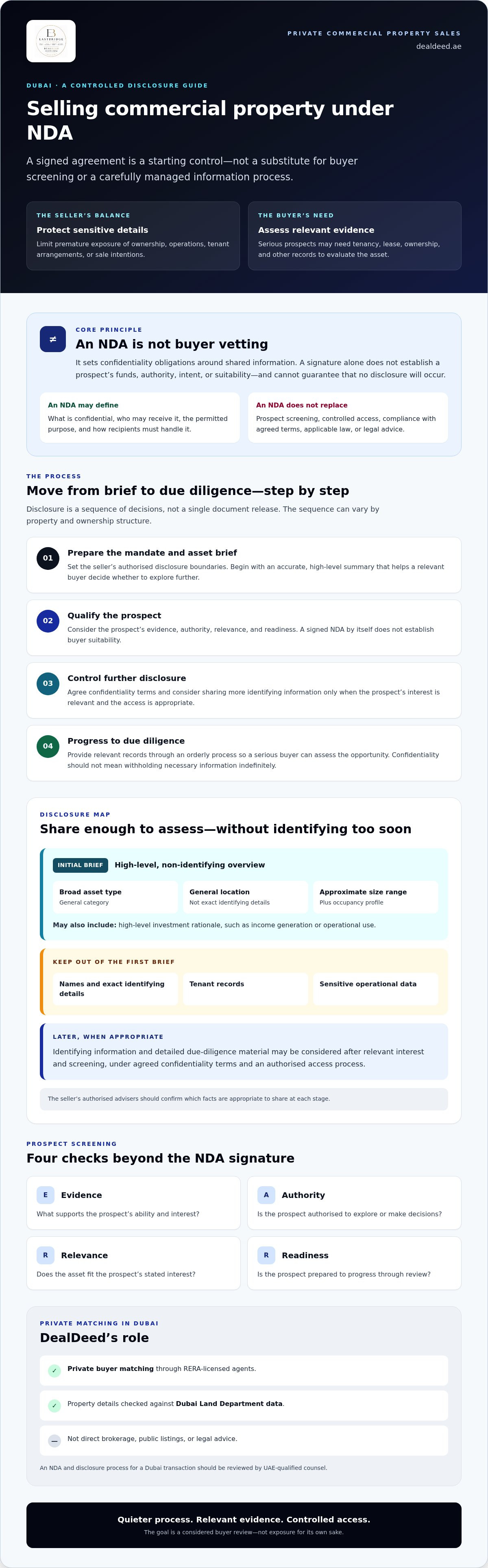
This guide explains how to structure disclosure in stages, qualify interested parties, and prepare information for serious buyer review. You’ll learn what an NDA can and can’t do, what to consider before sharing detailed records, and how a clear asset brief can support relevant introductions without public marketing. DealDeed’s private buyer matching connects sellers with vetted buyers through RERA-licensed agents, with property details checked against Dubai Land Department data. The aim is a quieter, evidence-led process, not exposure for its own sake.
Key Takeaways
- An NDA sets confidentiality obligations, but it doesn’t prevent every disclosure or replace careful control over information.
- For selling commercial property under NDA in Dubai, separate an anonymised asset summary from identifying records and detailed due-diligence documents.
- Assess a prospect’s evidence, authority, relevance, and readiness. A signed NDA alone doesn’t establish buyer suitability.
- Move methodically from mandate and asset brief to buyer qualification, controlled disclosure, and due diligence. The sequence can vary by property and ownership structure.
- DealDeed provides private buyer matching through RERA-licensed agents, not direct brokerage, public listings, or legal advice.
When does selling commercial property under NDA in Dubai make sense?
A non-disclosure agreement (NDA) is a confidentiality agreement. It sets obligations around information shared between parties, but it isn’t a guarantee that no one will disclose information or that every risk is removed. This Non-Disclosure Agreement (NDA) overview offers general background. An agreement for a Dubai transaction should be reviewed by UAE-qualified counsel.
Sellers may consider an NDA when early disclosure could expose ownership, business operations, tenant arrangements, or the fact that a sale is being considered. That concern can be especially relevant for income-producing, tenanted, operational, or strategically sensitive assets. The goal is to limit premature exposure while allowing a serious prospective buyer to assess the opportunity through an orderly process.
Illustrative scenario: A company considering the sale of a tenanted office building may first share a general asset summary with a prospective buyer. If the buyer’s interest is relevant and the prospect is screened, the seller can consider allowing access to more identifying information under agreed confidentiality terms. This illustrates staged disclosure, not a client outcome or a prescribed process.
Which commercial property sale situations may benefit from an NDA?
An NDA may be worth considering when revealing an asset’s identity or sale intentions could create avoidable concern among tenants, employees, business partners, or competitors. It isn’t necessary for every Dubai commercial property sale. The decision depends on the asset, the seller’s exposure concerns, the likely buyer pool, and professional advice.
Confidentiality goals don’t replace buyer due diligence. A buyer may need to review tenancy income, lease terms, ownership records, or other documents before deciding whether to proceed. The seller’s task is to manage access appropriately, not to withhold relevant information indefinitely. A private process and a public listing are different routes to exposure, but neither automatically determines whether an enquiry comes from a suitable buyer.
What an NDA can, and cannot, do
Depending on its wording, an NDA can define what information is confidential, who may receive it, the permitted purpose for using it, and how recipients must handle it. Its practical protection depends on clear terms, the parties covered, compliance with those terms, and applicable law. A signature alone doesn’t verify a buyer’s funds, authority, intent, or suitability.
For a broader view of discreet sale planning, see this guide to Dubai private property disposal guidance. An NDA is one control within a wider process, not a substitute for screening prospects or taking legal advice.
How to structure NDA-based disclosure without revealing everything at once
A controlled process separates what a prospect needs to assess the opportunity from details that could identify the asset or expose sensitive operations. For selling commercial property under NDA in Dubai, treat disclosure as a sequence of decisions, not a single document release. Ask UAE-qualified counsel to review the NDA and proposed disclosure process before sharing sensitive material.
What information belongs in an initial commercial property brief?
Start with a high-level summary that helps a relevant buyer judge whether to explore further, without identifying the property or its stakeholders. Depending on what the seller has authorised, it may describe:
- Broad asset type and general location
- Approximate size range and occupancy profile
- High-level investment rationale, such as income generation or operational use
Keep names, exact identifying details, tenant records, and sensitive operational data out of this first brief. The seller’s authorised advisers should confirm which facts are appropriate to share at each stage. A summary should be accurate, but it needn’t disclose the asset’s identity prematurely.
What should an NDA address before sensitive documents are shared?
An NDA can set rules for the purpose and handling of information. Cornell Law School describes an NDA as a legally binding confidentiality agreement, but the wording and effect depend on the agreement’s terms and applicable law. Ask UAE-qualified counsel to assess the proposed terms, including permitted recipients, use restrictions, duration, and return or deletion provisions.
Consider whether a buyer may share material with professional advisers and what conditions should apply to those recipients. Don’t assume that one signature automatically covers every person who may review the documents. Counsel can advise how the agreement should address onward disclosure and the parties’ responsibilities.
Use a staged sequence:
- Define sensitive information. Identify what could reveal ownership, tenants, operations, or the sale intention.
- Identify recipients. Confirm who is being considered and who may need access to assess the opportunity.
- Agree terms. Have counsel review the NDA and proposed disclosure controls.
- Release approved materials. Share only information authorised for that stage, then reassess before expanding access.
Keep a disclosure log showing who received each document, when they received it, and the agreed purpose. This creates a practical record of access. For context on verification and discreet transactions, see this DLD-verified private deal guidance. Sellers seeking controlled exposure can also explore private buyer brief matching, which is separate from legal advice or NDA drafting.
Screening Buyers and Access to Dubai Commercial Assets
A signed NDA is a confidentiality step, not proof of buyer quality. Before expanding access, assess the prospect against four points: evidence, authority, relevance, and readiness. An unqualified enquiry may offer little beyond general interest. A more credible prospect can explain how the asset fits its acquisition criteria, identify who can make or approve the decision, and provide appropriate evidence of capacity through suitable channels.
These indicators help guide the next step, but they don’t guarantee a completed deal. A buyer may sign an NDA without having the funds, authority, intent, or suitability to proceed. For transaction-specific questions about drafting, obligations, or remedies, consult UAE-qualified counsel and review the legal framework for NDAs in the UAE.
What should a seller assess before granting further access?
Ask the prospect to clarify its identity, decision-making authority, acquisition criteria, and stated capacity. The seller or authorised representatives can determine what evidence is appropriate and how it should be reviewed. Don’t treat a document request or NDA signature as a substitute for this assessment.
Set access stages in advance. For example, route questions through an authorised representative, release selected documents after assessing the prospect, and arrange meetings or site visits only when appropriate. The seller’s UAE-qualified advisers can recommend which checks and records suit the specific transaction.
How does property verification support a more credible match?
Accurate asset information helps representatives compare a buyer’s requirements with the property on offer. This can reduce mismatches and unnecessary circulation of details that aren’t relevant to a prospect. DealDeed checks property details against Dubai Land Department data as part of its private matching desk. That check should not be treated as a legal title opinion or a substitute for transaction due diligence.
In a private process, matching and transaction discussions are handled confidentially between RERA-licensed agents. Sellers should still agree who is authorised to communicate information and how access will progress. Learn more about private buyer brief matching in Dubai.
- Evidence: Is there appropriate support for the buyer’s stated capacity?
- Authority: Can the contact make or obtain the required decision?
- Relevance: Does the asset fit the prospect’s stated criteria?
- Readiness: Can the prospect explain a credible next step?
For selling commercial property under NDA in Dubai, the aim isn’t to collect more information than necessary. It’s to grant the right access, through the right representatives, at a pace supported by the seller’s advisers.
What steps take an NDA-based sale from mandate to due diligence?
A private sale needs a defined sequence, clear authority, and a controlled handover between introduction and transaction work. For selling commercial property under NDA in Dubai, the process can move through five stages:
- Clarify the mandate. Confirm who is authorised to act, the seller’s objectives, and the boundaries for disclosure.
- Prepare an asset brief. Assemble accurate, approved facts that describe the opportunity without sharing unnecessary identifying information.
- Qualify interest. Consider whether a prospect’s requirements and stated readiness align with the asset before expanding access.
- Control disclosure. Use the agreed confidentiality terms and release only materials approved for that stage.
- Coordinate due diligence. Route requests and clarifications through authorised representatives and advisers.
This is a working framework, not a fixed timetable. Timing and document requirements can vary with the asset type, ownership structure, buyer’s requests, and professional advice. Introductions and matching are distinct from price negotiations, brokerage, legal work, and transaction execution. Sellers should confirm who is responsible for each function before proceeding.
What should sellers prepare before sharing a commercial mandate?
Gather verified property facts, sale objectives, confirmation of authority to act, and preferred disclosure boundaries. Then identify which details need review before circulation, such as tenancy information, ownership documents, or operational records. The right materials depend on the asset and proposed transaction, so ask relevant advisers to confirm what should be prepared and when it can be shared.
A clear brief helps keep introductions relevant. DealDeed’s private matching desk connects sellers with serious, vetted buyers through RERA-licensed agents, and property details are checked against Dubai Land Department data. The desk facilitates introductions and matching, not legal advice or direct brokerage.
How should due diligence proceed after a buyer is engaged?
Once a prospect advances, use agreed communication channels and authorised advisers to manage document requests, questions, and any access. Keep a record of what has been released and to whom. Information should remain limited to the agreed purpose, and review new requests before sharing additional material.
Dubai-specific procedures and transaction requirements can depend on the facts of the deal. Have qualified professionals verify the steps that apply to the asset and parties rather than relying on a generic checklist. For a closer look at private introductions, review the private deal desk approach. To explore a relevant private matching or disposal mandate, contact DealDeed about your brief.
How DealDeed supports a confidential commercial property sale in Dubai
DealDeed operates a private matching desk for Dubai real estate. It connects sellers with relevant, vetted buyers through RERA-licensed agents. It isn’t a direct broker, public property portal, or legal adviser. Property details are checked against Dubai Land Department data, and matching and transaction discussions are handled confidentially between the agents involved. This supports controlled, non-public exposure, but it doesn’t guarantee confidentiality, a buyer, or a completed sale.
Sellers, agents, and investors can submit briefs or mandates for private matching. A clear commercial property brief helps indicate the asset type, key characteristics, and seller’s requirements without publicly listing or marketing the property. The match depends on the information provided and the fit between the opportunity and prospective buyers. For owners selling commercial property under NDA in Dubai, the matching desk is distinct from NDA drafting, legal advice, negotiations, and transaction execution.
What happens when a seller submits a quiet disposal mandate?
The mandate is the starting point for understanding the asset and the seller’s objectives. The seller should confirm who has authority to submit it and specify which information may be shared. DealDeed can use the brief to support private buyer matching through participating agents. Any further disclosure should follow the seller’s agreed boundaries and the parties’ process.
A submitted mandate isn’t a promise of a buyer, a transaction, a particular confidentiality outcome, or a completion date. It gives the parties a basis for assessing whether a relevant introduction may be possible. DealDeed charges participating agents a fixed introduction fee only if a matched deal completes. Users have no upfront registration or subscription costs.
What should a seller confirm before beginning?
Before submitting a commercial brief, confirm authority to act and decide what information can be shared at each stage. Ask UAE-qualified counsel to review NDA wording and advise on legal questions. DealDeed doesn’t draft NDAs or provide legal advice, so legal review remains with the seller’s chosen adviser.
If a private matching route fits your objectives, submit a private commercial property brief to DealDeed. Provide only information you’re authorised to share, and set out your disclosure preferences clearly. A disciplined brief gives the matching process a relevant starting point without placing the asset in a public listing environment.
Move forward with a controlled, evidence-led sale
Selling commercial property under NDA in Dubai works best when the agreement is part of a wider process. Define what must stay confidential, release information in stages, and assess buyer relevance and readiness before granting deeper access. An NDA sets obligations, but it doesn’t replace careful screening, clear disclosure controls, or advice from UAE-qualified counsel.
DealDeed offers a private matching desk, not direct brokerage or legal advice. Property details are checked against Dubai Land Department data, and private matching is handled between RERA-licensed agents. Participating agents pay a fixed introduction fee only if a matched deal completes.
If a quiet, non-public route fits your objectives, submit a private commercial property brief to DealDeed. Set out the asset’s key facts, your requirements, and what may be shared. A clear starting brief can help focus the process on relevant introductions. Proceed with care, and keep each disclosure deliberate.
Frequently Asked Questions
Can I sell commercial property in Dubai under an NDA?
Yes, you can use an NDA as part of a private sale process, subject to applicable UAE law and the agreement’s terms. For selling commercial property under NDA in Dubai, have UAE-qualified counsel review the document, including what information it covers, who may receive it, and how long obligations apply. An NDA supports controlled disclosure. It doesn’t replace buyer screening, due diligence, or the steps required to complete a property transfer.
Does an NDA guarantee that my Dubai property sale stays confidential?
No. An NDA creates confidentiality obligations for the parties it covers, but it can’t guarantee that information will never be disclosed or eliminate every risk. Protection depends on clear wording, who signs, compliance with the agreement, and applicable law. Limit access to relevant people, share information in stages, and keep a record of disclosures. Ask UAE-qualified counsel to advise on enforceability, drafting, and potential remedies for your circumstances.
What information should I share before a buyer signs an NDA?
Usually, begin with a high-level, anonymised summary rather than identifying records. If authorised, you might share the broad asset type, general location, approximate size range, occupancy profile, and investment rationale. Avoid names, exact identifying details, tenant records, and sensitive operational information at this stage. Decide with your advisers which facts can be shared and when. The summary should be accurate enough to assess relevance without exposing unnecessary details.
How do I verify a buyer for a confidential commercial property sale?
Assess more than the NDA signature. Confirm the prospective buyer’s identity, decision-making authority, acquisition criteria, and stated capacity through appropriate channels. Consider whether the asset fits their requirements and whether they can explain a credible next step. Ask UAE-qualified advisers which checks and records suit the transaction. Then grant access in stages, using authorised representatives to manage questions, documents, meetings, or a site visit.
Can I sell a Dubai commercial property without listing it publicly?
Yes. A seller may pursue an off-market route without publicly listing or marketing the property. This can limit public exposure, but it doesn’t automatically establish buyer quality or guarantee confidentiality. Private matching and carefully controlled disclosure can help direct information to relevant prospects. The sale still needs appropriate due diligence and the applicable Dubai transaction and transfer procedures. Confirm those requirements with qualified professionals familiar with the specific asset and parties.
What does DealDeed do in an NDA-based commercial property sale?
DealDeed operates a private matching desk, connecting sellers with relevant, vetted buyers through RERA-licensed agents. It doesn’t provide direct brokerage, public listings, NDA drafting, or legal advice. Property details are checked against Dubai Land Department data, and matching is handled between participating agents. DealDeed charges participating agents a fixed introduction fee only when a matched deal completes. Sellers, agents, and investors can submit briefs or mandates for private matching.
When should I involve a UAE lawyer in a private property sale?
Involve UAE-qualified counsel before sharing sensitive records or relying on an NDA, so the lawyer can review the wording and advise on permitted use, recipients, duration, and other relevant terms. Seek advice again as buyer requests, transaction documents, or ownership issues arise. Legal and transfer requirements can depend on the asset and parties. Counsel can help identify the appropriate process; a matching desk is not a substitute for legal advice.


