

What if the risk in a hotel sale isn’t only who sees the listing, but what they learn before they’re qualified? If you’re considering how to sell a hotel confidentially in Dubai, public exposure may unsettle employees, guests, suppliers or lenders. Unscreened enquiries can also consume time while sensitive details travel further than intended.
Wanting privacy is reasonable, but staying off public portals isn’t a complete process. Confidentiality depends on controlling disclosure, checking buyer suitability and defining what’s for sale: the property, the hotel operation or both. This guide explains how to set those controls and prepare a credible sale brief without sharing more than necessary at the outset.
You’ll learn how staged disclosure and an NDA can structure conversations, what information to verify before approaching buyers, and which legal, tax, licensing and real-estate questions to raise with qualified UAE advisers. You’ll also see when private agent-to-agent matching may fit a transaction that includes eligible Dubai real estate. DealDeed’s matching desk is an introducer, not a hotel broker or transaction adviser, so confirm that the mandate and asset structure fit before sharing sensitive details.
Key Takeaways
- For how to sell a hotel confidentially in Dubai, first define exactly what the deal includes: property, operations, shares or a combination.
- Prepare a concise sale brief that separates verified information from estimates and flags details that still need confirmation.
- Set disclosure stages and decide who can approve each release before buyer discussions begin.
- Compare public brokerage marketing, restricted private outreach and agent-to-agent matching against your exposure preferences and transaction scope.
- If the sale includes Dubai real estate, confirm whether the asset structure fits DealDeed’s private matching desk. Its DLD checks apply to property particulars, not all hotel-business information.
How to sell a hotel confidentially in Dubai without going public
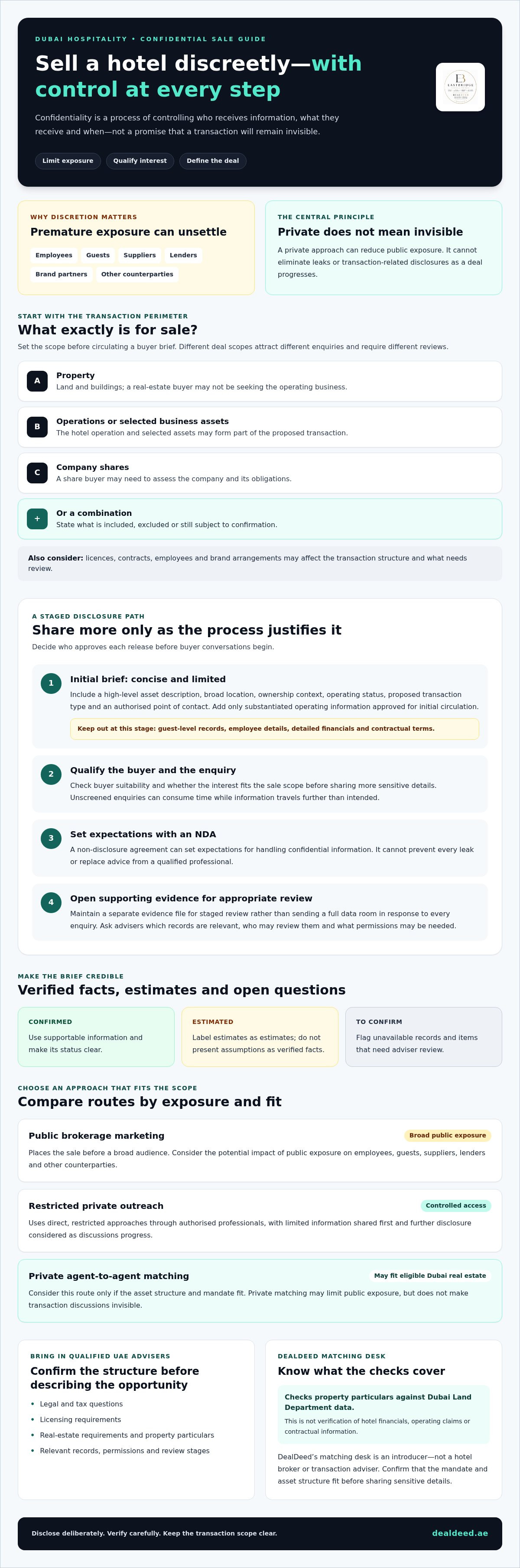
A confidential sale is not a sale without disclosure. It is a process that limits who receives information, what they receive and when. That distinction matters in Dubai’s hospitality market, where premature rumours could unsettle employees, guests, suppliers, lenders, brand partners or other counterparties. A private approach can reduce public exposure, but it can’t make transaction discussions invisible.
A private sale controls access to information; it does not make a transaction invisible. The aim is disciplined access, not an impossible promise that nobody will learn a sale is being considered. Before approaching anyone, decide who can approve disclosures and what should happen if interest becomes serious.
What does a confidential hotel sale involve?
Public advertising puts a sale in view of a broad audience. A private process uses direct, restricted approaches through authorised professionals. It shares limited information first, then considers more detailed disclosure as discussions progress. A non-disclosure agreement (NDA) can set expectations for handling confidential information, but it can’t prevent every leak or replace advice from a qualified professional.
Confidentiality also depends on careful information handling, clear authority to share and sensible conduct by everyone involved. Private matching may limit public exposure, but it doesn’t remove transaction-related disclosures that may arise as a deal advances.
What exactly is being sold: hotel property or hotel business?
Define the asset before circulating a buyer brief. The proposed transaction might cover land and buildings, the operating company’s shares, selected business assets and operations, or a combination. These are different scopes. A buyer interested in the real estate may not be seeking the operating business, while a buyer pursuing shares may need to assess the company and its obligations.
Licences, contracts, employees and brand arrangements may also affect the transaction structure and the information that needs review. Ask qualified legal, tax, licensing and real-estate advisers to confirm the asset perimeter and relevant Dubai requirements before describing the opportunity. Be precise about what is included, excluded or still subject to confirmation. This helps prevent mismatched enquiries and unnecessary disclosure.
Prepare a Dubai hotel sale brief before approaching private buyers
A concise, supportable brief helps a serious buyer understand the opportunity without receiving sensitive records too early. It should match the transaction scope established with your advisers and distinguish confirmed details from assumptions. For owners considering how to sell a hotel confidentially in Dubai, accuracy matters as much as discretion: unsupported claims can create confusion, while excess detail can expose the business before interest is qualified.
Which information belongs in an initial hotel-sale brief?
Keep the first document factual and limited. Include a high-level asset description, broad location, ownership context, operating status, proposed transaction type and an authorised point of contact. Add only operating information that is substantiated and approved for initial circulation. Leave out guest-level records, employee details, detailed financials and contractual terms at this stage.
Make the status of each material point clear. Identify estimates as estimates, note when a record is unavailable and flag items that need adviser review. Don’t present an assumption as a verified fact. A short brief can still be useful if it clearly states what remains to be confirmed.
How should a seller organise supporting evidence?
Build a separate evidence file for staged review instead of sending a full data room in response to every enquiry. Ask local legal, financial and hospitality advisers which records are relevant, who may review them and what permissions may be needed before disclosure. Keep sensitive documents restricted until the recipient and review stage are appropriate.
Where the sale includes Dubai real estate, check ownership and property particulars against appropriate official records, with advisers confirming the relevant process. DealDeed checks property details against Dubai Land Department data. That check is not verification of hotel financials, operating claims or contractual information. For background on property validation, see this guide to Dubai Land Department verified deals.
Use a simple disclosure log to track what is shared, with whom, when and under whose approval. This gives the seller and advisers a clear record and helps prevent outdated or unauthorised information from circulating.
- Initial brief: Approved summary and contact route.
- Further review: Supporting records released selectively, subject to adviser guidance.
- Ongoing control: Update the disclosure log whenever information is shared.
If the mandate includes eligible Dubai real estate, review whether DealDeed’s private matching desk may fit the property component. Confirm eligibility and asset structure before sharing sensitive material.
Control hotel-sale disclosure and qualify buyers before sharing details
A controlled process gives each recipient only the information needed for the next decision. An enquiry, introduction or signed NDA doesn’t by itself establish a buyer’s identity, authority or financial capacity. A smaller audience can still be useful when outreach is targeted and evidence-led. The aim is to focus on credible interest, not maximum circulation.
How can sellers reduce unnecessary exposure?
Agree on the disclosure sequence with your advisers before outreach begins. A practical structure is:
- Initial brief: Share a non-identifying summary, such as the broad location, asset type and proposed transaction scope. Leave out details that could identify the property or expose sensitive operations.
- Qualified interest: Have an authorised professional assess who is enquiring, whom they represent and why they are interested.
- Approved disclosure: Release only the information needed for the next stage, after recipient checks and seller approval.
- Professional review: Arrange appropriate review of more sensitive records through channels agreed with advisers.
- Transaction discussions: Continue disclosure according to the parties’ process and professional guidance.
Set clear permissions. Decide who can approve disclosure, which adviser or representative may communicate and what each recipient may receive. Agree with your advisers on communication channels and restrictions on onward sharing. An NDA may document confidentiality expectations, but it can’t guarantee that information will never be disclosed. A matching platform or buyer introduction doesn’t change that limit.
How do you distinguish serious hotel buyers from casual enquiries?
Ask authorised transaction professionals to assess the enquirer’s identity, mandate, acquisition purpose and capacity. Where appropriate, they can request supporting evidence through secure, professionally managed channels. Keep the assessment proportionate to the proposed deal and follow qualified local advice on suitable checks and documents.
Don’t treat an expression of interest, a signed NDA or an introduction as proof of funds or authority to proceed. These are steps in a process, not completed qualification. Record what has been checked, what remains outstanding and who approved each disclosure.
For owners considering how to sell a hotel confidentially in Dubai, a practical test is whether each release of information is justified by verified progress. Discreet matching through RERA-licensed agents may be relevant where a mandate includes eligible Dubai real estate, but confirm the asset’s fit and the scope of any checks before sharing sensitive details.
Choose the right Dubai sale route and advisers for your hotel
The right route depends on what’s being sold, how much exposure the owner accepts, the desired timing and advice from qualified professionals. Public brokerage marketing can reach a wider audience, but puts the opportunity in public view. Restricted private outreach narrows circulation to selected prospects. Agent-to-agent matching can provide a discreet introduction route, but suitability depends on the property and mandate.
Each approach balances reach and control differently. None removes the need to assess buyer interest or the transaction itself. When deciding how to sell a hotel confidentially in Dubai, choose a route based on the asset scope, not just the appeal of a particular channel.
- Public brokerage marketing: May suit a seller prioritising broad market exposure, with less control over who encounters the opportunity.
- Restricted private outreach: Limits circulation to selected contacts, but depends on clear authority and disciplined information handling.
- Agent-to-agent matching: Can introduce an opportunity through participating agents without public listings, where the asset and mandate are eligible.
When might private buyer matching suit a hotel seller?
Consider private matching when controlled outreach matters and the hotel transaction includes eligible Dubai real estate. DealDeed’s private matching desk connects sellers and buyers through RERA-licensed agents; it is an introducer, not the hotel broker or transaction adviser. Confirm that the hotel asset structure and mandate fit before submitting sensitive material. Discuss market reach and sale strategy with qualified advisers rather than assuming a private route suits every hotel.
A matching introduction has defined limits. It isn’t a valuation, negotiation, brokerage, due diligence or legal execution service. Those functions require appropriate professionals. An introduction also doesn’t guarantee that a buyer will proceed or that a transaction will complete. For broader context on a quiet property disposal, see this guide to selling Dubai property quietly.
Which professionals should the seller involve?
Bring in appropriately qualified Dubai real-estate and legal advisers to assess property ownership, transaction structure and applicable requirements. Ask tax and finance specialists to review matters within their expertise, and hospitality advisers to assess operating considerations. Verify current licensing, ownership, transfer and operational requirements with relevant professionals. Their guidance can help determine which route fits the seller’s objectives and the hotel’s asset perimeter.
If your mandate includes Dubai real estate, check whether your hotel property fits private buyer matching before sharing sensitive details.
Use DealDeed's private matching desk as a discreet next step
If the hotel transaction includes eligible Dubai real estate, DealDeed’s private matching desk may be one route to consider. It connects sellers and buyers through RERA-licensed agents without public listings. Property particulars are checked against Dubai Land Department data. That check does not verify hotel financials, operating performance, contracts or other business information.
Understand the service and its limits. DealDeed is an introducer, not a direct brokerage, hotel adviser, public portal or transaction-completion service. It doesn’t provide valuation, legal advice, due diligence or negotiation services. Those matters remain with the seller and their appointed professionals. Participating agents pay a fixed introduction fee only when a matched transaction completes. Users have no upfront registration or subscription costs.
What happens when a seller submits a private mandate?
Start by sharing a brief and confirming whether the property and transaction structure are eligible. If they fit, the mandate’s suitability for matching can be considered before any introductions. Confirm what information is needed and how it will be handled before sending sensitive documents. Begin with an approved summary, not unrestricted access to business records.
A matching process is not a promise of buyer interest, a sale timeline or a particular price. Nor does it guarantee confidentiality or completion. Keep your disclosure controls in place, and ask your advisers to guide any further information sharing and transaction steps.
What should the seller confirm before proceeding?
Before submitting a mandate, clarify whether the hotel’s ownership and proposed transaction structure fall within the desk’s scope. Establish the role of participating agents, what information may be shared and with whom, and the applicable fee arrangements. If the hotel business is being sold alongside the property, confirm which parts of the opportunity the matching route can address. Ask qualified local professionals about matters outside the introduction process.
For owners exploring how to sell a hotel confidentially in Dubai, confirming fit first can prevent unnecessary disclosure and mismatched expectations. If your mandate includes Dubai property, you can discuss a discreet property mandate before sharing confidential documents. Use the first conversation to establish scope and information requirements, rather than assuming every hotel asset is eligible.
Take the next step with a clear mandate
A disciplined hotel sale starts with a defined asset scope, a credible brief and a disclosure process that releases information only as discussions justify it. Confidentiality means controlling access, not assuming a transaction will remain unseen. Qualified Dubai advisers can help clarify property, operating and transaction questions before you approach buyers.
If the mandate includes Dubai real estate, DealDeed may be a private matching route to consider, subject to confirming eligibility. It connects sellers and buyers through RERA-licensed agents, and property particulars are checked against Dubai Land Department data. That check doesn’t extend to all hotel-business information. Participating agents pay a fixed introduction fee only upon successful completion; users have no upfront registration or subscription costs.
Understanding how to sell a hotel confidentially in Dubai means choosing a route that fits the asset and managing each disclosure deliberately. To explore whether your property mandate may fit, discuss a private matching process before sharing confidential documents. Confirm the scope with the right professionals, then take the next step with greater control.
Frequently Asked Questions
Can I sell a hotel in Dubai without listing it publicly?
Yes, a hotel sale can be explored through restricted private outreach rather than a public listing. Start with a non-identifying brief and let authorised professionals share further details selectively as buyer interest is assessed. This limits public exposure, but can’t ensure that nobody learns of the discussions. Agree with your advisers who may communicate and what can be disclosed before approaching prospects.
How do I sell a hotel confidentially in Dubai?
To sell a hotel confidentially in Dubai, define the transaction scope, prepare a factual brief and set rules for staged disclosure. Have authorised professionals assess buyer identity, mandate and capacity before releasing sensitive records. Decide who can approve each disclosure and how information may be shared. Confidentiality is a managed process, not a guarantee, so seek qualified Dubai legal, tax, licensing and real-estate advice.
Is it possible to sell a hotel without employees or guests finding out?
You can take steps to reduce the chance of premature disclosure, but you can’t guarantee that employees or guests won’t learn of sale discussions. Use a non-identifying initial brief, restrict access to sensitive records and limit communications to authorised contacts. Operational or transaction-related disclosures may become necessary as a deal progresses. Ask qualified advisers when and how relevant parties should be informed, taking account of the hotel’s circumstances and transaction structure.
What information should I prepare before approaching hotel buyers?
Prepare a concise overview of the hotel, broad location, ownership, operating status and proposed transaction scope. Clarify whether the opportunity concerns real estate, company shares, business assets or a combination. Separate verified facts from estimates and flag details that need adviser review. Keep detailed financial, guest, employee and contractual records restricted at the initial stage. Ask local legal, financial and hospitality advisers which supporting documents are relevant and suitable to share.
Do I need an NDA to sell a hotel privately in Dubai?
An NDA is commonly considered before sharing sensitive business or financial information with a prospective buyer. It can set expectations for how confidential information may be used or shared, but it can’t prevent every leak or guarantee confidentiality. Ask a qualified legal adviser to prepare or review the agreement and advise when to use it. An NDA also doesn’t replace buyer checks or careful control over which records are disclosed.
Can DealDeed sell my hotel directly?
No. DealDeed isn’t a direct hotel broker or transaction-completion service. Its private matching desk connects sellers and buyers through RERA-licensed agents for Dubai real estate, so confirm whether the hotel property and mandate are eligible before sharing sensitive information. Property particulars are checked against Dubai Land Department data, not all hotel-business information. Participating agents pay a fixed introduction fee only upon successful completion; users have no upfront registration or subscription costs.
How can I verify a buyer for a confidential hotel sale?
Ask authorised transaction professionals to assess the prospective buyer’s identity, authority to act, acquisition purpose and capacity. They can advise what supporting evidence is appropriate and how to request it through secure, professionally managed channels. Don’t treat an introduction, expression of interest or signed NDA as proof of funding. Record what has been checked and what remains outstanding, then rely on qualified advisers for next steps.
What is the difference between selling hotel property and selling a hotel business?
Selling hotel property concerns ownership of land and buildings. Selling a hotel business may involve company shares, operating assets or business operations, with or without the real estate. A combined transaction may cover both. The scope matters because licences, contracts, employees and brand arrangements may affect the structure and review process. Ask qualified Dubai legal, tax, licensing and real-estate advisers to confirm exactly what is included before circulating a sale brief.


