

Can a UAE property deal stay private without becoming difficult to verify? For sellers, a public listing can expose ownership details or signal plans before the right buyer is found. That concern is understandable. But private real estate transactions uae aren’t about removing checks. They’re about controlling who sees sensitive information and when.
Discretion has limits. A confidential introduction can reduce public exposure, but it doesn’t replace due diligence, regulatory requirements or the formal transfer process. Serious buyers still need evidence, and transaction details must be handled through appropriate channels.
This guide explains what “private” means in practice, how off-market opportunities are sourced and matched, and which information can be shared selectively. You’ll also learn how to distinguish a verified opportunity from an unsupported claim, and how an agent-mediated matching desk can connect motivated sellers with vetted buyers. DealDeed checks property details against Dubai Land Department data and facilitates confidential introductions through RERA-licensed agents. The goal is a controlled process, not an opaque one.
Key Takeaways
- Understand how private real estate transactions uae limit public exposure without turning a property deal into an informal or unverified arrangement.
- Follow a clear path from defining a buyer brief or disposal mandate to selective sharing, relevance screening and formal transaction steps.
- Compare public listings, private introductions and a hybrid approach to choose the right balance of reach, discretion and credibility-building.
- Use a practical checklist to prepare accurate property information, set disclosure boundaries and account for differences between emirates.
- See how DealDeed’s agent-mediated matching connects relevant briefs and mandates, with property details checked against Dubai Land Department data.
What private real estate transactions in the UAE actually mean
A private property transaction limits public exposure while keeping the deal structured. Instead of broadcasting an opportunity through a public listing, the parties share information selectively with relevant recipients. The process remains evidence-led: a quiet introduction doesn’t replace checking property details, documenting agreements or completing the formal transfer through the appropriate channels.
Privacy means controlled sharing, not absolute secrecy. A seller may choose not to publish an address or sale plans broadly, while still sharing enough information for a suitable buyer to assess the opportunity. As interest develops, further details can be disclosed to the relevant parties. This can reduce unnecessary exposure, but it can’t guarantee that every detail stays undisclosed or remove applicable due diligence and transaction requirements.
How a private property deal differs from a public listing
A public listing aims for broad visibility. A private introduction circulates an opportunity selectively, guided by a defined property brief or seller mandate. This can reduce irrelevant enquiries, but it doesn’t guarantee a faster sale. The result depends on whether the opportunity fits a buyer’s needs. For market context, Real estate in Dubai includes an overview of the emirate’s market and relevant institutions. Whichever route the parties take, claims and property details still need appropriate verification before they proceed.
Who uses private transactions and why
Private routes can suit owners who want to limit public attention, buyers seeking a specific area or asset type, and investors working to a defined acquisition brief. Licensed agents can use a mandate or buyer brief to coordinate a relevant introduction without circulating details indiscriminately. This approach isn’t limited to luxury homes or institutional capital. Its defining features are a clear match and controlled disclosure, not a particular property value or buyer profile.
People searching for “private real estate transactions uae” are often weighing discretion against confidence in the opportunity. A credible private process addresses both: it controls who receives information while preserving a route to verification and formal completion. Quiet should mean selective, not vague.
How a discreet UAE property transaction moves from brief to match
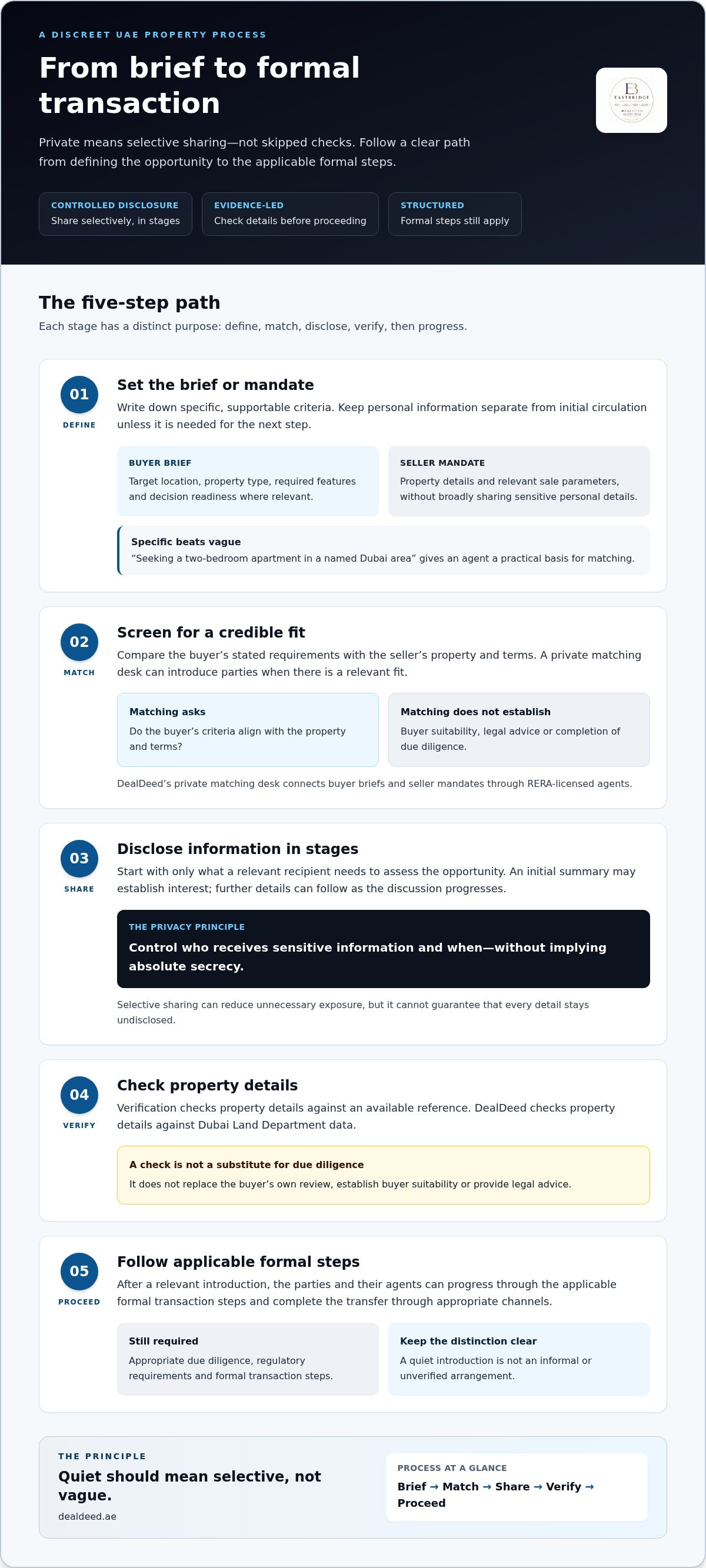
A private deal works best when each step has a clear purpose. Define the mandate, screen for relevance, share only what the recipient needs, verify property details, then progress through the applicable formal transaction steps. This creates control without confusing a private introduction with legal advice or conveyancing.
A buyer brief is a concise record of acquisition criteria, decision readiness and the property features that matter. It gives agents a practical basis for assessing fit. A seller mandate serves a similar purpose, setting out the asset and the seller’s disposal parameters without broadcasting sensitive personal details.
What to include in a buyer brief or seller mandate
For a buyer brief, specify the target location, property type and required features, such as a particular layout or use. Note decision readiness where relevant, so an introduction reflects the buyer’s current position. For a seller mandate, describe the property and relevant sale parameters. Keep personal information separate from initial circulation unless it’s needed for the next step.
Specific, supportable details are more useful than broad claims. “Seeking a two-bedroom apartment in a named Dubai area” gives an agent something to match. “Looking for a strong investment” leaves too much open to interpretation. The same principle applies to a disposal mandate: accurate property information helps establish relevance before further disclosure.
Where matching and verification fit
Once a brief or mandate is clear, a private matching desk can compare the stated requirements and introduce parties where there’s a credible fit. Share information in stages and with relevant recipients. An initial summary may be enough to establish interest; further details can follow as the discussion progresses.
Matching and verification answer different questions. Matching asks whether the buyer’s criteria align with the seller’s property and terms. Verification checks property details against an available reference. It doesn’t establish a buyer’s suitability, replace independent due diligence or provide legal advice. DealDeed checks property details against Dubai Land Department data, but that check doesn’t replace a buyer’s own review.
After a relevant introduction, the parties and their agents can progress the transaction through applicable formal steps. Matching doesn’t replace those steps or remove regulatory and due diligence requirements. For readers considering private real estate transactions uae, that distinction matters: a quiet process should still leave a clear path from brief to verification to completion.
For a structured introduction, DealDeed’s private matching desk connects buyer briefs and seller mandates through RERA-licensed agents.
Private versus public property transactions: what buyers and sellers trade off
The right route depends on what matters most: broad reach, controlled disclosure or a balance of both. A private introduction isn’t automatically more secure or more suitable than a public listing. Each approach has different demands, and none guarantees a sale or a particular outcome.
| Approach | Audience reach | Information exposure | Buyer targeting | Credibility work |
|---|---|---|---|---|
| Public listing | Broad visibility to people searching the market | Details chosen for publication are widely accessible | Interest may come from a wide range of buyers | Clear, accurate listing information helps establish confidence |
| Private introduction | Limited to selected recipients | Details can be shared selectively as discussions progress | Focused on buyers whose stated criteria appear relevant | Matching, qualification and evidence matter because reach is narrower |
| Managed hybrid | Combines selective circulation with broader exposure where appropriate | Disclosure can vary by channel and stage | Can target defined buyers while retaining wider reach | Requires coordination so information remains consistent and accurate |
When public exposure may serve a seller’s objectives
A public campaign can make sense when reach is the priority and the seller is comfortable sharing selected property information openly. Greater visibility can bring enquiries from a wider pool, though those enquiries may vary in relevance. Public marketing isn’t inherently harmful, just as a private route isn’t inherently safer. The decision depends on the seller’s goals and disclosure preferences.
When selective introductions may better fit the brief
Selective circulation may suit an owner seeking to reduce unnecessary exposure, or a buyer looking for a defined property type or location. A narrower audience puts more weight on the quality of the match. Clear criteria, relevant introductions and credible property information help make the opportunity understandable without broadcasting it widely.
Privacy alone doesn’t establish buyer seriousness, verify a property or make completion certain. Parties still need appropriate checks and formal transaction steps. A hybrid approach may suit a seller who wants to begin with controlled introductions and adjust the level of exposure if the response doesn’t meet their objectives.
For anyone weighing private real estate transactions uae, the useful question isn’t which route is best in every case. It’s which balance of reach, disclosure and qualification fits the mandate, and what evidence will support confidence as the discussion advances.
A practical checklist for private property transactions across the UAE
Preparation protects both discretion and deal quality. Before circulating a buyer brief or seller mandate, clarify the objective, check that the information is accurate and limit disclosure to what each stage requires. This checklist helps organise the process without treating privacy practices as legal advice or a substitute for professional guidance.
Prepare the information before sharing a brief
- Define the objective. State what the buyer is seeking or what the seller intends to dispose of. Include location, property type, required features and relevant decision readiness.
- Keep initial details concise. Share enough to assess fit, such as a general location and property type. Reserve sensitive documents and personal details for later stages, when they’re relevant to the recipient and transaction.
- Check accuracy and consistency. Make sure property descriptions, ownership information and buyer criteria are precise. Avoid unsupported claims or wording that could create a misleading impression.
- Set disclosure boundaries. Record who may receive information, what may be shared and for what transaction purpose. Review those boundaries as discussions progress.
- Separate matching from due diligence. A brief or property-detail check can help establish relevance, but it doesn’t replace the buyer’s own review or other transaction requirements.
Treat emirate-specific requirements as a verification point
Don’t assume a process used in Dubai automatically applies in Abu Dhabi. The relevant authorities and transaction procedures can differ. Dubai’s real estate framework involves the Dubai Land Department and the Real Estate Regulatory Agency; Abu Dhabi has the Abu Dhabi Real Estate Centre. Before relying on licensing, transfer or documentation details, verify current requirements with the appropriate emirate authority or another authoritative source.
This distinction matters whether an opportunity is shared privately or publicly. Controlled disclosure governs how information is circulated; it doesn’t determine which formal steps apply to a transaction. For Dubai property information, DealDeed checks details against Dubai Land Department data. Readers can also consult the Dubai Land Department verified deal checks guide for more on the role of data checks, keeping that verification separate from independent due diligence.
Before an introduction, use this checklist: clear objective, accurate brief, staged disclosure, recorded recipients and emirate-specific requirements verified. That preparation supports private real estate transactions uae without suggesting that quiet handling removes formal obligations.
Submit a buyer brief or seller mandate to support a relevant, discreet introduction through DealDeed’s matching desk.
How DealDeed supports confidential, evidence-led property matching
DealDeed operates a private matching desk for Dubai real estate, connecting motivated sellers with serious, vetted buyers through RERA-licensed agents. The process is built around a brief or mandate, not a public listing: agents submit relevant criteria, potential matches are identified, and property details are checked against Dubai Land Department data. Controlled sharing and verification work together, while formal due diligence and transaction requirements remain part of the deal.
A controlled introduction, not a public listing
DealDeed isn’t a public property portal or a direct brokerage. It facilitates confidential, agent-to-agent introductions, keeping the search focused on the submitted buyer brief or seller mandate. A buyer seeking a defined asset or location can be matched with a relevant disposal mandate instead of receiving broad, untargeted listings. The introduction helps establish relevance; it doesn’t guarantee a match or a completed transaction.
What participants can expect from the matching desk
The process keeps each step distinct. Agents submit briefs or mandates. Relevant opportunities are matched. Property details are checked against Dubai Land Department data. That check supports confidence in the information shared, but it doesn’t replace a buyer’s own due diligence, legal advice or formal transfer steps.
Users don’t pay an upfront registration or subscription fee. Participating agents pay a fixed introduction fee only when a matched deal completes. The fee isn’t a percentage-based commission. The matching desk supports introductions, while the transaction proceeds through the appropriate parties and formal requirements.
For sellers, a quiet disposal mandate gives agents a structured way to present an opportunity selectively. For buyers, a concise brief helps agents assess fit before sensitive details are circulated. This approach suits people who value controlled access and evidence over public reach, without treating privacy as a substitute for verification.
For a closer look at private real estate transactions uae, DealDeed’s matching desk offers an agent-mediated route from brief to relevant introduction. Submit a buyer brief or quiet disposal mandate to begin.
Submit a buyer brief or quiet disposal mandate
Move forward with discretion and confidence
Private real estate transactions uae work best when discretion is paired with a clear process. A private introduction can limit unnecessary exposure, but it doesn’t replace verification, due diligence or formal transaction steps. A focused buyer brief or seller mandate helps agents assess relevance and share information selectively.
DealDeed connects motivated sellers and serious buyers confidentially through RERA-licensed agents in Dubai. Property details are checked against Dubai Land Department data, while participating agents pay a fixed introduction fee only if a matched deal completes. Verification and controlled sharing support a considered introduction without promising a particular outcome.
Ready to set out your acquisition criteria or share a disposal mandate? Submit a buyer brief or quiet disposal mandate. A precise brief is a practical first step toward a relevant introduction, with privacy and evidence kept in view.
Frequently Asked Questions
What is a private real estate transaction in the UAE?
A private real estate transaction limits public exposure while keeping the deal structured and subject to relevant checks and formal steps. Instead of broadly advertising a property, a seller or agent shares information selectively with relevant prospective buyers. In private real estate transactions uae, “private” describes how an opportunity is introduced, not a way to bypass verification, due diligence or the applicable transfer process.
Are private property transactions legal in the UAE?
Private introductions can be part of a property transaction when the parties follow applicable requirements. Keeping a sale off public listings doesn’t exempt buyers or sellers from relevant documentation, due diligence or formal transfer procedures. Requirements can vary by emirate and transaction, so a private arrangement shouldn’t be treated as legal advice. Verify current rules with the appropriate authority or a qualified professional before proceeding.
Can you buy property in Dubai without a public listing?
Yes. A public listing isn’t the only way to find a property in Dubai. A buyer may receive a selective introduction through an agent based on a defined brief, such as a preferred area, property type or required feature. A private route changes how the opportunity is sourced and shared; it doesn’t remove the need to check the property, assess the terms and complete the applicable transfer process.
How does a discreet property sale work in Abu Dhabi?
A discreet Abu Dhabi sale can begin with a seller mandate shared selectively with relevant prospective buyers through agents. The parties can discuss the opportunity and disclose further information as the process advances. Privacy controls circulation, not the formal transaction. Because procedures and responsible authorities can differ from Dubai, verify current Abu Dhabi licensing, documentation and transfer requirements with authoritative sources before relying on process details.
Does a private real estate transaction still require verification?
Yes. A private introduction doesn’t prove that property details or transaction claims are accurate. Buyers should carry out appropriate due diligence, and property information should be checked before the parties proceed. DealDeed checks property details against Dubai Land Department data, but that check has a defined role: it doesn’t replace a buyer’s independent review, legal advice or the formal steps required to complete a transaction.
Are private property deals recorded with the relevant authority?
A private marketing route doesn’t mean a completed transfer is kept outside the relevant property authority’s process. Public exposure and official registration are different: an opportunity can be shared selectively while the transaction proceeds through applicable formal steps. Requirements vary by emirate and transaction. For a specific Dubai or Abu Dhabi deal, verify the current transfer and registration process with the relevant authority.
Who can participate in DealDeed's private property matching process?
DealDeed’s matching desk is for sellers, buyers, investors and agents with a property mandate or defined acquisition brief. Agents submit briefs or mandates, and matching is handled confidentially between RERA-licensed agents. DealDeed focuses on Dubai real estate and checks property details against Dubai Land Department data. Users pay no upfront registration or subscription fee; participating agents pay a fixed introduction fee only when a matched deal completes.


