

The best alternative to Dubizzle may not be another portal. For owners weighing Dubizzle property alternatives for discreet high net worth sales Dubai, broader exposure can bring more enquiries, but not necessarily more qualified buyers. A high-value sale calls for control over who receives property details and how introductions are handled.
Public portals advertise properties to a broad audience. Private matching follows a different route: a seller’s mandate is considered against buyer requirements, with potential introductions made through licensed agents rather than a public listing. Neither approach suits every sale. The right choice depends on how much exposure you want and how you prefer to reach credible, motivated buyers.
This guide compares the options using practical criteria: confidentiality, buyer fit, verification, and control over information. It also explains how DealDeed’s private matching desk connects sellers with serious buyers through RERA-licensed agents, with property details checked against Dubai Land Department data. The aim is a clearer, more controlled path to a discreet Dubai sale.
Key Takeaways
- Public portals offer broad visibility; private mandates and agent-to-agent matching use more controlled introductions. Choose the route that fits your exposure priorities.
- Compare Dubizzle property alternatives for discreet high net worth sales Dubai by visibility, enquiry handling, buyer qualification, data checks, and seller control.
- Set clear rules for what property information can be shared, with whom, and at which stage of the sale.
- Private matching can follow a defined sequence: submit a mandate, validate property details, identify a relevant buyer brief, then introduce agents.
- DealDeed’s private matching desk avoids public listings, checks property details against Dubai Land Department data, and connects sellers with serious buyers through RERA-licensed agents.
Dubizzle alternatives for discreet Dubai property sales: what changes?
The choice is not simply between more buyers and fewer buyers. It is between broad public reach and controlled introductions shaped around a seller’s privacy and buyer criteria. A portal listing makes a property visible to a wide audience. A private mandate sets out how the property may be introduced without public advertising. Agent-to-agent matching connects a seller’s representative with an agent whose buyer brief may fit the property. These routes differ in distribution and handling, not in the legal requirements of completing a Dubai property transaction.
What does a public property portal make visible?
A portal listing presents property information publicly to people browsing the site. Depending on what the seller includes, it may reveal the property type, location, asking price, and images. This creates a broad point of discovery and invites enquiries from interested viewers. That reach can suit sellers seeking open exposure, but may be less suitable for an owner who wants to limit how widely the sale is known. Public visibility alone does not determine enquiry quality or sale value.
What counts as a discreet alternative?
A private mandate is an instruction for handling a sale with controlled circulation. It is not automatically a buyer-matching process. Informally sharing an unadvertised listing can also keep it off public portals, but without a defined matching framework, circulation may spread beyond the intended audience. Private buyer-brief matching is more deliberate: property details are considered against a buyer’s requirements, with introductions handled through licensed agents. For a closer look at the process, this guide to selling property quietly in Dubai explains the private-sale approach.
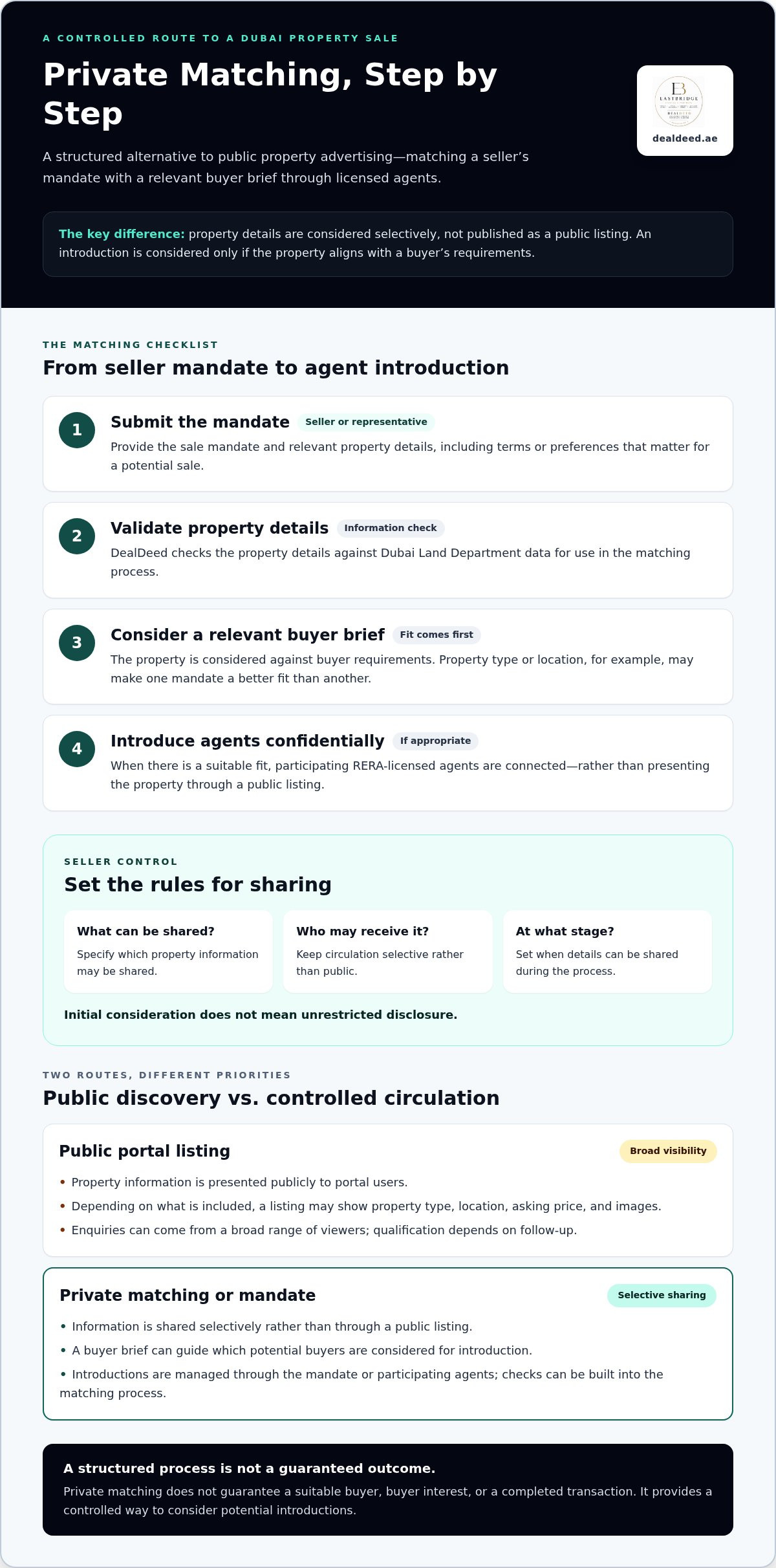
| Factor | Public portal listing | Private matching or mandate |
|---|---|---|
| Exposure | Property information is publicly presented to portal users. | Information is shared selectively rather than through a public listing. |
| Enquiry handling | Enquiries arrive through the listing’s available contact route; handling varies. | Introductions are managed through the mandate or participating agents. |
| Buyer qualification | Interest may come from a broad range of viewers; qualification depends on follow-up. | A buyer brief can guide which potential buyers are considered for introduction. |
| Verification | Verification depends on the parties and process involved. | Checks can be built into the matching process. DealDeed checks property details against Dubai Land Department data. |
For owners assessing Dubizzle property alternatives for discreet high net worth sales Dubai, the practical question is how much exposure the sale needs and who should receive the details. A portal prioritises public discovery. Private matching prioritises controlled circulation and fit between a property and a buyer brief. Neither route guarantees a particular outcome. Choose based on the seller’s priorities and the process that will follow.
How private property matching works without public marketing
Private property matching replaces public distribution with a defined sequence: submit a mandate, validate property details, identify a relevant buyer brief, then introduce agents. DealDeed does not publish the property as a public listing or market it publicly. Instead, information is handled within a confidential, agent-led process.
Private matching connects a seller’s property mandate with a potentially suitable buyer brief through licensed agents, without publishing the property publicly.
For owners comparing Dubizzle property alternatives for discreet high net worth sales Dubai, the distinction is practical: the route controls how the opportunity is shared, while the match depends on the property and the buyer’s requirements. A private process does not promise that a suitable buyer will be found. It provides a structured way to consider potential introductions.
From seller mandate to relevant buyer brief
A seller or representative submits a mandate outlining the property and the terms or preferences relevant to a potential sale. DealDeed considers the property against buyer requirements. For example, a buyer seeking a particular property type or location may fit one mandate but not another. If there is a suitable fit, the introduction takes place between RERA-licensed agents, not through a public listing.
The sequence is straightforward:
- Submit: Provide the sale mandate and relevant property details.
- Validate: Check property details against Dubai Land Department data.
- Match: Consider whether the property aligns with a buyer brief.
- Introduce: If appropriate, connect the participating agents confidentially.
This structure helps keep circulation intentional. A seller can state what information may be shared and at what point, so initial consideration does not mean unrestricted disclosure. Matching does not guarantee buyer interest or a completed transaction.
What verification does, and does not, establish
DealDeed checks property details against Dubai Land Department data. This supports the accuracy of the information used in the matching process. It is not a valuation, legal advice, a complete legal due-diligence exercise, or a guarantee about the transaction. Buyers and sellers still need to address the checks and documentation relevant to their own transaction. This Dubai Land Department verified-deal guide explains how data validation fits into private-market introductions.
Keep those roles distinct. A data check can help ground property details in official records, but it does not by itself establish market value, resolve every ownership or authority question, or confirm that a sale will proceed. An agent-led introduction is a starting point for a potential transaction, not a substitute for the parties’ due diligence and transaction arrangements.
To begin a discreet process, set out the mandate and information-sharing boundaries through DealDeed’s private matching desk.
Dubizzle versus private matching: compare the route, not just the reach
A public listing and a private introduction solve different problems. One puts a property before a broad audience; the other limits circulation and seeks relevant introductions through agents. Neither route guarantees more buyers, a higher sale price, or a completed transaction. Compare how each handles exposure, enquiries, qualification, information checks, and seller control.
| Factor | Public portal listing | Private matching |
|---|---|---|
| Visibility | Property information is made available to portal users. | Information is shared selectively rather than published as a public listing. |
| Enquiry flow | Enquiries come through the listing’s contact route; the seller or representative may need to manage responses. | Potential introductions are handled through participating agents. |
| Buyer qualification | Interest can come from a range of viewers. Follow-up determines what each enquiry represents. | A buyer brief can guide which potential buyers are considered, without guaranteeing a suitable match. |
| Data checks | Checks depend on the parties and process used. | DealDeed checks property details against Dubai Land Department data. |
| Seller control | Public visibility is part of the route; the seller can decide what information to include in the listing. | The mandate can guide what information is shared and through which agent introductions. |
When public exposure may fit the seller’s objective
If broad discovery is the priority, a portal listing may be a reasonable route to consider. It puts the property in front of people browsing publicly, while leaving the seller or representative to manage resulting enquiries. Weigh that visibility against the time and attention involved in reviewing responses. A public channel is not inherently unsuitable for a high-value property; it simply makes exposure a central part of the approach.
When controlled introductions may better fit
Private matching may suit an owner who prefers limited circulation and introductions shaped by a buyer’s stated requirements. Agent participation provides a channel for sharing the opportunity with a potentially relevant buyer, but it does not mean every suitable buyer is reached or that a match is assured. The professional guide to private real estate matching outlines how this agent-led route differs from public discovery.
Keep the limits clear. Private matching does not promise more buyers or a higher sale price. It changes how the property is distributed and how potential introductions are considered. The right route can also depend on whether a relevant buyer brief is available, the transaction structure, and the requirements that apply to the sale. Those details matter more than assuming one channel is always superior.
For sellers weighing Dubizzle property alternatives for discreet high net worth sales Dubai, start with a practical question: is public visibility a priority, or would controlled introductions better fit the owner’s preferences? The answer can guide the route, while valuation, negotiations, and transaction steps remain separate considerations.
A discreet-sale checklist for Dubai property owners
A clear brief helps keep a private sale deliberate. Before sharing a property opportunity, decide what should be disclosed, what a potential buyer needs to assess fit, and who is authorised to represent you. These decisions give participating agents a practical basis for considering relevant buyer briefs without turning the process into a public listing.
Use this checklist to prepare:
- Exposure preference: State that you prefer private introductions and set any limits on how widely the opportunity may circulate.
- Asset details: Record accurate property characteristics, location, and other facts needed to understand the asset. Keep information evidence-led.
- Buyer criteria: Note relevant requirements, such as the property type or location sought, and any seller objectives that affect a potential fit.
- Information stages: Specify which details may be shared for initial consideration and which should be disclosed only later.
- Representative authority: Identify the representative who may communicate about the mandate and clarify the scope of their role.
For owners weighing Dubizzle property alternatives for discreet high net worth sales Dubai, the brief is more than a property summary. It sets circulation boundaries and gives licensed agents useful context for assessing whether a buyer’s stated requirements align with the asset. A defined mandate can reduce ambiguity about what may be shared, by whom, and at what stage. It cannot guarantee a suitable introduction or a completed sale.
Set boundaries for information sharing
Separate essential property facts from sensitive personal or ownership details. A potential buyer may need enough information to assess relevance, while other details can be reserved for a later stage. State circulation limits and approval preferences in the mandate. Be specific: for example, distinguish permission to share the property type and general location from permission to circulate identifying ownership information. These boundaries guide handling, but do not promise anonymity or absolute confidentiality.
Make the brief useful to a serious buyer
Accuracy matters more than volume. Describe the asset clearly, include its location and relevant characteristics, and state the seller’s objectives where appropriate. Avoid unsupported claims about value, condition, or transaction readiness. DealDeed checks property details against Dubai Land Department data, while valuation and other transaction checks remain separate considerations. A precise brief gives agents a clearer basis for assessing buyer fit, without implying that a match is assured.
Review the mandate before circulation. Confirm that the named representative is authorised to discuss the opportunity and that the sharing preferences reflect the seller’s current instructions. Clear boundaries support a more controlled process, while a useful buyer brief supports relevant consideration.
To set out a property mandate for private buyer matching, explore private matching with DealDeed.
How DealDeed offers a quieter alternative to Dubizzle
DealDeed offers a different route from public advertising. It operates a private matching desk for Dubai real estate. Sellers submit a relevant brief or mandate for consideration; DealDeed does not publish listings or market properties publicly. The focus is matching motivated sellers with serious, vetted buyers through participating RERA-licensed agents.
What DealDeed’s private matching desk does
The process is structured around the mandate and the buyer’s requirements. Property details are checked against Dubai Land Department data, then considered in relation to relevant buyer briefs. If a potential fit emerges, the introduction is made between agents. This gives the parties a defined channel for discussing the opportunity without putting a public listing into circulation.
The sequence is direct:
- Submit a brief or mandate: Set out the relevant property information and sale context.
- Review property details: DealDeed checks details against Dubai Land Department data.
- Consider buyer fit: A mandate may be assessed against requirements from serious buyers.
- Introduce agents: Where there is a relevant opportunity, participating agents can progress discussions confidentially.
A data check is a practical point of reference, not a valuation or a substitute for the parties’ own transaction due diligence. Likewise, a buyer introduction is not a promise of an offer or a completed sale. It is a more controlled way to consider potential alignment between an asset and a buyer brief.
For sellers comparing Dubizzle property alternatives for discreet high net worth sales Dubai, the distinction is the route: public exposure versus selective, agent-led matching. DealDeed charges a fixed introduction fee to participating agents only when a matched deal completes. Sellers and buyers are not charged that fee, and users have no upfront registration or subscription costs.
A clear next step for sellers and representatives
Sellers, investors, and agents can submit a relevant property brief or mandate for private matching. A useful submission states the asset facts clearly, identifies the seller’s objectives, and sets out what information may be shared and when. This gives the matching process a clear starting point while keeping the intended circulation in view.
If a quieter, agent-led route fits your sale objectives, submit a private property brief to DealDeed. There is no upfront registration or subscription cost. Start with a clear mandate and stated sharing boundaries.
Set the terms before your next introduction
Decide how much visibility your sale requires, then put your preferred boundaries and objectives into a clear mandate. This gives any potential introduction a defined starting point, rather than leaving exposure and information-sharing to chance.
For owners considering Dubizzle property alternatives for discreet high net worth sales Dubai, discretion is not simply about avoiding a public listing. It also means being deliberate about timing, the details shared, and the people involved at each stage. A considered brief can help you begin without assuming one route suits every property or seller.
If a controlled, agent-led introduction aligns with your priorities, take the next step at your own pace. Submit a private property brief to DealDeed and set out how you want the opportunity handled. A clear brief is a practical beginning, with the level of discretion guided by your preferences.
Frequently Asked Questions
Can a discreet Dubai property sale guarantee seller anonymity?
No. A private sale can limit public exposure, but it cannot guarantee anonymity throughout a property transaction. Information may need to be shared with relevant parties as discussions progress, and transaction steps can require identity and ownership details. Set out what may be shared, with whom, and at what stage. This gives representatives clear instructions without promising that personal or ownership information will never be disclosed.
Is private property matching the same as a pocket listing?
No. A pocket listing generally means a property is offered privately rather than advertised publicly. Private matching adds a buyer-brief process: a seller’s property details are considered against buyer requirements, with potential introductions handled through agents. The terms can overlap, but the methods are not identical. For a Dubai seller, the key distinction is whether the opportunity is simply circulated privately or considered through a structured matching process.
Can a seller move from private matching to a public listing later?
Potentially, yes. A seller may decide that broader exposure better suits their objectives if private introductions do not meet expectations. Before changing routes, review the mandate and any representative arrangements, then clarify which information can be published and who is authorised to proceed. Manage the transition deliberately so details are not circulated publicly before the seller has decided to change the exposure approach.
Does selling a Dubai property privately guarantee a higher sale price?
No. A private sale does not guarantee a higher price, just as public advertising does not guarantee a particular outcome. The result depends on factors such as the asset, market conditions, buyer interest, and negotiated terms. For sellers comparing Dubizzle property alternatives for discreet high net worth sales Dubai, private matching changes how potential buyers are approached. It does not establish market value or replace informed pricing and negotiation.
How does DealDeed verify property details against Dubai Land Department data?
DealDeed checks the property details submitted for matching against Dubai Land Department data. This provides an evidence point for assessing whether the information aligns with relevant data available for the property. It is not a valuation, legal opinion, or complete due-diligence review, and it does not guarantee a transaction. Questions about ownership, authority, or transaction documents should be addressed through the appropriate checks for that specific sale.
Who pays DealDeed’s introduction fee when a matched property deal completes?
The participating agent pays DealDeed’s fixed introduction fee when a matched property deal completes. The fee is not charged to the seller or buyer, and users have no upfront registration or subscription cost. For a Dubai seller, this clarifies who pays for the introduction and when. It does not change the parties’ separate transaction arrangements or imply that a match or completed sale is guaranteed.


