

Should your UAE property brief be visible to the market, or shared quietly through agent introductions? The Houza vs private broker matching desk UAE choice starts with that distinction. A public portal supports property discovery; a private desk is built around controlled, confidential matching.
It’s reasonable to want reach without inviting unsuitable enquiries or unnecessary exposure. But these routes aren’t interchangeable: Houza is a public property portal, while DealDeed is a private matching desk, not a portal or direct brokerage. DealDeed connects buyers and sellers through RERA-licensed agents, with property details checked against Dubai Land Department data.
This comparison will help you choose a route that fits your property, privacy preference and transaction participants. We’ll explain how public discovery differs from agent-to-agent matching, what each approach can and can’t do, and what information helps make a private buyer brief or quiet disposal mandate useful. You’ll also see how confidentiality, verification and next steps fit into the process, so you can choose based on your priorities rather than visibility alone.
Key Takeaways
- Distinguish public property discovery from confidential, agent-led introductions before choosing a route for your UAE brief.
- Use the Houza vs private broker matching desk UAE comparison to weigh exposure, enquiry handling and the level of control your transaction needs.
- Match the route to your brief: broad visibility may suit a public campaign, while specific requirements may benefit from controlled introductions.
- Prepare clear property or buyer criteria so a private brief or mandate can be reviewed and matched more effectively.
- Understand how DealDeed’s agent-to-agent process handles property-detail checks and suitable introductions without publishing public listings.
Houza vs. a Private Broker Matching Desk: Two Different Routes to Property
Start with the decision that shapes the rest of the search: do you want broad public discovery, or controlled introductions through agents? Houza and a private matching desk address different needs. A property portal presents listings for people to discover and evaluate. A matching desk uses a buyer’s criteria or a seller’s mandate to guide confidential introductions. This distinction matters in the UAE, where Dubai and Abu Dhabi have distinct property markets and transaction processes, within a wider sector shaped by varied communities and ownership arrangements, as outlined in this overview of real estate in Dubai.
What does Houza help a property searcher do?
Houza is a UAE property portal focused on public property discovery. Searchers can find properties presented for viewing, review the information shown and follow the enquiry route provided with a listing. That is the portal layer, not the same as brokerage: a broker advises or represents parties in a transaction, while a portal helps people discover advertised properties. Listing details and enquiry routes can vary, so compare the information shown for each property. For a buyer seeking a wider set of publicly presented options, discovery is the central value.
What does a private broker matching desk do?
A matching desk starts with a defined brief, not an open search page. A buyer can set out the property type, location, budget range, timing and other essential criteria. A seller’s mandate can specify the asset, preferred terms, timing and conditions for an introduction. The desk uses those details to identify a potential fit and facilitate a confidential introduction through agents.
DealDeed connects buyers and sellers through RERA-licensed agents. It is a matching desk, not the broker acting for either party. Property details are checked against Dubai Land Department data, and matching and transaction discussions remain confidential between the agents involved. The desk aims to reduce irrelevant circulation by bringing a specific brief or mandate to suitable participants. For a fuller explanation of this model, see the private real estate matching guide.
Consider a buyer looking for a particular villa configuration in a defined Dubai community. A portal can support open-ended browsing across advertised options; a private brief can focus agent introductions on those criteria. For a seller, the choice may be between public exposure and a discreet mandate-led approach. Public visibility can support wider discovery, while private matching prioritises control and relevance. Neither route is automatically right for every property or participant.
So, the practical question in Houza vs private broker matching desk UAE is not which option is universally better. It’s whether the transaction needs public discovery or a more controlled route to potential counterparties. Keeping portal, brokerage and matching roles separate makes that choice clearer.
How Public Discovery and Private Matching Work in the UAE
The difference becomes clearer when you follow what happens to a property or brief at each stage. Public discovery places property information where searchers can find it. Private matching moves a defined buyer brief or seller mandate through a controlled agent-to-agent process. Neither route guarantees a transaction, and confidentiality should not be mistaken for anonymity: relevant information is shared with participants assessing a potential fit.
The public property-discovery journey
Houza is a public property portal. The broad discovery sequence is simple: search, review the information displayed for a property, then follow the enquiry route provided. The searcher uses visible details to compare potential options; the listing agent or other identified contact handles the enquiry and any subsequent discussion. Details and enquiry options can vary by listing.
Public visibility helps a buyer survey advertised opportunities, but it doesn’t by itself establish that the buyer is qualified or that property information has been independently verified. Treat a listing as a starting point for enquiry, not proof of suitability, availability or transaction readiness.
The private brief-to-introduction journey
Private matching begins with a buyer, investor or seller setting out a relevant brief or mandate. DealDeed reviews property details against Dubai Land Department data, then facilitates suitable introductions through RERA-licensed agents. The agents handle confidential matching and transaction discussions; DealDeed connects the parties rather than acting as their broker. The UAE Ministry of Economy & Tourism’s guidance on record-keeping for real estate brokers provides context for the regulated role of agents in property transactions.
- Submit: The buyer shares criteria such as property type, preferred area, budget range and timing. A seller sets out the asset and mandate terms.
- Review: DealDeed reviews the brief or mandate and checks property details against Dubai Land Department data.
- Introduce: Where there’s a suitable fit, relevant parties are introduced through RERA-licensed agents. Information is shared to assess that fit.
- Progress: The agents and transaction participants discuss the opportunity and decide whether to proceed. A match is an introduction, not a promise of completion.
This sequence makes the visibility trade-off concrete. On a portal, a searcher evaluates what’s publicly presented. In private matching, information is shared with relevant agents and potential counterparties for a defined purpose, without a public listing. The process is confidential, but that doesn’t mean no one beyond the submitting party will see relevant details.
DealDeed’s property-detail checks against Dubai Land Department data inform its private introductions. If a focused, agent-led route suits your brief, you can submit a buyer brief or seller mandate for private matching. That’s the practical distinction in Houza vs private broker matching desk UAE: public discovery supports browsing, while private matching organises introductions around stated criteria.
Houza vs. a Private Matching Desk: Compare Reach, Control, and Verification
The useful comparison is not simply “more exposure” versus “more privacy.” It’s how each route handles visibility, enquiries and evidence. Houza is a public property-discovery portal. DealDeed is a private matching desk that connects parties through RERA-licensed agents and checks property details against Dubai Land Department data. Neither route guarantees a sale. The right fit depends on what the seller or buyer needs the process to do.
| Factor | Houza | Private matching desk |
|---|---|---|
| Visibility | Properties are presented for public discovery. The information visible depends on the listing. | Property details are shared for relevant, confidential introductions rather than published as public listings. |
| Enquiry path | A searcher reviews a listing and uses the enquiry route shown for that property. | A buyer brief or seller mandate guides agent-to-agent introductions where there is a potential fit. |
| Confidentiality | Public discovery involves visible listing information. Privacy depends on the listing and portal experience. | Matching and transaction discussions are handled confidentially between participating agents. This is controlled sharing, not absolute anonymity. |
| Verification | Assess the evidence presented with each listing; public presentation alone does not establish independent verification. | DealDeed checks property details against Dubai Land Department data. |
| Potential fit | A seller who deliberately wants public exposure, or a buyer exploring advertised options. | A seller with a confidentiality-sensitive mandate, or a buyer whose requirements are specific enough to guide introductions. |
When public visibility may better serve the brief
Public discovery can make sense when a seller deliberately wants a property presented to people browsing advertised options. For buyers, visible information offers a way to compare features and shortlist properties before making an enquiry. It’s a starting point, not a qualification check: exposure doesn’t prove a buyer is ready, make a property suitable or ensure a faster transaction. Review the information and enquiry route shown for each listing.
When controlled introductions may better fit the brief
A private route may suit a seller who wants to limit public exposure, or a buyer seeking a narrow combination of location, asset type and terms. A defined brief helps agents assess fit before an introduction; property-detail checks provide a separate layer of information, not a promise that every aspect of a transaction has been verified. The Dubai real estate deal desk guide explains the professional matching model in more detail.
Public exposure makes a property discoverable; confidential introductions direct relevant details to potential counterparties without guaranteeing a match or a sale. In the Houza vs private broker matching desk UAE decision, choose according to the visibility the mandate calls for, not an assumption that one route always produces better results.
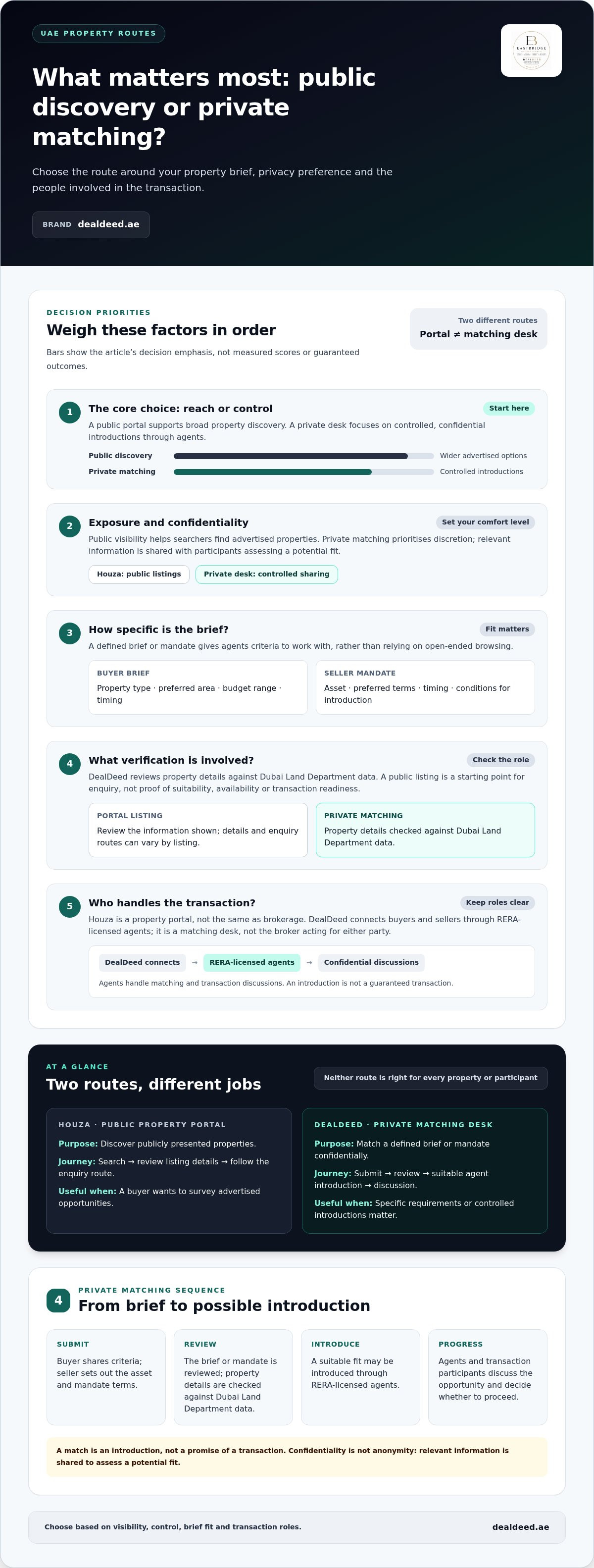
How to Choose Between Houza and Private Matching for a UAE Property Brief
Choose the route by starting with the outcome, not the platform. Does the seller want a property publicly discoverable, or is limiting exposure central to the mandate? Does the buyer need to explore a range of advertised options, or have specific criteria that should guide introductions? In the Houza vs private broker matching desk UAE decision, these answers matter more than a simple preference for online or agent-led processes.
Questions to settle before choosing a route
Use these questions to turn a general preference into a practical instruction:
- What level of exposure is intended? If open discovery is part of the seller’s objective, a public portal may be relevant. If public visibility would create unwanted attention, consider a controlled introduction route.
- How specific is the buyer’s brief? A broad search for available options differs from a defined requirement covering location, property type, budget and timing. Precise criteria can help agents assess whether an introduction may fit.
- Who needs to take part? Identify the seller or buyer’s existing agent and the other transaction participants who need relevant information. For Dubai matching through DealDeed, introductions are handled through RERA-licensed agents.
- Which emirate is involved? A brief in Dubai and one in Abu Dhabi may involve different transaction participants and regulatory processes. Don’t assume a process used in one emirate automatically applies in another.
Can public discovery and private introductions complement each other?
Sometimes a seller or buyer may consider more than one route, but a combined approach isn’t suitable by default. The mandate, seller’s preference and buyer’s requirements should determine whether public exposure is appropriate alongside confidential introductions. Before using a route, clarify what information may be shared, with whom and for what purpose. A private mandate is not consent to publish details publicly.
For example, a buyer broadly exploring apartments in Dubai may benefit from browsing visible listings and comparing the information presented. A buyer seeking a specific villa in a particular community, with defined requirements, may find an agent-led introduction more relevant. Neither example guarantees an enquiry, match or completed transaction. The point is to align the route with the brief.
Private matching is more controlled, not a substitute for every public campaign. If a seller’s objective depends on broad public discovery, a private desk alone may not serve that objective. If discretion and criteria-led introductions take priority, public exposure may be unnecessary or unwelcome. Make the choice explicit with the relevant participants rather than allowing visibility to happen by default.
Once the requirements are clear, DealDeed’s private matching route can connect a Dubai buyer brief or seller mandate with relevant parties through RERA-licensed agents. Submit a Dubai buyer brief or seller mandate to begin a criteria-led introduction process.
How DealDeed’s Private Matching Desk Handles UAE Property Introductions
DealDeed is a private matching desk for Dubai real estate. It connects motivated sellers with serious, vetted buyers through RERA-licensed agents. It does not publish public listings or act as a direct broker. Its role is to organise relevant introductions, with property details checked against Dubai Land Department data.
That distinction matters in the Houza vs private broker matching desk UAE comparison. A portal puts property information into a public discovery environment. DealDeed works from a defined buyer brief or seller mandate and facilitates confidential introductions through agents. The process is designed for relevance and controlled sharing, not public exposure or a guaranteed transaction.
What participants can expect from DealDeed
Buyers, investors and sellers can register to submit briefs or mandates without upfront registration or subscription costs. A buyer’s criteria, or a seller’s instructions, guide the review and any suitable introduction. Property details are checked against Dubai Land Department data, while matching and transaction discussions are handled confidentially between RERA-licensed agents. DealDeed facilitates the connection; the agents handle brokerage and transaction discussions.
Confidentiality means information is shared to assess a potential fit, not that no other participant will receive relevant details. No introduction guarantees a match, offer or completed sale. This is a private route to potential counterparties, not a public listing service.
Submit a brief or mandate with clear requirements
Precision helps make a brief useful. Buyers should describe the property type, preferred location, budget range, timing and essential requirements. Sellers should identify the asset, relevant terms, timing and any conditions that should guide introductions. Clear priorities distinguish firm requirements from preferences and give agents a practical basis for assessing potential fit.
The process moves from submission to review, followed by suitable agent introductions where the criteria align. Agents participating in a matched deal pay DealDeed a fixed introduction fee only after that deal completes. Users pay no upfront registration or subscription charge. The fee is tied to participating agents and completion, not simply to submitting a brief.
For agents, the desk provides an agent-to-agent route to relevant briefs and mandates. For buyers and sellers, it offers a structured way to put specific requirements in front of appropriate participants without publishing a public listing. Any next conversation or transaction remains subject to the parties’ assessment and agreement.
If a confidential, criteria-led introduction fits your requirements, prepare the relevant property or buyer details and submit a private property brief. A clear brief gives the matching process a defined starting point, without promising a particular introduction or outcome.
Set the Right Route for Your Next Property Move
Make your priorities explicit before choosing a route. Decide how much visibility you’re comfortable with, which criteria are essential and who should take part in any introduction. That clarity helps keep the process aligned with your transaction, whether you’re searching or preparing a property mandate.
For a confidential, agent-led route, DealDeed checks property details against Dubai Land Department data and facilitates introductions handled between RERA-licensed agents. Participating agents pay a fixed introduction fee only when a matched deal completes. These steps support a considered process, not a promise of an introduction or sale.
The Houza vs private broker matching desk UAE choice comes down to the kind of discovery your brief calls for. If a private introduction fits, take the next step and submit a private property brief. A clear brief gives your requirements a focused starting point. Choose the level of visibility that fits your property objectives.
Frequently Asked Questions
Is Houza the same as a private broker matching desk?
No. Houza is a property-discovery brand, while a private matching desk uses buyer briefs and seller mandates to organise introductions. In the Houza vs private broker matching desk UAE comparison, the key difference is the route: public browsing versus criteria-led, agent-to-agent matching. Listing information and enquiry routes can vary. DealDeed facilitates confidential introductions through RERA-licensed agents rather than publishing public listings.
Can a Dubai property be matched privately without a public listing?
Yes. A seller can submit a quiet disposal mandate for potential matching with a relevant buyer brief, without publishing a public listing through DealDeed. For example, a seller may define the property and preferred terms while an investor sets out location and asset criteria. Any introduction depends on fit and the parties involved. A private route doesn’t guarantee a match, an offer, a completed transaction or a particular sale result.
What does a private matching desk verify before introducing parties?
DealDeed checks property details against Dubai Land Department data and facilitates introductions through RERA-licensed agents. That check provides a basis for reviewing property information, but it shouldn’t be treated as confirmation of title, physical condition, a buyer’s funding or the likelihood of completion. If an introduction progresses, the relevant parties should address those separate matters through the appropriate professionals and official transaction processes.
Who pays DealDeed’s introduction fee, and when?
Participating real estate agents pay DealDeed a fixed, non-percentage introduction fee only when a matched property deal is successfully completed. Users don’t pay an upfront registration or subscription charge. The fee isn’t due simply because someone submits a brief, registers or receives an introduction. For a buyer or seller, the practical distinction is that the fee is charged to participating agents and tied to a completed match.
Can a seller keep property details confidential during private matching?
DealDeed handles transactions confidentially between RERA-licensed agents and doesn’t publish public listings. A seller can submit a quiet disposal mandate, with relevant information used to assess potential introductions. Confidential handling isn’t the same as absolute anonymity: a suitable potential counterparty may need relevant details to consider the property. Sellers can make their sharing preferences clear and limit identifying information to what’s needed for a potential introduction.
Is Houza or private matching better for selling a Dubai property?
Neither route is universally better; the right choice depends on the seller’s priorities. Public discovery may fit an objective that depends on visible exposure, while private matching may suit a seller who values controlled introductions to buyers with specific criteria. This is the core Houza-versus-private-desk decision in Dubai. Neither route guarantees a qualified enquiry, a completed transaction or preferred terms, so base the choice on the mandate rather than assumed results.
Can investors and agents submit briefs to DealDeed?
Yes. Agents, investors and sellers can register to submit briefs or mandates for DealDeed’s private matching process. An investor can outline acquisition criteria such as property type, preferred area, budget range and timing; an agent can submit relevant client requirements or a seller mandate. Clear, current information helps participants assess the request. Registration and submission don’t guarantee a suitable match or a completed transaction.


