

Two brokers can market the same Dubai property when the seller authorises both under an agreed arrangement. Avoiding conflicts of interest in Dubai co-brokerage deals starts with defining that arrangement before either broker acts.
Shared marketing can broaden a property’s reach, but unclear authority can lead to disputes over introductions, confidentiality and compensation. Set out each broker’s responsibilities and the agreed process in writing instead of relying on assumptions.
This guide explains how to structure shared property marketing, document buyer introductions, compete fairly and agree compensation. It also covers Form I, which records a co-broker arrangement, including the commission split and confidentiality obligations for client information. A clear process helps protect each party’s interests and keep the transaction professional.
Key Takeaways
- Disclose personal interests and protect confidential company information before pursuing a property opportunity.
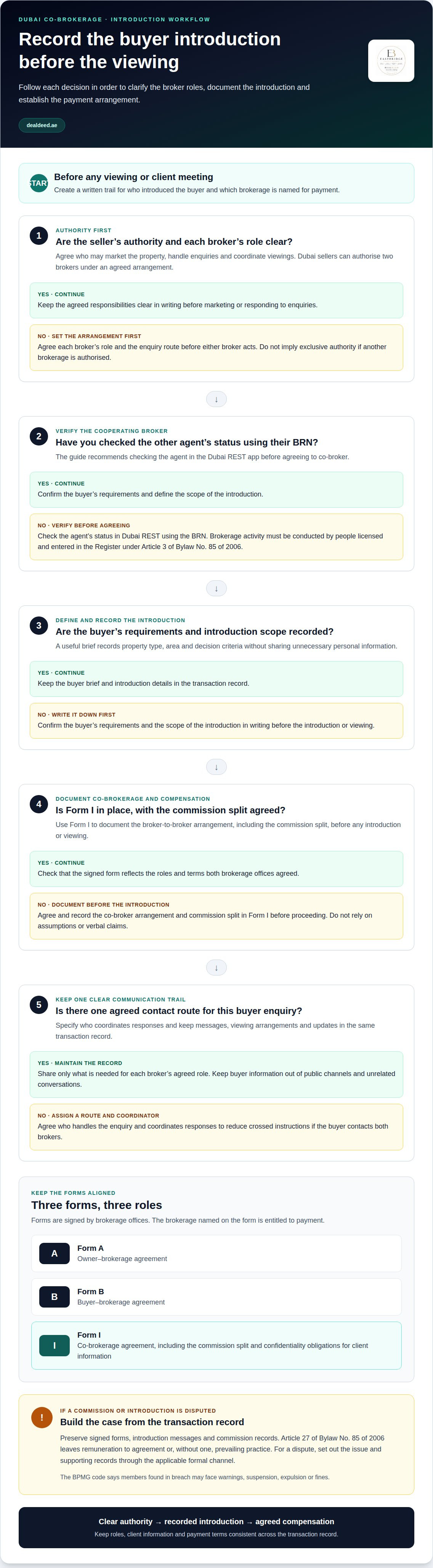
- Record who introduced the buyer and agree on the co-broker arrangement before making the introduction.
- Keep competition professional: respect client relationships, permissions and each broker’s agreed role.
- Set out compensation and any changes in writing, and disclose compensation from multiple parties before accepting it.
Conflicts involving company property, information or opportunities
A seller can authorise two brokers to market the same Dubai property under an agreed arrangement. If brokers represent competing buyers, disclose the conflict, protect each client’s information and agree how both mandates will be handled before proceeding.
-
Obtain Informed Consent for Dual Agency
Before representing multiple sides in a Dubai real estate transaction, disclose the conflict and obtain informed written consent from all parties. The BPMG code requires this consent. Explain whom you represent and what information must remain confidential. Consent does not allow you to use one client’s negotiation position, buyer brief or offer details to benefit another.
-
Handle Competing Buyer Representation
Separate each buyer’s instructions and records when both want the same property. Tell each client about the competing representation without revealing the other buyer’s identity, budget or offer. If you can’t protect both clients’ interests, take the necessary procedures to protect the affected client, as required under Article (17) Bis Fourth of Decision No (1/R) Of 2000 Concerning The Regulation As To Brokers.
- Keep company information and opportunities within their authorised use. A director’s conflict duty under section 165(2) of the ADGM Companies Regulations 2020 covers exploiting company property, information or opportunities, even if the company could not take advantage of them. For brokers, the practical control is clear: don’t use confidential client or company information for personal benefit or to redirect an estate opportunity.
- Protect owner and property information during marketing and viewings. Dubai regulations prohibit brokers from obtaining property-owner data unlawfully. Use information shared through an authorised relationship, and keep client details confidential under the co-brokerage arrangement. Form I agreements specify confidentiality obligations for client information, so follow those terms when sharing details with the cooperating broker.
Documenting buyer introductions to prevent disputes
Record each introduction before a viewing or client meeting. In Dubai, clear records help establish who introduced the buyer and which brokerage is named for payment.
-
Route Buyer Enquiries Through One Contact
Agree on one contact route for each buyer enquiry and specify who coordinates responses. Keep messages, viewing arrangements and updates in the same transaction record. This helps prevent crossed instructions if a buyer contacts both brokers directly. Share only what is needed for each agreed role, and don’t circulate buyer information through public channels or unrelated conversations.
-
Screen Brokers and Verify Buyer Requirements
Before agreeing to co-broker, verify the other agent’s status in the Dubai REST app using their BRN. Confirm the buyer’s requirements and the scope of the introduction, then record both in writing. A brief covering property type, area and decision criteria gives the cooperating broker useful context without revealing unnecessary personal information.
-
Check Co-Brokerage Rules and Forms
Use Form I to document the broker-to-broker arrangement, including the commission split, before any introduction or viewing. Dubai brokerage activity must be conducted by people licensed and entered in the Register under Article 3 of Bylaw No. 85 of 2006. Form A, Form B and Form I are signed by brokerage offices, and the brokerage named on the form is entitled to payment.
Form A records the owner-brokerage agreement, Form B the buyer-brokerage agreement, and Form I the co-brokerage agreement. Keep each form consistent with the roles you have agreed.
-
Address Commission and Conflict Disputes
Preserve signed forms, introduction messages and commission records. Article 27 of Bylaw No. 85 of 2006 leaves remuneration to agreement or, without one, prevailing practice. The BPMG code says members found in breach may face warnings, suspension, expulsion or fines. For a dispute, set out the issue and supporting records through the applicable formal channel rather than relying on verbal claims.
For a controlled route from a buyer brief to a documented introduction, consider confidential buyer matching.
Fair competition between brokers
Fair competition relies on clear authority, accurate information and professional conduct. To avoid conflicts of interest in Dubai co-brokerage deals, make each broker’s role transparent while allowing authorised cooperation.
- Confirm the seller’s authority and each broker’s role before marketing. Dubai sellers can authorise two brokers under an agreed arrangement. Record what each broker may do, including who handles enquiries and coordinates viewings. Don’t imply exclusive authority if the seller has authorised another brokerage. Written terms help clarify who may speak for the seller and how responsibilities are divided.
- Use owner information only for its authorised purpose. Dubai regulations restrict brokers from directly contacting property owners to market or purchase property. Brokers may contact existing clients when they properly document the relationship and consent. Don’t use another broker’s owner details to bypass an agreed route. Respecting these boundaries helps avoid conflicts of interest in Dubai co-brokerage deals and supports a professional working relationship.
- Keep advertising accurate and authorised. The Dubai Land Department requires an advertising permit for regulated property advertising activities, processed through Trakheesi. A broker applying for relevant permits must provide a marketing contract with the property owner. Ensure each public advertisement reflects the authorised property details and the seller’s agreed terms. Don’t publish competing versions that create confusion about availability or authority.
- Apply professional standards to every cooperating broker. Article 18 (6) Of Decision No (1/R) Of 2000 Concerning The Regulation As To Brokers requires brokers and representatives in the United Arab Emirates to respect professional ethics and avoid conduct that could harm the market’s reputation or its participants. Brokerage firms must observe honesty and integrity and avoid conflicts. Keep negotiations factual, communicate changes directly, and don’t undermine another broker with unverified claims.
Multiple-party compensation
For residential and commercial deals, set compensation by written agreement rather than assuming property type determines the split. Article 27 of Dubai Bylaw No. 85 of 2006 leaves broker remuneration to agreement or, without one, prevailing practice.
- Agree the commission allocation before agents share a listing or buyer introduction. Dubai co-brokered deals commonly split commission 50/50, but the written agreement should record the actual arrangement. Under Article 31 of Dubai Bylaw No. 85 of 2006, brokers acting together for one party in the same negotiation divide the fee according to their agreement. Keep the split clear, including each brokerage’s role and payment entitlement.
- Disclose compensation from multiple parties before accepting it. The BPMG code requires disclosure and informed consent from all parties before a member accepts compensation from more than one party to a transaction. Put the disclosure and consent in writing. The code also requires written disclosure to consumers if an agent or connected person receives a referral reward for recommending a service.
- Document changes before an offer is submitted. The BPMG code says brokers must communicate changes to offered compensation before that point. Record the revised terms and communicate them to affected parties; don’t rely on a verbal update. Commission invoices are subject to 5% VAT, including when the fee is split between agents, so make the invoice allocation consistent with the agreed payment arrangement.
- Distinguish joint appointments from separate appointments. Under Article 32 of Dubai Bylaw No. 85 of 2006, when one party separately appoints several brokers for the same matter and only one concludes the transaction, that broker receives the entire remuneration. Set out the relationship and entitlement in the contract; don’t assume a shared listing means every agent receives a share.
For a discreet way to structure broker cooperation, use the Agent-to-Agent Deal Desk.
Residential and commercial deals are treated alike: the property type does not determine the commission split, which should be set by written agreement. Co-brokered deals commonly use a 50/50 split, while under separate appointments the broker who concludes the transaction receives the full remuneration.
DealDeed: Agent-to-Agent Deal Desk
DealDeed’s Agent-to-Agent Deal Desk gives RERA-licensed agents a discreet way to coordinate property opportunities and buyer introductions. It privately connects motivated sellers with serious, vetted buyers, with no public listings or marketing.
Private Buyer Brief Matching helps connect a buyer brief with a relevant property opportunity, while Quiet Disposal Mandates support a discreet sale process. DealDeed verifies property details against Dubai Land Department data, grounding matches in checked information. Every match involves a RERA-licensed agent on each side.
This is a practical next step when the parties need controlled introductions rather than public exposure. Contact DealDeed to discuss an Agent-to-Agent Deal Desk arrangement.
Set the Terms Before the Next Opportunity
A co-brokerage opportunity is a chance to clarify expectations before client interests overlap. Avoiding conflicts of interest in Dubai co-brokerage deals means agreeing how introductions, information and compensation will be handled before discussions gather pace.
For a discreet way to progress a Dubai or Abu Dhabi property opportunity, DealDeed offers Private Buyer Brief Matching, Quiet Disposal Mandates and an Agent-to-Agent Deal Desk. These routes address different needs, from matching a buyer brief to coordinating between agents or managing a quiet sale mandate.
Choose the arrangement that fits the opportunity, then keep the next step direct and documented. Contact DealDeed to discuss your co-brokerage deal. A clear starting point can help keep the working relationship focused and professional.
Frequently Asked Questions
Can two brokers market the same Dubai property?
Yes. A seller can authorise two brokers to market the same property under an agreed arrangement. Each broker’s authority and permitted marketing activity should follow the seller’s instructions and the relevant advertising permit. For example, if one broker handles enquiries while another arranges viewings, record those roles clearly so buyers receive consistent information and neither broker implies sole authority.
How to control the brokerage relationship?
Define authority, responsibilities, communications and compensation in written agreements. For a co-broker arrangement, specify who handles buyer enquiries, property access, updates and offer discussions. Keep decisions within those agreed roles. If the seller changes instructions or adds another agent, update the relevant records and inform affected parties before crossed messages or conflicting commitments arise.
How can Dubai brokers verify each party's RERA registration and authority to represent a client?
Verify a co-broker’s registration using the agent’s BRN in the Dubai REST app. Article 3 of Dubai Bylaw No. 85 of 2006 requires brokerage activity to be conducted by people licensed and entered in the Register. Confirm representation through the relevant signed brokerage agreement, such as Form A for an owner relationship or Form B for a buyer relationship.
What disclosures are required for dual agency or representing both sides in a Dubai property deal?
The BPMG code requires informed written consent from all parties before a member represents multiple parties in a Dubai real estate transaction. Explain the dual role and limits on sharing confidential information before proceeding. Consent should identify whom the agent represents, so each party understands the arrangement and does not assume the agent acts exclusively for them.
How can brokers document client consent and disclose financial or personal interests in Dubai?
Record each party’s informed consent in writing, identifying the transaction, parties, disclosed interest and agreed representation. Under the BPMG code, a member must disclose their own or an immediate family member’s personal interest before the client signs an agreement. If compensation comes from more than one party, disclose it and obtain informed consent from all parties before acceptance.
What due diligence steps should Dubai brokers take before sharing client leads or property information?
Before sharing a lead, verify the co-broker’s BRN through Dubai REST and confirm that the client authorised the introduction. Check that the buyer’s requirements fit the property, then share only information needed for the agreed purpose. Use authorised records for property details and preserve confidentiality. Dubai regulations prohibit brokers from obtaining property-owner data unlawfully.


