

A quiet sale is not an invisible one. When selling a tenanted building quietly in Abu Dhabi, the aim is to limit unnecessary public exposure, not to bypass official records or buyer checks. That distinction matters when the building is occupied and tenancy details can affect a buyer’s assessment.
It is reasonable to be cautious about public marketing and to ask how existing leases affect a sale. Tenancy agreements generally continue with the new owner under the same terms, so serious buyers need clear, accurate information. Private outreach can make the process more controlled, but it cannot guarantee anonymity, a buyer or secrecy throughout the formal transaction.
This guide explains how to organise tenancy and property records for buyer review, approach qualified prospects without broad public advertising, and check the requirements that apply in Abu Dhabi. It also covers where advertising permits and DARI registration fit into the process, and why you should confirm that any private buyer-matching route can accept an Abu Dhabi building before proceeding.
Key Takeaways
- Before selling a tenanted building quietly in Abu Dhabi, decide what information can be shared, with whom and at what stage.
- Organise current lease terms, occupancy details and rental records so prospective buyers can assess the building using evidence, not assumptions.
- Compare private outreach with public marketing by weighing exposure, buyer reach, information control and the work each route requires.
- Use a five-step preparation process to confirm authority, separate verified facts from estimates, set disclosure limits, qualify buyers and coordinate access.
- Before using a private buyer-matching desk, confirm Abu Dhabi mandate eligibility and local process details. An introduction is not brokerage, valuation, legal advice or a sale guarantee.
Why sell a tenanted building quietly in Abu Dhabi?
An owner considering a sale may want to test buyer interest without drawing attention to the building or disrupting tenants. Controlled outreach can limit unnecessary exposure, but it cannot guarantee complete secrecy. Selling a tenanted building quietly in Abu Dhabi means choosing how and to whom the opportunity is presented, while still sharing material information with serious prospective buyers and completing the required formal steps.
What does a quiet property sale actually mean?
A public listing can make a property visible to a broad audience through portals and other advertising. Private outreach is more selective: information goes to a limited group of relevant, qualified prospects, often through participating agents. The distinction resembles the broader idea of a private outreach or public listing, though the term alone does not establish what is permitted for a specific Abu Dhabi asset.
Confidentiality depends on the process, permissions and conduct of everyone involved. Agree in advance what can be shared, with whom and at what stage. Limiting exposure does not mean concealing occupancy, lease terms or other material facts. Buyers need accurate information to assess the opportunity, and the sale still has to follow applicable Abu Dhabi requirements. Confirm local advertising and transaction procedures with qualified professionals.
Why might an owner keep an occupied building off public portals?
Public visibility may bring casual enquiries as well as serious interest. An owner may prefer to reduce unqualified calls, avoid unnecessary site visits and control when detailed property information reaches prospective buyers. This can be useful while the seller organises records or decides how to present an occupied asset.
Tenants have their own routines and privacy interests. Unplanned visits or wide circulation of property details can cause avoidable disruption. A considered process sets expectations for information sharing and access rather than treating an occupied building like an empty unit. It does not assume that public exposure will lower the property’s value or damage tenant relations. Instead, it gives the owner more control over how the sale is introduced.
There is a necessary balance. Keep broad publicity limited if that suits the seller’s priorities, but give serious prospects reliable information through a controlled review process. Quiet outreach manages visibility; it is not a reason to withhold relevant facts or skip official requirements. Assess a private route for its suitability to the Abu Dhabi asset before agreeing to a mandate or sharing buyer information.
How do existing tenancies shape an Abu Dhabi building sale?
For a buyer, an occupied building is both a property and a set of active rental arrangements. Lease dates, occupancy, rent collection and agreed terms help the buyer assess income, commitments and the practical handover. Accurate records make that review more orderly for the seller. When selling a tenanted building quietly in Abu Dhabi, prepare the evidence before sharing details and distinguish confirmed facts from estimates or matters still under review.
A rent roll is a property-by-property summary of occupancy, lease dates and rent details. It gives buyers a structured starting point for reviewing the building’s tenancy and income position. It supports due diligence, but it does not replace signed agreements or prove that every listed figure is current. Check the schedule against source documents and mark any gaps clearly.
Which tenancy records should a seller organise?
Build a schedule for each unit or property, showing occupancy status, lease start and expiry dates, rent details, deposits and recorded amendments. Gather signed tenancy documents, relevant correspondence and evidence supporting the figures. Note whether information is confirmed, estimated or awaiting verification. Before sharing records at an early stage, limit personal data and ask an adviser what to redact. Buyers may need further documents later, but an initial review need not expose unnecessary tenant information.
Clear records also make inconsistencies easier to spot. For example, if the rent schedule shows a different lease expiry from the signed agreement, reconcile the discrepancy before sending the schedule to a prospective buyer. For broader principles on controlled disclosure, see this confidentiality guide for high-net-worth transactions.
What must be checked before promising a vacant or occupied handover?
Verify each lease’s current status, expiry, renewal terms and any agreed arrangements with the tenant. Do not assume a sale automatically ends, transfers or changes a tenancy. Abu Dhabi tenancy, sale, disclosure and notice requirements can affect what the seller may promise and when. Have qualified Abu Dhabi counsel confirm the rules for the specific building and proposed handover before making commitments to a buyer.
As a general point for buyer review, existing tenancies may continue with the new owner under their existing terms. Treat the precise effect and any notice requirements as matters for local legal verification, not assumptions. If considering a private matching route, review DealDeed’s buyer-matching approach and confirm Abu Dhabi mandate eligibility and local verification arrangements before proceeding. An introduction is not legal advice or a guarantee of a sale.
Private outreach or public listing: which route fits an Abu Dhabi asset?
The choice is not simply private versus public. Consider how much visibility you want, which buyers you need to reach and how much time you can give to managing enquiries. For selling a tenanted building quietly in Abu Dhabi, private outreach can prioritise selectivity, while public marketing can offer broader visibility. Neither route guarantees a buyer, preferred terms or a completed transaction.
Use this comparison to frame the decision:
| Factor | Private outreach | Public listing |
|---|---|---|
| Exposure | Information is shared selectively with relevant prospects. | The opportunity is visible to a wider audience. |
| Buyer reach | Focused on a narrower pool. Reach depends on the matching process and buyer brief. | May attract enquiries from a broader range of potential buyers. |
| Information control | The seller can set stages for sharing details, subject to permissions and participant conduct. | Public materials can circulate beyond the seller’s intended audience. |
| Seller workload | Requires clear criteria for qualifying prospects and controlling disclosures. | May bring more enquiries to screen and coordinate. |
Confidential outreach does not guarantee an anonymous transaction.
When might a controlled buyer search suit the seller?
It may suit an owner concerned about ownership visibility, tenant routines or unnecessary site visits, and willing to review enquiries selectively. The search needs a precise buyer brief supported by reliable property and tenancy records, so prospects can be assessed against the actual opportunity. Before proceeding through a matching desk, confirm that it accepts Abu Dhabi mandates and clarify which licensed agents can participate. DealDeed’s guide to selling property quietly in Dubai covers a Dubai-focused process; it does not confirm Abu Dhabi eligibility.
When might wider public exposure be more appropriate?
A seller may favour public marketing when broad discovery matters more than restricting outreach, particularly if the asset could appeal to different buyer groups. Wider visibility can also mean more enquiries to manage and less control over who sees published information. In Abu Dhabi, property advertising requires a Madhmoun permit, and transactions are officially processed through DARI. Confirm applicable requirements and the best route with a qualified local adviser, taking account of your priorities, tenant considerations and capacity to handle enquiries.
If considering private buyer matching, first verify the service’s Abu Dhabi eligibility and local process. Review DealDeed’s private matching approach, then confirm whether it can accept this asset before sharing a mandate. A private introduction is a route to potential buyers, not brokerage, a promise of confidentiality or a sale guarantee.
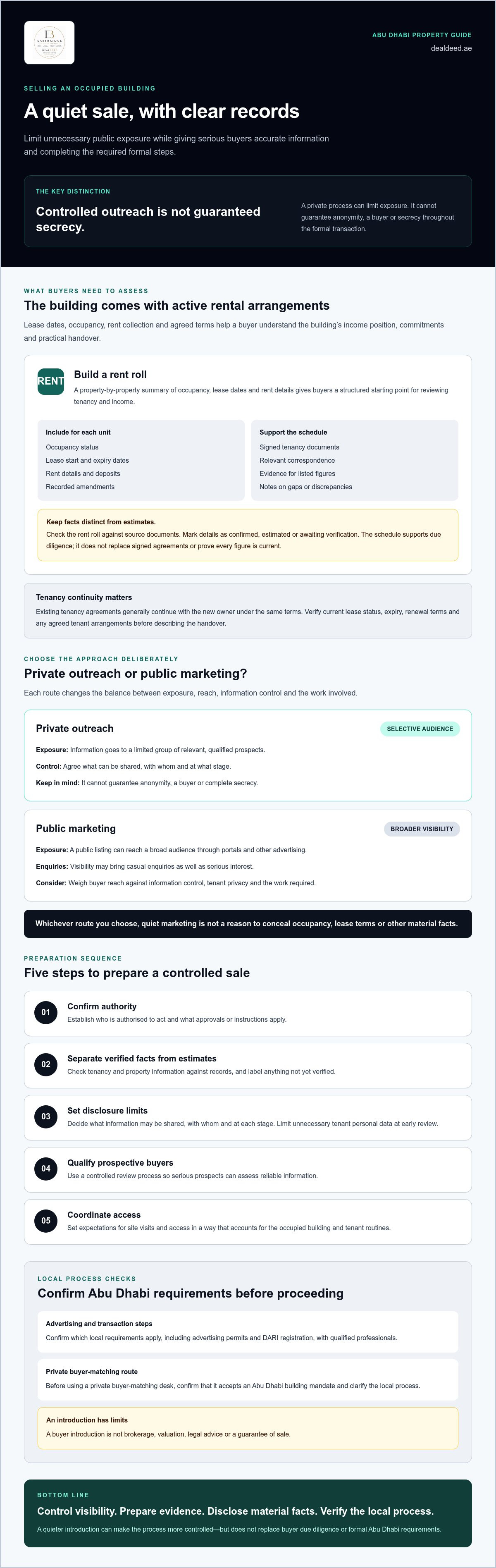
How to prepare a quiet sale of a tenanted building: five steps
A controlled sale starts before the first buyer approach. When selling a tenanted building quietly in Abu Dhabi, put authority, evidence and disclosure rules in order first. Separate verified facts from estimates, assumptions and points requiring professional review. This helps prevent an early summary from being mistaken for a confirmed representation.
- Confirm authority. Identify who can instruct a sale and who must approve decisions. Ask local advisers to check ownership authority, decision-makers and any required approvals before approaching buyers.
Checkpoint: Confirm the seller’s authority and approval pathway with the relevant adviser, and record who may approve disclosures and next steps.
- Organise the evidence. Assemble title and property records, tenancy schedules, lease documents and income records. Confirm the correct Abu Dhabi property-record authority and verification route. Do not assume a process used in another emirate applies. Label each item as verified, estimated, assumed or awaiting review.
Checkpoint: Reconcile key figures and dates against source documents, and flag unresolved discrepancies rather than presenting them as facts.
- Set disclosure controls. Decide what can be shared at each stage and with whom. A short initial brief may be enough to assess preliminary interest; sensitive documents can wait for a later, appropriate review. Agree on information-handling expectations with participants and seek advice on personal-data redaction.
Checkpoint: Keep an approved disclosure list, with a named decision-maker for requests outside its limits. The guide to Abu Dhabi real-estate privacy offers related considerations.
- Qualify buyers. Compare each prospect’s stated requirements with a clear buyer brief for the building. Share only information appropriate to that stage, and keep buyer questions distinct from confirmed property facts. Ask qualified local professionals to verify legal, title, tenancy, disclosure and transaction requirements before relying on any assumption.
Checkpoint: Record why a prospect is being considered and what information they have received before making further disclosures.
- Manage access. Plan site visits around tenant privacy and daily routines. Coordinate requests in advance, and have local advisers confirm applicable notice and access requirements before setting an appointment. Keep a log of recipients, documents shared, enquiries and follow-up actions.
Checkpoint: Confirm the access process and any required notice before arranging a viewing. Do not promise entry until the relevant requirements are checked.
Before submitting an Abu Dhabi mandate, verify service eligibility and local arrangements. Check whether DealDeed can consider your Abu Dhabi mandate; its private matching role is distinct from legal advice or a guarantee of a buyer or sale.
How to pursue a confidential buyer match for an Abu Dhabi building
A private matching desk can connect a prepared seller mandate with relevant buyer briefs, limiting the need for public advertising. Its value is a disciplined introduction, not a promised outcome. If you are selling a tenanted building quietly in Abu Dhabi, first establish whether the service accepts Abu Dhabi assets and how local verification will work.
DealDeed describes its private matching activity as focused on Dubai. Its stated property verification refers to Dubai Land Department data, so it should not be treated as verification for an Abu Dhabi building. Confirm the jurisdiction and applicable property-record process before sharing a mandate.
A verified brief helps buyers assess fit without public advertising, while leaving detailed due diligence for the appropriate stage.
What should an owner ask a private matching service?
Ask direct questions before submitting sensitive records:
- Does the desk accept Abu Dhabi building mandates, and which locally eligible licensed agents would handle introductions?
- How are property records, tenancy documents and prospective buyer credentials checked for this asset?
- What confidentiality controls apply, who can receive information, and how is onward sharing managed?
- When do any fees become payable, who is responsible for them, and do the stated terms apply to an Abu Dhabi mandate?
DealDeed describes a fixed introduction fee payable by participating agents only after a completed deal. Confirm the current terms, applicability and fee responsibility for the specific mandate. A matching introduction is not direct brokerage, public marketing, a valuation, legal advice or a guarantee of confidentiality, price, buyer or sale.
What happens after a suitable buyer is identified?
An introduction may lead to an expression of interest, followed by a controlled review of supporting records, negotiation and transaction support from the relevant qualified professionals. The seller decides what may be disclosed at each stage. A buyer match does not replace legal, tenancy or title review, and it does not itself complete a transfer.
For an Abu Dhabi asset, verify the correct authorities, required documents and settlement process with qualified local professionals. Transactions are officially processed through DARI, so private outreach does not remove formal registration requirements. Check any advertising or agent requirements that apply to the chosen route before proceeding.
Before committing, confirm the basics. If you are considering a private mandate, contact DealDeed to discuss a private mandate after confirming Abu Dhabi eligibility, participating agent arrangements and the next steps for local verification.
Make the next move with verified information
A discreet sale depends on preparation, not promises of invisibility. Keep tenancy records accurate, decide how information will be shared, and weigh selective buyer outreach against the visibility of public marketing. Before selling a tenanted building quietly in Abu Dhabi, confirm local tenancy, title and transaction requirements with qualified advisers.
DealDeed describes confidential buyer matching through licensed agents, with a fixed agent introduction fee payable only after successful deal completion. Its stated focus is Dubai, so confirm Abu Dhabi mandate eligibility, participating agent arrangements and local verification procedures before proceeding. A buyer introduction is not brokerage, legal advice or a guarantee of a sale.
If a private mandate may suit your priorities, discuss a private property mandate with DealDeed and first confirm whether the service can consider your Abu Dhabi asset. With the right checks in place, you can approach the next step with greater control.
Frequently Asked Questions
Can I sell a tenanted building in Abu Dhabi without publicly listing it?
You may explore selective buyer outreach without placing the building on a public portal, but first confirm which advertising rules apply to your approach. Abu Dhabi property advertisements require a Madhmoun permit, and transactions are registered through DARI. A quiet sale limits public exposure; it does not bypass required permits, official records or buyer due diligence. Ask a qualified local adviser to review the proposed route before sharing an offer.
What happens to tenants when a building is sold in Abu Dhabi?
Existing tenancy agreements generally continue with the new owner under the same terms, so do not assume a sale ends a lease. The buyer will need accurate details of occupancy, lease dates, rent and agreed arrangements to plan for handover. Confirm the effect of each lease, any transfer documentation and applicable Abu Dhabi requirements with qualified local counsel before making promises about vacant possession.
Do I have to tell tenants that the building is for sale?
Do not assume either that a tenant must be told immediately or that no notice or communication is required. The answer can depend on the tenancy terms, proposed access and applicable Abu Dhabi rules. Ask local counsel to confirm any notification, notice or viewing requirements before approaching tenants. Whatever the timing, avoid unplanned visits and handle tenant information carefully while giving prospective buyers material facts about occupancy.
How do buyers assess a building that already has tenants?
Buyers typically review occupancy, lease terms, expiry and renewal dates, rent records, deposits and relevant amendments or correspondence. A property-by-property rent roll gives them a concise starting point, but it should match the supporting documents. Mark figures that are estimates or still being verified. A buyer may then seek further evidence through controlled due diligence, so prepare accurate records before sharing a summary or arranging a review.
Is a private sale better than a public listing for an occupied building?
Neither route is automatically better. Private outreach may suit an owner prioritising selective disclosure and fewer casual enquiries, while public marketing can offer broader visibility to potential buyer groups. Each route has trade-offs in reach, information control and the work needed to manage enquiries. Neither guarantees a buyer or preferred terms. Compare both against your priorities, tenant considerations and Abu Dhabi advertising requirements with a qualified local adviser.
How can I protect tenant privacy during a building sale?
Use staged disclosure. Start with a property summary that avoids unnecessary personal details, then share relevant tenancy documents only with appropriate prospective buyers during due diligence. Ask an adviser which details should be redacted, and keep a record of who received each document. Coordinate viewings respectfully, and confirm applicable notice and access requirements first. Privacy controls should limit exposure without hiding occupancy or other material facts from serious buyers.
Does DealDeed handle quiet building sales in Abu Dhabi?
Confirm Abu Dhabi eligibility before treating DealDeed as an option for your building. DealDeed describes a private matching desk focused primarily on Dubai, connecting sellers with buyers through licensed agents without public listings or marketing. Its stated verification process uses Dubai Land Department data, not Abu Dhabi records. Ask whether the mandate is accepted, which eligible agents can participate and what local verification arrangements apply. Confirm current fee terms as well.


