

A discreet Dubai property sale can stay out of public marketing, but it can’t bypass required transaction procedures. If you’re researching how to keep a property sale out of Dubai news, the distinction matters: privacy means limiting avoidable exposure, not erasing official records or avoiding disclosure obligations.
It’s reasonable to be cautious. A public listing can circulate details about your property and signal your intentions to people you haven’t chosen to inform. Yet avoiding public advertising doesn’t mean you must rely on unverified enquiries or give up access to serious buyers. The right approach is controlled, not invisible.
This guide explains what can be kept confidential, what may need to be shared, and what to clarify before appointing an agent. You’ll also learn how vetted, agent-to-agent introductions can connect a seller with relevant buyers without a public listing. DealDeed’s private matching desk works through RERA-licensed agents and checks property details against Dubai Land Department data. It isn’t a direct brokerage service, and no private route guarantees complete anonymity. The aim is quieter exposure, credible introductions, and a clear understanding of the obligations that remain.
Key Takeaways
- To understand how to keep a property sale out of Dubai news, focus on reducing voluntary publicity rather than expecting complete secrecy.
- Compare public portals, restricted agent circulation, and private buyer matching by reach, exposure, and how much control you retain.
- Before sharing documents, set clear privacy priorities and confirm the agent’s responsibilities and licensing.
- Ask a RERA-licensed agent or qualified UAE legal professional which transaction requirements apply to your specific sale.
- A private matching desk can connect a seller mandate with relevant buyer briefs through licensed agents, without publishing a public listing.
How a Dubai property sale can attract public attention, and what you can control
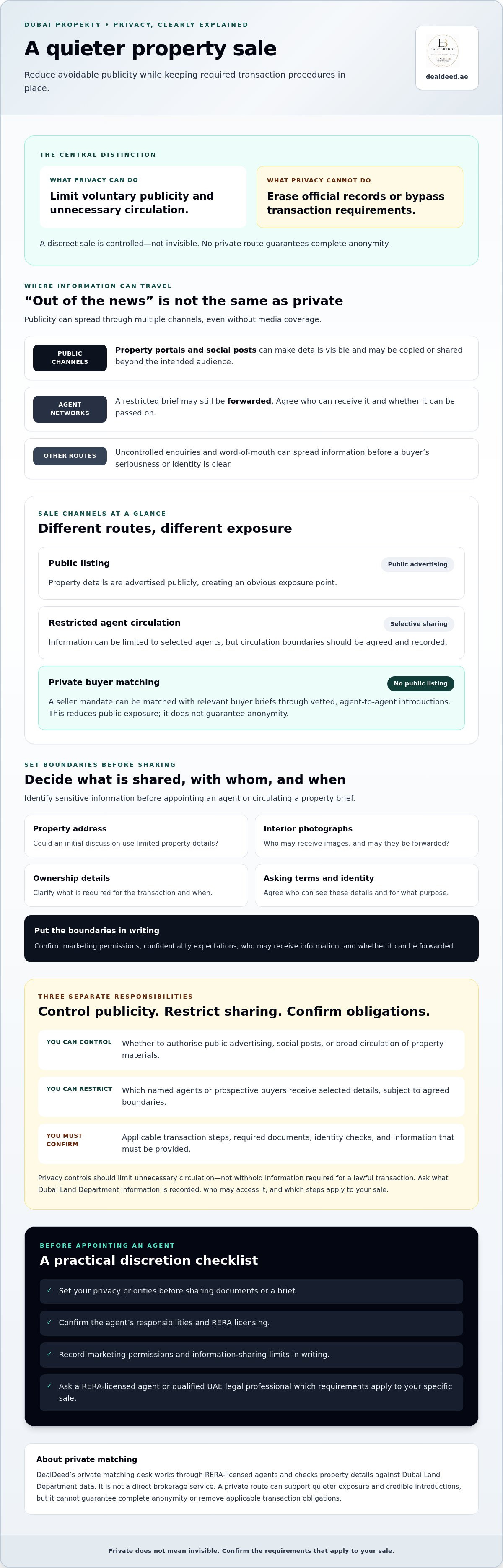
A private sale process can reduce unnecessary exposure. It can’t promise that nobody will learn the property is for sale or that a transaction has taken place. “Out of the news” is also narrower than “private”: a sale may draw no media coverage yet still appear on a property portal, circulate among agents, or become a topic of conversation.
Public advertising is an obvious exposure point, but not the only one. A social post can be copied or shared beyond its intended audience. An agent’s brief may be forwarded. Uncontrolled enquiries can lead to property details being shared before a buyer’s seriousness or identity is clear. Even a private approach can travel further than intended once information leaves your hands.
To understand how to keep a property sale out of Dubai news, focus on the steps you can govern: whether public marketing is authorised, which people may receive information, and what details can be shared at each stage. Agree these boundaries with your appointed professional and put them in writing. For a broader view of the disposal process, see this guide to selling property quietly in Dubai.
What does keeping a property sale out of the news actually mean?
Discretion means limiting voluntary publicity and unnecessary circulation, not making a transaction invisible. News coverage is only one channel. Portals, agent networks, social media, and word-of-mouth can spread information without any journalist being involved. A restricted process may reduce the audience, but no private route can guarantee that details will never become public. Privacy law offers a broad introduction to concepts around personal information, but it isn’t a substitute for advice on requirements that apply in the UAE.
Which details should a seller decide how to share?
Before engaging an agent or sharing a brief, identify the information you consider sensitive. This may include the full property address, interior photographs, ownership details, asking terms, and your identity. Decide who may receive each item, for what purpose, and whether it can be forwarded. For example, you might want an initial buyer discussion to use limited property details, with more information shared only after the buyer has been vetted.
Ask your appointed professional to confirm the proposed sharing process and record agreed marketing permissions and confidentiality expectations in writing. These boundaries should control unnecessary circulation, not withhold information required for a lawful transaction. Confirm with a RERA-licensed agent or qualified UAE legal professional what must be disclosed and when for your specific sale.
Dubai confidentiality limits: protect privacy without bypassing transaction requirements
Confidentiality controls can limit voluntary publicity. They don’t exempt a seller from transaction procedures that apply to the sale. A private mandate, restricted buyer brief, or decision not to advertise publicly should never be treated as permission to skip required registration, identity checks, or disclosures. Confirm current requirements for your specific property and ownership structure with a RERA-licensed agent or qualified UAE legal professional.
Keep three categories separate:
- Controllable publicity: whether to authorise public advertising, social posts, or broad circulation of property materials.
- Restricted information: details shared selectively with named agents or prospective buyers, subject to agreed boundaries.
- Professional confirmation: transaction steps, required documents, identity checks, and any information that must be provided under applicable rules.
Dubai Land Department records and transaction requirements are not matters to guess at. Ask your adviser what information is recorded, who may access it, and which steps apply. For example, limiting circulation of a seller brief is different from withholding ownership or identity information required to progress a transaction. The distinction is central to how to keep a property sale out of Dubai news: manage optional exposure, not required processes.
What can a seller request from agents and advisers?
Set expectations in writing before sharing sensitive material. Specify whether public listings, photography, advertising, or onward sharing are permitted. Ask who may receive the address, images, ownership details, and asking terms, and what buyer checks take place before those details are released. Keep copies of approved materials, recipient records where available, and any changes to your instructions. Clear documentation helps everyone follow the same boundaries.
Privacy has limits even inside a controlled process. The UAE Government Media Office describes record-keeping obligations for real estate brokers, including retaining transaction records for a minimum of five years. Ask your appointed professional how applicable retention requirements affect information handling. Confidentiality should mean controlled access, not a promise that records won’t be kept.
What should never be treated as optional?
Don’t rely on assurances that a sale can avoid official registration, identity checks, or other applicable procedures. Requirements can depend on the transaction and parties involved. Verify them with relevant Dubai authorities and qualified local professionals before agreeing to a process or signing documents. This section is general guidance, not a legal conclusion.
If controlled buyer introductions are a priority, you can review how DealDeed’s private matching desk works through RERA-licensed agents. A private route may limit public marketing, but it cannot guarantee complete secrecy or remove transaction obligations.
Public listing or private buyer matching: compare Dubai sale channels
Choosing a sale channel is a balance between reach and control. Public advertising may put a property in front of a wider audience, while restricted circulation can narrow who sees the details. A narrower audience may mean less visibility. It doesn’t guarantee the same buyer reach or sale outcome.
| Channel | Potential reach | Exposure and seller control |
|---|---|---|
| Public property portal | Broad visibility to portal users and people who encounter shared listings. | High public exposure. The seller can approve listing terms, but may have less control once material is published or circulated. |
| Restricted agent circulation | Depends on the professionals contacted and their relevant buyer networks. | More controlled than a public listing, provided sharing permissions and onward circulation are clearly agreed. |
| Private buyer matching | Focused on buyer briefs that may align with the property; reach is narrower and not equivalent to broad advertising. | Can limit public distribution and support selective introductions, though information may still travel beyond the intended recipients. |
When might public marketing fit, and when might it not?
Consider your priorities, property type, timing, and capacity to handle broad enquiries. A seller seeking wide exposure may prefer a public listing. Someone prioritising controlled circulation may consider agent-only sharing or private matching. A public listing doesn’t automatically cause negative press or reduce a property’s value. The trade-off is practical: wider visibility can bring more attention, while making circulation harder to contain.
How does a controlled introduction process work?
A controlled process starts with a defined property brief. The seller and appointed professionals agree what details can be shared, with whom, and at what stage. Before an introduction, ask what buyer checks are performed and how agents coordinate follow-up. Vetting can help assess whether an enquiry is relevant, but it can’t guarantee that every buyer is suitable or ready to proceed.
DealDeed’s private matching desk connects seller mandates with relevant buyer briefs through RERA-licensed agents. It doesn’t publish public listings or provide direct brokerage. Property details are checked against Dubai Land Department data, and transactions are handled confidentially between licensed agents. This limits public marketing through the desk, not all possible circulation or required transaction procedures. For more detail on the model, read the Dubai private real estate matching guide.
If you’re weighing how to keep a property sale out of Dubai news, choose a channel based on the exposure you’ll accept and the buyers you need to reach. No option fits every property or seller.
How to arrange a discreet property sale in Dubai: a practical checklist
A discreet sale depends on clear instructions and controlled decisions at each stage. Before sharing a property brief, appoint an appropriately licensed professional and agree who is responsible for enquiries, buyer introductions, document handling, and any marketing. Don’t send sensitive records until you’ve confirmed who will receive them and why.
Before sharing a property brief
Separate the facts needed to assess initial interest from details that should be disclosed only later, where appropriate. Confirm each recipient’s identity and professional role. Ask how enquiries, buyer interest, and access to documents will be recorded and managed. Then put the sharing rules in writing.
- Set your privacy priorities. Decide whether your priority is avoiding public advertising, limiting the number of people who see the property details, or keeping your identity out of early discussions where appropriate.
- Appoint the right professional. Confirm the professional’s role, licensing status, and responsibilities. Ask who will handle buyer contact and keep you informed.
- Approve an information-sharing plan. Specify which materials may be used, who may receive them, whether anything can be forwarded, and whether public publication is authorised. Record any later changes.
- Prepare a limited initial brief. Include what’s needed to assess buyer interest, but don’t send additional documents or identifying details without confirming the purpose and recipient.
- Review introductions and enquiries. Ask what screening process will be used and what information will be shared before a buyer is introduced. A screening process can inform your decision, but it can’t guarantee a buyer’s suitability or ability to proceed.
- Track progress and reassess. Keep a record of introductions, requests for further information, permissions granted, and changes to the sale approach. Before moving forward, have qualified local advisers confirm current documentation and transaction requirements.
During buyer introductions and due diligence
Release information progressively when it’s appropriate, authorised, and consistent with your written plan. For example, a buyer may first receive a concise brief, followed by additional property details if their interest is credible and the next step requires them. Your appointed professional should explain how buyer interest is assessed, how documents are handled, and when the process shifts into formal due diligence. Verify any required disclosures or transaction steps with qualified local advisers; privacy instructions don’t replace them.
Before authorising marketing or an introduction, confirm:
- The professional’s identity, role, and licensing status.
- Which materials are approved, and whether public publication is permitted.
- Who may receive the brief and whether onward sharing needs your approval.
- How enquiries, buyer checks, document access, and progress updates will be managed.
- Which transaction requirements need professional confirmation before proceeding.
For a controlled route to relevant buyer briefs through licensed agents, explore DealDeed’s private buyer brief matching. A written plan won’t make a sale invisible, but it gives you a clearer basis for deciding what to share and when.
Use a private matching desk when controlled exposure is the priority
A private matching desk offers a different route from a public listing or direct brokerage. DealDeed doesn’t publish property listings or represent sellers as a broker. It connects seller mandates with relevant buyer briefs through RERA-licensed agents, keeping the process between participating professionals rather than advertising the property publicly through the desk.
The process begins with a seller mandate outlining the property and sale objectives. DealDeed checks property details against Dubai Land Department data, then looks for relevant buyer briefs. If there’s a potential fit, the introduction and transaction coordination take place through licensed agents. A match is an introduction, not a promise that a buyer will proceed or that a sale will complete.
DealDeed charges a fixed introduction fee to participating agents only if a matched transaction completes. Sellers aren’t charged directly by DealDeed. Transaction requirements still apply, and a private matching route can’t guarantee complete secrecy or remove required procedures.
What to confirm before choosing a private matching route
Before proceeding, ask how buyer vetting is handled, how property details are verified, and what information may be shared at each stage. Confirm which agent represents each party, who manages negotiation, and who is responsible for transaction steps. Then compare the expected reach and transparency of the process with your privacy priorities. A controlled channel may limit public exposure, but it won’t necessarily reach as many buyers as broad advertising.
How to take a discreet next step with DealDeed
Prepare a concise mandate that describes the property, your sale objectives, and your confidentiality preferences. Be clear about which details can be shared for an initial match and which require your approval before release. You can then assess whether the private matching desk is suitable for your property and expectations. Any introduction depends on the relevance of available buyer briefs; it isn’t a guaranteed outcome.
If the approach fits, submit a private property brief to DealDeed to begin a discreet first conversation. It’s a practical way to explore controlled buyer matching without placing the property on a public listing through DealDeed.
Choose a quieter route with clear boundaries
Knowing how to keep a property sale out of Dubai news starts with one distinction: you can limit voluntary publicity, but you can’t promise complete secrecy or bypass applicable transaction requirements. Set written rules for what may be shared, with whom, and whether public marketing is authorised. Then confirm current obligations with a RERA-licensed agent or qualified UAE legal professional.
The right channel depends on your priorities. Broad advertising may offer wider visibility; controlled buyer matching can keep circulation more focused, without guaranteeing equivalent reach or a completed sale. DealDeed’s private matching desk connects seller mandates with relevant buyer briefs through RERA-licensed agents, and checks property details against Dubai Land Department data. Its fixed introduction fee is charged to participating agents only after a matched deal completes.
If a controlled introduction process suits your objectives, submit a private property brief to DealDeed. Start with clear instructions and a considered plan. You can pursue a sale with greater control over avoidable exposure while meeting the requirements that apply.
Frequently Asked Questions
Can I sell a Dubai property without listing it publicly?
Yes. You can explore a sale through restricted agent circulation or private buyer introductions instead of publishing a listing on a property portal. A smaller audience may mean less exposure, but it can also limit buyer reach. Agree in writing which property details may be shared and with whom. A private sales route doesn’t remove applicable transaction procedures, so confirm the requirements for your property with a qualified local professional.
How do I keep a Dubai property sale out of the news?
To manage how to keep a property sale out of Dubai news, limit voluntary publicity: don’t authorise public advertising or social posts unless you choose to, and set clear rules for sharing briefs and documents. Ask professionals to introduce the property only through agreed channels and to explain how enquiries are handled. No approach guarantees that information won’t circulate. Dubai property transactions must be registered with the Dubai Land Department, creating an official record distinct from news coverage.
Can I sell my property in Dubai without an agent?
Yes, owners may sell directly without an agent, but they then need to manage the sale process themselves. That can include coordinating with the buyer, handling documents, and arranging transaction steps. Before proceeding, confirm current requirements with the Dubai Land Department or a qualified UAE legal professional. If you appoint an agent, verify their RERA licensing and agree on their responsibilities, marketing permissions, and information-sharing boundaries before giving them property documents.
Will a private property sale stay completely confidential?
No private sale process can guarantee complete confidentiality. Details may be forwarded, discussed among people involved, or shared beyond the original recipients. A completed transaction also involves required procedures and official records. The practical aim is to reduce avoidable publicity, not make the sale invisible. Ask each professional who can access your information, how it may be used, and whether onward sharing is allowed. Put agreed boundaries in writing and review them if the process changes.
How can I find serious buyers without advertising my Dubai property?
Ask a RERA-licensed agent about restricted introductions or a private buyer-matching route. Share a concise brief, clarify which details can be disclosed, and ask how buyer interest is assessed before further information is released. DealDeed matches seller mandates with relevant buyer briefs through RERA-licensed agents and checks property details against Dubai Land Department data. Matching can support focused introductions, but it doesn’t guarantee a suitable buyer, equivalent reach to public advertising, or a completed sale.
What should I verify before sharing property details privately?
Confirm each recipient’s identity, professional role, and licensing status. Agree in writing which details may be shared, with whom, and whether recipients can forward them. Ask how enquiries are screened, who can access documents, and how information is handled and recorded. For example, you may approve a limited initial brief while reserving ownership documents for a later step. Don’t withhold information required for the transaction; ask a qualified local professional what must be provided and when.


