

Maximum visibility is often the fastest route to devaluing a prime property. When evaluating a listing on Bayut vs quiet disposal mandate Dubai real estate strategy, many asset owners assume that casting the widest digital net guarantees the highest closing price. You want clean liquidity and strict price integrity. Instead, open public exposure routinely invites speculative viewing requests, unqualified inquiries forwarded by competing agents, and archived price drops that dilute your negotiating leverage.
Once a high-value asset is indexed across portals, private floor plans, sensitive financial holdings, and valuation histories become permanent public record. This analysis evaluates the strategic differences between public portal exposure on Bayut and private quiet disposal mandates to protect asset value in Dubai. We break down RERA compliance frameworks, buyer vetting protocols, and transaction privacy safeguards to help you determine the optimal exit path for your portfolio.
Key Takeaways
- Deciding between a listing on Bayut vs quiet disposal mandate Dubai real estate approach hinges on whether you require mass retail visibility or institutional valuation defense.
- Public portal exposure archives price reductions and days on market, creating digital listing fatigue that invites lowball bids.
- Compliant quiet mandates utilize private RERA Form A agreements and direct Dubai Land Department verification, bypassing public advertising permits entirely.
- Institutional deal desks enforce strict non-disclosure terms and verify liquid capital before disclosing title data or floor plans.
- Liquid, entry-level apartments thrive on high-volume portal algorithms, whereas trophy villas and prime commercial assets require private matching to retain pricing power.
The Strategic Divide: Public Portal Exposure vs Confidential Mandate Execution
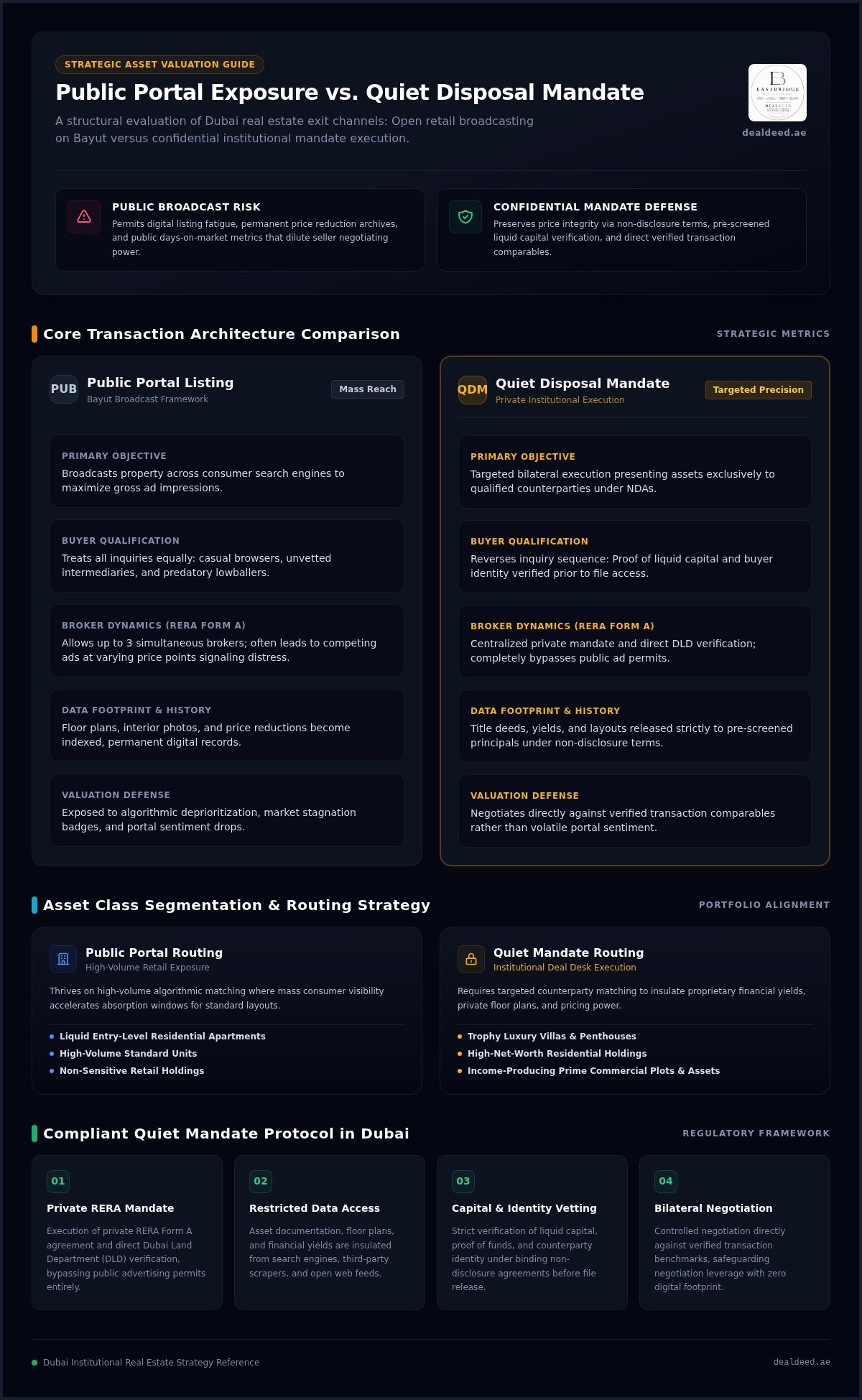
Public portal marketing operates on a broadcast model. It broadcasts property details across consumer search engines to capture maximum retail traffic. A quiet disposal mandate takes the opposite approach. It relies on targeted bilateral execution, presenting the asset exclusively to qualified counterparties under binding non-disclosure terms.
Deciding between a listing on Bayut vs quiet disposal mandate Dubai real estate strategy requires understanding asset sensitivity. High-volume residential apartments often benefit from open algorithmic visibility. High-net-worth residential holdings, income-producing commercial plots, and penthouses do not. Mass syndication creates overexposure, whereas private execution preserves negotiating leverage. In fluctuating market conditions, open-market price discovery exposes sellers to public price reductions; quiet mandates protect baseline pricing by negotiating directly against verified transaction comparables rather than portal sentiment.
The Architecture of a Public Portal Listing
A public portal listing syndicates detailed asset records across open search engines and third-party scrapers. High-resolution interior photography, private floor plans, and asking prices are visible to everyone: speculative agents, curious neighbors, active tenants, and competing investors. Public accessibility creates friction. Every operational adjustment, days-on-market metric, and price drop becomes permanent digital data. If an asset fails to trade within typical absorption windows, public algorithms deprioritize the listing, leaving a paper trail that predatory buyers exploit to negotiate discounts.
The Framework of a Quiet Disposal Mandate
A quiet disposal mandate operates through private channels, mirroring the institutional mechanics of pocket listings in real estate to insulate property data from public aggregators. The asset is never broadcast across consumer web feeds. Instead, transaction briefs move strictly through verified broker networks and pre-screened private buyer registers.
- Restricted Documentation: Title deeds, floor plans, and financial yields are released only after verifying buyer liquidity and identity under strict non-disclosure terms.
- Direct Information Control: Asset principals dictate who views property data, eliminating unvetted inquiries and rogue agent listings.
- Valuation Defense: Negotiations proceed without public price-drop badges or algorithmically calculated market stagnation markers.
The distinction is structural. Public portals prioritize ad impressions; quiet mandates prioritize closing precision.
Comparing Bayut Listings and Quiet Mandates: Transaction Metrics That Matter
Evaluating a listing on Bayut vs quiet disposal mandate Dubai real estate path comes down to measuring signal against noise. Portals optimize for gross impressions. Private mandates optimize for transaction certainty. While an open portal cast might generate hundreds of clicks, the operational friction of filtering those leads falls squarely on the seller.
Under Dubai regulations, an owner can issue RERA Form A mandates to a maximum of three brokers simultaneously. On public portals, this often results in three competing agencies advertising the same unit at different price points, confusing buyers and signaling urgency. A quiet mandate eliminates this friction by centralizing execution under private non-disclosure terms, safeguarding negotiation leverage from start to finish.
Lead Quality and Buyer Qualification Standards
Public portal algorithms treat every inquiry equally. A click from a casual browser carries the same technical weight as an inquiry from a funded family office. In reality, open listings generate significant operational drag: unvetted intermediaries, curious neighbors, and speculative lowballers requesting disruptive physical inspections.
Quiet mandates reverse the inquiry sequence. Capital is vetted before access is granted. Proof of funds and buyer identity are verified prior to releasing title documentation or scheduling private viewings. Transactions align cleanly with UAE official property ownership regulations, ensuring that property viewings involve only liquid principals ready to transact.
Information Security and Digital Footprint Control
Every public listing creates a permanent digital footprint. Aggregators scrape asking prices, time on market, and downward revisions. If an asset sits for sixty days, algorithms highlight the stagnation, prompting buyers to submit offers well below market value.
Sophisticated owners execute a sell property quietly in Dubai strategy to keep sensitive transactions offline. Pricing stays private. Tenant operations remain undisrupted. Motives for selling stay confidential. For principals and certified brokers demanding institutional discretion, coordinating through DealDeed's deal desk ensures direct access to pre-screened buyers without public pricing exposure or digital valuation decay.
The Asset Degradation Risk: How Portal Overexposure Erodes Luxury Valuations
Overexposure devalues prime real estate. When choosing between a listing on Bayut vs quiet disposal mandate Dubai real estate approach, owners often underestimate how portal aggregators track listing history. Broadcast algorithms incentivize clicks, not value defense. Once an asset lingers online, public metrics turn against the principal, transforming a premier property into perceived distressed stock.
The Psychology of Days on Market in Dubai Real Estate
Public portals conspicuously display active listing durations to every prospective buyer. In the prime sector, high cumulative days on market trigger immediate buyer skepticism. Purchasers assume hidden defects: compromised construction, tenant disputes, or title complications.
When an owner adjusts an asking price to regain algorithmic traction, portals flag the listing with prominent price-drop badges. This creates a predatory response. Instead of attracting qualified retail bids, public reductions signal seller fatigue, encouraging institutional buyers to submit aggressive lowball offers. Private mandates eliminate this digital decay. Days on market remain unrecorded, and negotiations proceed based on asset fundamentals rather than public algorithms.
Broker Duplication and Conflicting Valuation Damage
The open market frequently suffers from broker duplication. Industry audits show that 15% to 25% of public portal listings in Dubai are outdated, stale, or duplicated across competing agencies. When an owner authorizes multiple brokers under non-exclusive arrangements, those brokers race to capture search portal leads rather than represent the seller's long-term interest.
This dynamic damages an asset's market standing in several distinct ways:
- Price Discrepancies: Competing agents advertise the same property at varying asking prices to undercut one another for buyer clicks.
- Distorted Specifications: Inconsistent floor areas and conflicting service charge figures dilute listing authenticity across search results.
- Institutional Disengagement: Serious family offices and sovereign capital avoid properties circulating across multiple consumer portals, viewing them as compromised or chaotic.
Deploying a private dubai real estate deal desk eliminates multi-agent confusion entirely. The mandate remains centralized, transaction parameters stay verified, and the asset avoids the valuation erosion inherent to public portal clutter.
How to Execute a Compliant Quiet Disposal Mandate in Dubai
Executing a private transaction in the emirate requires strict regulatory discipline. When evaluating a listing on Bayut vs quiet disposal mandate Dubai real estate strategy, market participants often mistakenly believe off-market sales bypass RERA oversight. In practice, compliant quiet disposals adhere to a precise legal framework that satisfies Dubai Land Department standards while keeping asset data completely confidential.
Legal Structuring: RERA Form A Without Digital Marketing Clauses
Every legitimate sale in Dubai begins with RERA Form A. For a quiet mandate, this agreement is structured with explicit non-public marketing provisions. The contract legally authorizes the broker to represent the asset while barring open syndication across public portals, social channels, or print media.
Because the property is never advertised to the public, an electronic Trakheesi permit and Madmoun QR code aren't required. The seller retains full legal protection under Dubai real estate law, while the asset remains insulated from digital tracking and public price-drop badges.
Verification Protocols: Protecting Seller and Asset Integrity
Once legal representation is established, the transaction moves through a controlled five-step execution protocol:
- Title Validation: The broker verifies ownership records directly against official dubai land department verified deals infrastructure, confirming clear title and clean equity before approaching capital networks.
- Anonymized Investment Teasers: The desk drafts a blind brief detailing specifications, gross yields, and sector benchmarks without disclosing villa numbers, floor plans, or identifiable street coordinates.
- Institutional Non-Disclosure Agreements: Prospective buyers must sign binding confidentiality terms and demonstrate verified proof of liquid funds prior to receiving sensitive property files.
- Restricted Documentation Release: Full title records, service charge accounts, and floor plans circulate only to vetted principals.
- Private Viewing Coordination: Physical inspections are arranged exclusively for decision-makers or authorized fiduciaries, eliminating disruption from unqualified viewers.
This systematic workflow ensures that transactions close quickly without exposure fatigue. If you are an asset owner or certified broker looking to execute an off-market sale, register a quiet disposal mandate with DealDeed to access pre-qualified institutional capital under absolute confidentiality.
Choosing Your Path: When to List Publicly vs Deploy DealDeed's Deal Desk
Every asset requires a matching distribution method. Deciding on a listing on Bayut vs quiet disposal mandate Dubai real estate path isn't a matter of preference. It's a structural decision governed by property typology, target liquidity pools, and privacy thresholds.
Broadcast platforms excel when an asset fits standard retail search parameters. Private matching desks take over when publicity creates valuation friction, tenant complications, or security risks for the owner.
Decision Matrix: Identifying Your Asset Class
Commodity residential units (standard one- and two-bedroom apartments in high-density districts like Jumeirah Village Circle or Business Bay) depend on consumer search volume. Retail end-users search portals daily. In these segments, algorithmic reach accelerates absorption, and public price discovery carries minimal reputational risk.
Prime and non-standard assets require the opposite environment:
- Trophy Residences: Luxury villas in Palm Jumeirah or Emirates Hills demand quiet execution to keep wealth profiles and interior layouts off public databases.
- Income-Generating Commercial Stock: Exposing tenanted logistics hubs, retail plazas, or residential buildings publicly can trigger lease terminations, panic among tenants, and destabilized yields.
- High-Value Land Plots: Publicly broadcasting prime development parcels invites speculative intermediaries who claim mandates they don't hold.
For these assets, capital moves through private networks. Family offices and sovereign entities actively leverage private real estate matching in Dubai to acquire assets without the interference of retail bidding wars.
The DealDeed Private Desk Advantage
DealDeed is not a consumer brokerage or a public property aggregator. It functions as an institutional deal desk connecting RERA-licensed sell-side brokers with verified buy-side representatives, sovereign entities, and private family offices.
Rather than compounding percentage commissions that erode transactional equity, DealDeed charges transacting agents a flat introduction fee strictly upon successful deal registration. There are zero upfront listing fees, zero subscription paywalls, and zero consumer-facing advertisements. The asset never appears on search engines. Dubai Land Department records validate the title deed behind closed doors, preserving pricing integrity and ensuring that sensitive properties trade cleanly on their true fundamentals.
Securing Value Through Private Execution
Choosing between a listing on Bayut vs quiet disposal mandate Dubai real estate approach defines how the market perceives your asset. Mass syndication suits standard residential stock where retail search volume drives velocity. For trophy villas, penthouses, and commercial parcels, public exposure invites price degradation, unqualified inquiries, and an irreversible digital footprint.
Private execution puts control back where it belongs: with the principal. By securing direct title validation against Dubai Land Department records, transactions proceed on verified data rather than speculative sentiment. Operating through a strictly private matching desk accessible only by licensed RERA professionals, sensitive holdings bypass consumer portals entirely. With flat transaction introduction fees and zero upfront costs, you defend your equity while negotiating directly with vetted counterparties.
Protect your asset provenance and trade on your terms. Register your quiet disposal mandate with DealDeed to execute your next transaction with institutional discretion and absolute market clarity.
Frequently Asked Questions
Does selling off-market via a quiet disposal mandate take longer than listing publicly on Bayut?
No. A quiet disposal mandate often closes faster because it targets pre-vetted, liquid counterparties directly. While public portals generate immediate clicks, filtering unqualified inquiries and negotiating non-binding offers extends transaction timelines. Private deal registers report a median turnaround of 11 to 21 days to secure a binding offer. Quiet mandates eliminate retail viewing delays and connect principals straight to institutional capital with ready funds.
Can I legally sell real estate in Dubai without listing it on public portals or social media?
Yes. UAE and Dubai Land Department regulations permit private off-market property transfers. When comparing a listing on Bayut vs quiet disposal mandate Dubai real estate path, legal compliance requires an executed RERA Form A between seller and broker. Because the transaction operates privately via institutional introducer desks rather than open marketing channels, electronic Trakheesi permits and public Madmoun QR codes aren't required. Contracts execute legally at authorized DLD Trustee hubs.
How do I prevent rogue brokers from posting my property on Bayut without my permission?
Protect your title deed and withhold unwatermarked photography. In Dubai, brokers must hold a signed RERA Form A and an approved Trakheesi permit to advertise publicly. If an unauthorized agent publishes your asset, report the listing directly via the DLD REST app or RERA compliance portal. The Dubai Land Department's advertising governance systems penalize unpermitted listings with statutory fines starting at AED 50,000, quickly eliminating fraudulent ad duplication.
What documents are required to initiate a compliant quiet disposal mandate in Dubai?
Initiating a compliant mandate requires an official title deed issued by the Dubai Land Department, valid Emirates IDs or passports of all titleholders, and an executed RERA Form A detailing private agency representation. If the asset is held under a corporate entity or SPV, you'll also need the certificate of incorporation and trade license. These documents allow the matching desk to validate ownership cleanly before drafting blind teasers.
How are buyers vetted for proof of funds before seeing an off-market luxury property?
Private desks enforce strict onboarding protocols before coordinating viewings. Prospective buyers or their certified RERA brokers must execute an institutional non-disclosure agreement and submit documentary proof of liquidity. This includes verifiable bank comfort letters, escrow verification, or official statements of account. If a party cannot demonstrate liquid capital capable of completing the acquisition at registered DLD benchmark values, the desk withholds title specifics and declines private property access.
Is a quiet disposal mandate suitable for apartments, or is it exclusively for luxury villas?
While trophy villas and penthouses are traditional quiet assets, private mandates suit any property where publicity creates friction. Bulk apartment blocks, tenanted mid-market portfolios, and specialized commercial units benefit significantly from quiet matching. When an investor evaluates a listing on Bayut vs quiet disposal mandate Dubai real estate strategy for tenanted apartments, a private mandate prevents tenant panic, preserves in-place lease agreements, and defends net rental yields against public market speculation.
What happens if a property listed on public portals fails to sell and becomes stale?
Portals archive listing dates, exposing accumulated days on market to prospective buyers. When properties sit past typical absorption cycles, algorithms deprioritize them in search feeds. Lower rankings force brokers to discount asking prices, displaying price-drop badges that attract opportunistic lowball bids. Once an asset develops digital fatigue, sellers often withdraw the listing completely for several months to reset buyer perception before re-entering through private off-market channels.


