

A hotel portfolio’s asking price in Dubai is not a reliable valuation on its own. An off-market hotel apartment portfolio sale in Dubai should be assessed against the assets, operating performance and ownership structure, rather than a single market-wide rate.
Those figures show why headline prices need context. Key count, location, operator, occupancy, room rates, running costs and the quality of the underlying records all shape how buyers assess a portfolio. A quiet sale also depends on verified information and controlled disclosure, not broad public exposure.
This guide explains how hotel and serviced-apartment portfolios are verified, which specifications matter, how confidential sales are handled, and how asking prices are assessed in AED. It shows what separates a headline figure from a defensible valuation, and which information supports a serious buyer review. The focus is evidence, operating detail and discretion.
Key Takeaways
- Learn which ownership, registration and operating records help establish that a portfolio is ready for serious buyer review.
- Assess hotel apartments by more than unit count: management terms, service charges, space and income arrangements all shape portfolio quality.
- Understand how confidential sale processes can limit public exposure while information is shared with vetted buyers.
- See how location, operator performance and operating costs inform a price assessment, and where private buyer matching can support the next step.
Asset verification and transaction process
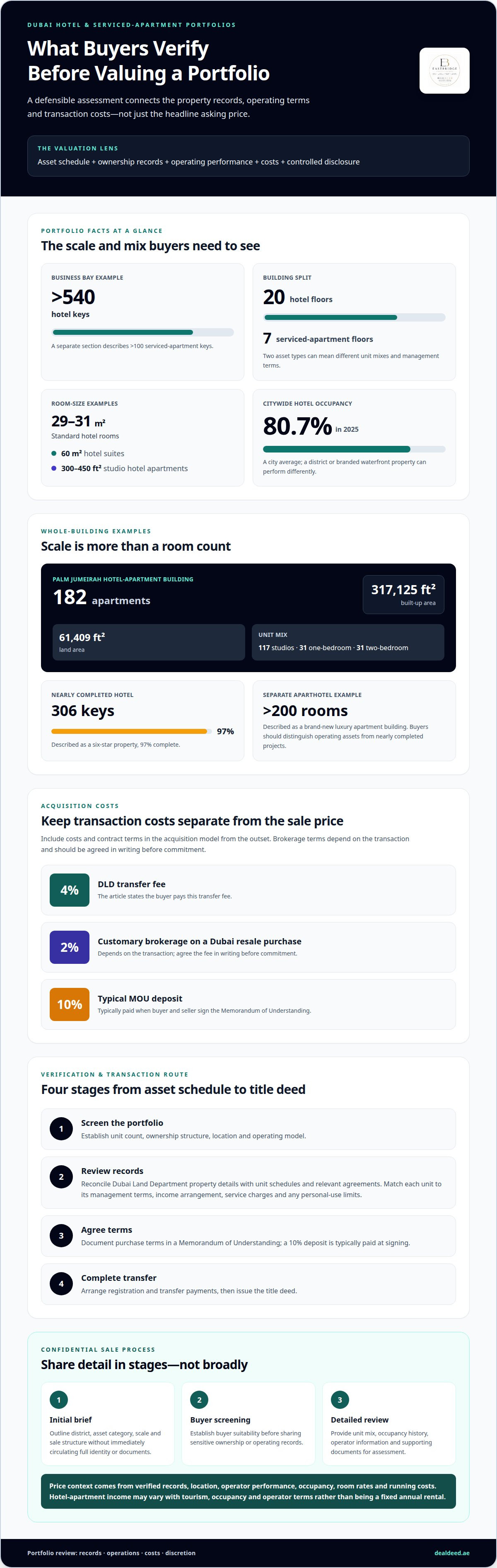
Verification starts with the asset schedule, not the headline price. For each hotel apartment, align unit identifiers, ownership details and property records with Dubai Land Department data. A studio and a larger suite should appear as distinct assets, with ownership and status documented for each. Reconcile the portfolio total against individual records so the proposed purchase clearly covers the assets presented for sale.
Operating documents matter alongside title information. Map each unit to its management agreement, income arrangement, service charges and any limits on personal use. Hotel apartment income may depend on tourism, occupancy and operator terms rather than a fixed annual rental. Buyers should check the registration status of relevant contracts as part of due diligence. Gaps between the asset schedule and operating documents can affect the assessment and transaction terms.
A professional acquisition process usually moves through defined stages:
- Screen the portfolio: establish the unit count, ownership structure, location and operating model.
- Review records: reconcile Dubai Land Department property details with unit schedules and relevant agreements.
- Agree terms: document the purchase terms in a Memorandum of Understanding. A 10% deposit is typically paid when buyer and seller sign it.
- Complete transfer: arrange registration and transfer payments, then issue the title deed.
Transaction costs should be separated from the agreed sale price. A buyer pays a 4% DLD transfer fee. Customary brokerage on a Dubai resale purchase is 2%, but the fee depends on the transaction and is agreed in writing before commitment.
For a portfolio valued in the millions, include costs and contract terms in the acquisition model from the outset. Clear records help buyers assess the real estate, ownership and income together, rather than treating each hotel room as an isolated purchase.
Hotel and serviced-apartment portfolio specifications
Portfolio specifications should distinguish hotel rooms from serviced-apartment units. A Business Bay tower listing describes more than 540 hotel keys and more than 100 serviced-apartment keys. Its layout separates a 20-floor hotel from a seven-floor serviced-apartment section. That split affects how investors assess operating records, unit mix and management terms. A single key count can obscure two different asset types.
Unit sizes add another comparison point. A Dubai hotel listing gives standard rooms as 29-31 square metres and suites as 60 square metres. Studio hotel apartments are usually between 300 and 450 square feet. These figures help buyers assess the physical mix, but location and operating terms still shape performance. A Jumeirah asset, for example, shouldn’t be compared with a residential villa or a Business Bay tower on unit size alone.
Tenure is specific to each property. Whether an asset is freehold, leasehold or subject to usufruct rights depends on its registered title and ownership documents. According to Dubai Land Department, foreign investors can own hotel apartments in Dubai’s approved freehold areas.
Dubai tourism and DTCM licensing requirements depend on the property’s operating activity. For a hotel or serviced apartment, match the operating licence and relevant permits to the asset’s actual use and operator arrangements. A mismatch in use or unclear responsibilities can affect continuity after purchase.
Service charges can exceed those for residential properties because hotel apartments may include housekeeping and reception. Contracts may also limit personal use. These terms affect investor flexibility and net income, alongside occupancy, room rates, management fees and operator reputation. Variable tourism demand is another acquisition risk: hotel apartment returns can change with market conditions.
For owners considering a discreet sale, quiet portfolio disposal can keep the process focused on relevant, vetted buyers rather than public exposure.
Confidential hotel and whole-building listings
A confidential sale controls when property details become visible and to whom. Start with a limited brief describing the district, asset type and operating scale, without immediately circulating the full identity or document set. Once buyer suitability is established, share further materials in stages. This keeps early discussions focused while preserving a clear path to due diligence.
Whole-building details need more than a room count. A Palm Jumeirah hotel apartment building is described with 182 apartments across 317,125 square feet of built-up area, on land measuring 61,409 square feet. Its unit mix includes 117 studios, 31 one-bedroom apartments and 31 two-bedroom apartments. Those specifications help buyers assess layout, scale and the relationship between land, built area and saleable assets.
Completion and operating status also shape a listing. One Dubai hotel listing describes a 306-key, six-star property that is 97% complete. A separate five-star aparthotel is described as a brand-new luxury apartment building with over 200 rooms. Buyers need to distinguish an operating asset from a nearly completed project because their diligence priorities differ.
A structured confidential process can release information in stages:
- Initial brief: outline the district, asset category, scale and sale structure.
- Buyer screening: establish suitability before sharing sensitive operating or ownership records.
- Detailed review: provide unit mix, occupancy history, operator information and supporting documents for assessment.
Occupancy belongs beside location and operator quality, not in isolation. Dubai’s average hotel occupancy was 80.7% in 2025, but a district or branded waterfront property can perform differently from the citywide average. A marina location, freehold status and waterfront access may inform buyer interest, while actual operating results remain central. According to Dubai Land Department, properties priced at AED 2 million or above may qualify the buyer for a Golden Visa; eligibility depends on the applicable criteria, not simply a listing description.
Dubai hotel and aparthotel sale prices
Dubai hotel apartment prices span individual units and operating buildings, so one average cannot value every asset. These figures describe different market segments, not a ready-made benchmark for a portfolio sale.
Whole-building asking prices show why asset scale and income must be considered together. For an off-market hotel apartment portfolio sale in Dubai, price per key offers an initial comparison, but does not account for occupancy, room mix, operating costs or asset condition.
Hotel performance provides context, not a valuation by itself. Dubai’s average daily hotel rate was AED 579 in 2025, and revenue per available room was AED 467. A branded property in Dubai Marina may draw interest for its district, rating and nearby restaurants, but buyer analysis still needs the property’s own operating records. Foreign ownership in an approved freehold area also doesn’t establish a building’s returns or sale value.
A defensible assessment of an off-market hotel apartment portfolio sale in Dubai weighs location, key count, unit mix, operator reputation, occupancy history, management fees, service charges and required capital expenditure. Strong tourism can support income, but hotel returns vary with market conditions and running costs. Test the asking price against operating performance and the rights included in the sale, not a luxury label alone.
Portfolio pricing is case-specific, with an indication provided after a quote request; the assessment considers asset scale, operating performance, location and transaction structure. For a discreet valuation and buyer process, request a private portfolio assessment.
DealDeed
DealDeed connects motivated Dubai property sellers with serious, vetted buyers through a confidential process. For hotel apartment portfolios, its private matching desk offers a discreet route when public exposure is unsuitable and verified asset details need to reach relevant buyers.
Private Buyer Brief Matching aligns buyer requirements with suitable opportunities. Quiet Disposal Mandates support sellers seeking a confidential sale, while the Agent-to-Agent Deal Desk facilitates transactions between RERA-licensed agents. DealDeed verifies property details against Dubai Land Department data. Matches remain private, with no public listings or marketing.
This approach suits owners preparing a portfolio for qualified buyer review and buyers seeking hotel or serviced-apartment assets that fit a clear brief. It is not a substitute for a public market launch when broad exposure is the priority. Contact DealDeed to discuss a confidential portfolio sale or submit a buyer brief.
Set the next move on your terms
An off-market hotel apartment portfolio sale in Dubai should start with a clear decision about the desired outcome, not simply a target figure. Consider whether the priority is transferring the entire portfolio, selling a defined group of assets, or approaching suitable buyers at a particular time. That direction shapes how the opportunity is presented and which details are shared first.
Before discussions begin, align decision-makers on the sale perimeter, confidentiality expectations and available evidence for buyer review. A focused mandate keeps conversations relevant and limits unnecessary exposure. Buyers can use a concise brief covering asset type, location and investment priorities to focus attention on suitable opportunities.
DealDeed can support the next step through confidential buyer matching, sale mandates and agent-to-agent coordination. If a private process fits your objectives, contact DealDeed about a portfolio. A clear starting brief can move the discussion forward with focus and discretion.
Frequently Asked Questions
What off-market hotel apartment portfolios are currently for sale in Dubai?
Specific off-market portfolios are shared privately, so their identities and availability are not presented as a public inventory. Access depends on seller consent and buyer suitability. A useful buyer brief states preferred areas, asset type, budget, minimum discount and investment horizon. Portfolio discussions proceed through RERA-licensed agents, with sensitive details disclosed under confidentiality arrangements.
Which Dubai areas have hotel apartment portfolios available off-market?
There is no public area-by-area register of confidential opportunities. Buyer briefs can specify districts such as Dubai Marina, Business Bay or Palm Jumeirah, but naming an area does not establish that a portfolio there is available. Matching also considers the preferred asset type and operating profile, helping focus a search on suitable districts without publicly identifying the seller’s property.
What are the portfolio sizes, unit counts, and property specifications?
Specifications vary by asset and belong in a portfolio schedule, rather than being inferred from a building’s headline key count. Useful fields include unit types, individual unit areas, total built-up area, land area, completion or operating status, and included facilities. For mixed hotel and serviced-apartment buildings, separate the two components so buyers can assess their different layouts and operating arrangements.
What are the asking prices, price per key, and valuation benchmarks?
Confidential asking prices are shared with relevant buyers through a controlled sale process. Price per key provides a comparison point: divide the indicated building value by the number of keys. Treat the result as an initial measure, not a valuation. A fuller assessment considers operating income, asset condition, unit mix, location, operator terms and capital requirements. Asking prices and evidence from completed transactions are not interchangeable.
What rental income, occupancy, and yield figures are available?
Income records may show fixed-return, revenue-share or hybrid arrangements, while operating reports can include occupancy and room-rate performance. Request figures tied to the specific asset and period, then distinguish gross income from what remains after management fees, service charges and operating costs. Citywide hotel indicators provide context, but do not establish a particular portfolio’s rental income or yield.
What due diligence is required for an off-market hotel apartment portfolio purchase in Dubai?
Due diligence should reconcile the proposed sale schedule with ownership records, unit identifiers and the assets included in the transaction. Review the operator agreement, income structure, service charges, licensing records, personal-use terms and building condition. For a mixed-use tower, confirm which hotel and serviced-apartment components are included. Compare operating reports with the unit schedule before assessing income or agreeing final terms.


