

A discreet sale still needs a defensible price. An asking price is a starting point, not a universal measure of value.
The right figure depends on the building’s location, condition, permitted use, occupancy and income profile. A private process can limit public exposure, but serious buyers still need clear evidence to assess the price.
This guide explains how public and private channels affect a sale, what information supports an asking price, and how to approach a confidential commercial property transaction. It also compares broad public exposure with a controlled buyer brief, so you can weigh reach against discretion before setting a price.
Key Takeaways
- Choose between open exposure and a closed buyer process by weighing reach against confidentiality.
- Build an asking price around the building’s location, condition, use, occupancy and income, not a single headline comparison.
- Buyers can access quieter opportunities through trusted professional networks and clearly defined acquisition briefs.
- Before proceeding, assess the building’s details against your business needs and long-term objectives.
Selling commercial property through open and closed platforms
Public platforms increase visibility; private channels limit who sees property details. For an off-market commercial building sale in Abu Dhabi, choose the process only after defining the likely buyer and the level of exposure you are comfortable with.
Transaction costs may include transfer charges, professional fees and tax where applicable. The applicable items depend on the transaction structure, so sellers should account for them when calculating net proceeds.
Prepare a consistent document file before sharing details: ownership records, lease information, floor plans, maintenance records and relevant business licence documents. Compare the licensed activity with the premises’ current use, then redact sensitive tenant or financial details until buyers are vetted.
Use nearby commercial examples to describe the asset accurately, not as automatic valuations. Radiant Bridges on Al Reem Island includes office and retail space, studios, one-, two- and three-bedroom apartments, and three-bedroom duplexes; its unit sizes range from 311 to 4,555 square feet. Radiant Atrium includes office and retail space, studios, and one- and two-bedroom apartments, ranging from 355 to 6,044 square feet. Industrial premises or retail space in Zayed City may attract different buyer profiles.
Commercial Brokerage and Buyer Support
A commercial real estate professional can organise property information, identify suitable buyer profiles and coordinate initial discussions. Assess whether the process protects tenant information and clearly presents income, occupancy, permitted use and condition. Buyers also need an orderly route from initial review to document assessment, not just a headline description. Agree how enquiries will be handled and what information will be shared at each stage.
Off-Market Search and Buyer Due Diligence
Buyers can define requirements by location, intended use, space configuration and income profile, then review opportunities through professional networks or private channels. Compare properties by area and type: an industrial building, retail unit and office asset serve different operational needs. Before progressing, reconcile ownership documents, lease schedules, licence records, floor plans and stated income. With fewer public comparisons, examine the evidence behind the asking price and flag any mismatch between recorded use, tenant activity and the proposed purchase.
Asking prices
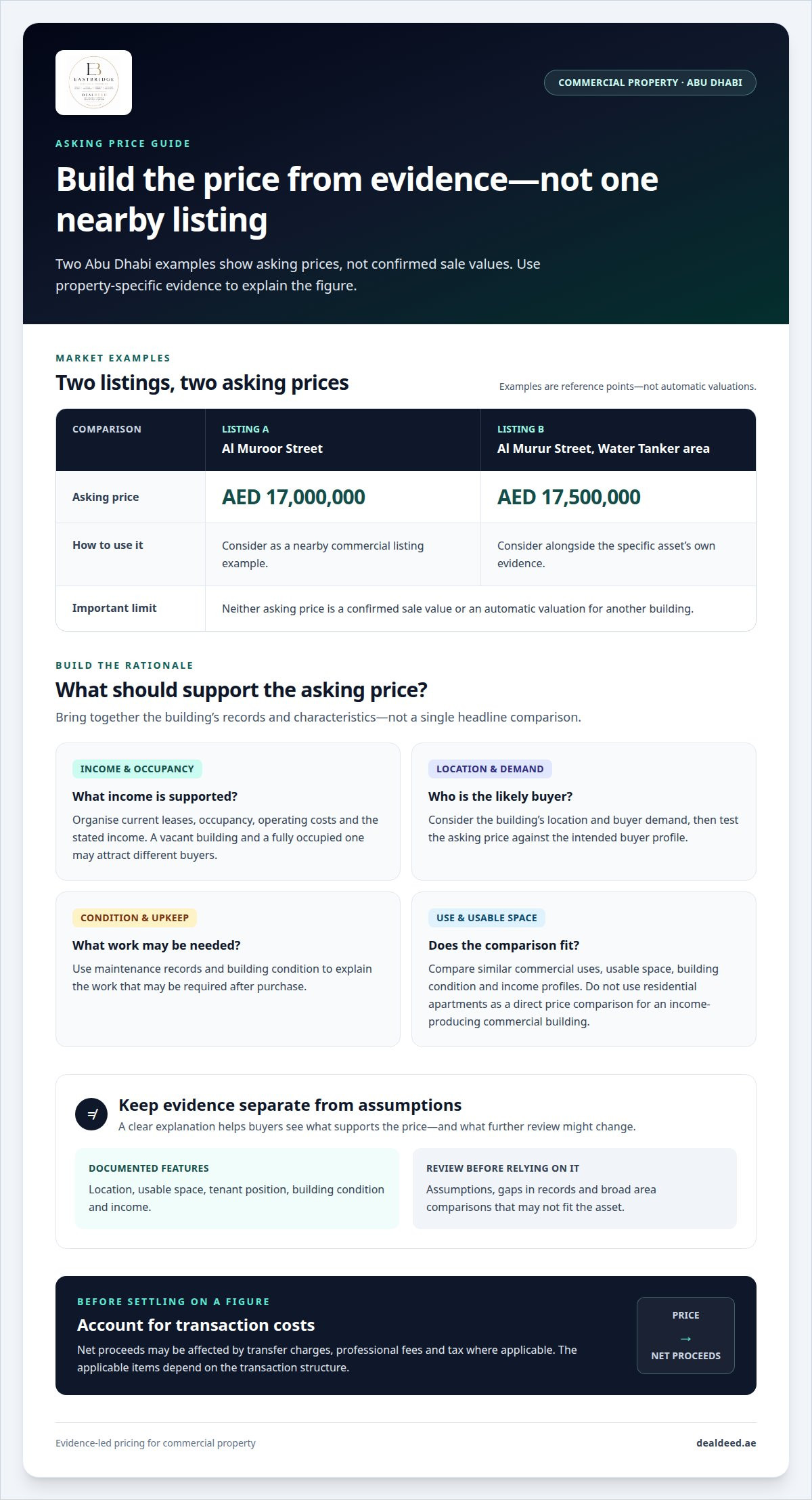
Set an asking price from the building’s income, condition, location and buyer demand, not a single nearby listing. Abu Dhabi examples show a wide spread: a building on Al Muroor Street is listed at د.إ 17,000,000, while one in the Al Murur Street, Water Tanker area is listed at د.إ 17,500,000. These are asking prices, not confirmed sale values or automatic valuations.
Start with the asset’s evidence. Organise current leases, occupancy, operating costs, permitted use and maintenance records. Assess how each affects expected income and the work required after purchase. A vacant building and a fully occupied one may attract different buyers, even in the same Abu Dhabi district.
Select comparisons by property type and location. An income-producing commercial building should not be priced against residential apartments simply because both are on an island or in Al Reem Island. Compare similar commercial uses, building condition and income profiles. If close comparisons are limited, explain the asking price through documented features instead of treating a broad area average as decisive.
Keep the asking price and negotiation rationale consistent. Prepare a concise explanation covering location, usable space, tenant position, building condition and income. Separate verified records from assumptions. Buyers can then see what supports the price and what further review might change. This is particularly useful in a private sale, where fewer public listings may be available for comparison.
Before setting the final figure, test it against the intended buyer profile and likely transaction costs. A seller prioritising a controlled process can use confidential sale discussions to present the opportunity selectively. The asking price should remain evidence-led, whether the building is in central Abu Dhabi or a developing commercial district.
How can buyers find off-market commercial buildings for sale in Abu Dhabi?
Start with a precise acquisition brief. Define intended use, preferred districts, building condition, occupancy and acceptable layout. A medical operator, for example, needs a different property profile from a logistics business. Clear criteria help professional networks identify suitable opportunities without broad public exposure.
Use established real estate relationships and private buyer channels to find off-market opportunities. Share your brief with relevant commercial property professionals, and explain your decision process and information requirements. A specific brief is easier to match than a general request for any commercial building in Abu Dhabi.
Choose a location that fits the business model. Al Maryah Island is Abu Dhabi’s financial district and home to the Abu Dhabi Global Market free zone. Mussafah Industrial Area has space suited to manufacturing, logistics and storage. Al Raha Beach may suit hospitality and tourism businesses, while Saadiyat Island’s museums, universities and resorts create opportunities in education, arts and tourism.
- Set the brief: Define use, location, occupancy and building configuration.
- Use relevant networks: Share requirements with professionals active in the chosen property segment.
- Screen each opportunity: Compare location, use and available property details with the brief.
Assess demand by the activities each district supports. Al Khalidiyah has offices, shops and showrooms; Zayed City, also called Khalifa City C, offers commercial offices and retail near the airport. These differences help buyers focus on a location that fits their operations, rather than a building merely because it is available.
Keep the first review focused. Request core property details through the agreed channel, compare them with your brief and identify gaps before progressing. In an off-market search, discretion works best alongside clear criteria and a prompt, informed response when a suitable building is presented.
Before deciding, assess your long-term goals and budget. Research the property, consider your business requirements and work with experienced real estate professionals to evaluate the opportunity.
What due diligence should buyers conduct on an Abu Dhabi commercial building?
Start with the property records and compare them with the building on site. Review ownership documents, floor plans, stated use, leases and maintenance records together. This cross-check is especially important off-market, where there may be fewer public details for comparison. Record discrepancies before discussing terms.
Inspect the building’s physical condition and layout. An Airport Street listing describes a four-floor property with a mezzanine and four shops. Use those details to structure a site review: compare the shop count and floor arrangement with the plans, then note visible maintenance needs and areas for further assessment.
- Ownership and plans: Match the documents to the property’s recorded details and physical layout.
- Occupancy and income: Compare lease terms, occupied units and rent records with the seller’s summary.
- Use and operations: Review business licence activities, tenant operations and the building’s stated use together.
- Condition: Record maintenance issues and assess how they affect planned operations.
Test the income case by reconciling lease schedules with rent records, occupancy and the seller’s stated figures. A mismatch between occupied units and reported income changes the investment picture. Separate documented income from projections, and note lease terms that may affect continuity after completion.
Finally, assess the fit with your operating plan. A buyer planning retail use should consider access, shop configuration and tenant mix; an office buyer should focus on usable layout and existing occupancy. Experienced real estate professionals can help organise the review and identify asset-specific questions. Keep a written record of findings and unresolved points for negotiation.
For a discreet, structured introduction to suitable opportunities, share your commercial buyer brief.
Treat research, business requirements and professional advice as connected parts of the same decision. Consider the information gathered in light of the intended business, rather than treating the property review as separate from the buyer’s needs. Experienced real estate professionals can support a thorough, needs-led assessment and help organise any questions that remain. This approach gives prospective buyers a clearer basis for deciding whether an opportunity merits further consideration and whether it aligns with their business priorities.
DealDeed: Private Buyer Brief Matching
DealDeed’s Private Buyer Brief Matching is for buyers with clear requirements who want a confidential route to relevant opportunities in Abu Dhabi. Set out the intended use, preferred locations, building profile and evaluation criteria. A focused brief gives the matching process a clear basis.
For owners considering a private sale, Quiet Disposal Mandates support a discreet approach. The Agent-to-Agent Deal Desk gives agents a channel for deal discussions. These options suit different needs: finding a property, preparing a quiet disposal, or coordinating between agents.
Share your requirements or discuss a confidential sale through DealDeed’s website.
Set the Terms for Your Next Move
Before approaching buyers, define success beyond the asking price. Set boundaries for who receives property details, what information is shared at each stage and which offer terms merit further discussion. This gives an off-market commercial building sale in Abu Dhabi a clear framework from the first introduction.
Keep the process aligned with your priorities as circumstances change. A seller may value confidentiality and timing differently from a buyer assessing operational fit. Put those priorities in writing and use them to guide discussions rather than reacting to each enquiry in isolation. A controlled process gives you room to assess proposals without losing sight of the intended outcome.
When you’re ready to discuss a discreet sale, contact DealDeed about your sale. A clear starting point can make the next decision more deliberate and give your transaction direction.
Frequently Asked Questions
What does an off-market commercial building sale in Abu Dhabi mean?
An off-market sale is one in which the owner seeks buyers without publicly advertising the building. Details are shared selectively, often through professional networks and direct introductions. An owner might, for example, share a brief describing the property’s use and income profile with relevant prospective buyers, then disclose further records after an NDA is signed. Private matching controls exposure, but does not remove the need for pricing evidence and careful review.
What are the steps to complete a commercial property sale in Abu Dhabi?
Begin by agreeing the asking price and sale terms, then prepare a consistent file of ownership, occupancy and property records. Share the opportunity with suitable buyers through a confidential process and assess offers against the seller’s priorities, not price alone. Once terms are agreed, both sides coordinate document review, resolve outstanding questions and arrange completion and transfer. Keep a written record of agreed terms and documents exchanged at each stage.


