

Broad marketing reach can create a wide trail of owner and property details. To understand how to prevent data leaks when selling a property in Dubai, decide what to share, who should receive it, and whether the sale needs public exposure at all.
Start by distinguishing among a public listing, marketing through selected brokerages, and a private approach to vetted buyers. Each exposes information differently. Selling discreetly does not mean withholding details from a serious buyer; it means sharing relevant information deliberately instead of placing sensitive details in public view.
This guide explains how to limit the circulation of owner information, keep identifying details out of listings, and choose a marketing route that fits your privacy priorities. It also covers the UAE’s personal data protection rule: according to UAE Legislation, Federal-Law No. 45 of 2021 is the rule on the Protection of Personal Data. The aim is a controlled process, with clear boundaries around what is shared and with whom.
Key Takeaways
- Limit owner and property information to the details each recipient needs, and control how documents are shared.
- Keep identifying details out of public listing materials; share fuller property information selectively with serious prospects.
- Choose between public, selected-brokerage, and private marketing based on the level of exposure you’re prepared to accept.
- Understand which personal and financial details may enter the sale process, then use a discreet buyer-matching route when privacy is a priority.
Limiting the circulation of property and owner information
Reduce exposure by limiting who receives seller details and using them only for the transaction. In Dubai, privacy starts with broker contact and continues through document sharing, digital communication, and transfer.
-
Limit broker contact with owners
Use a written agreement to set out who may approach buyers and what information they may share. Dubai rules restrict brokers from directly contacting property owners to market or purchase property. Brokers may contact existing clients when the relationship and consent are properly documented. Treat unsolicited requests for owner details cautiously. Breaches of rules on obtaining and using property-owner information can attract regulatory penalties.
-
Share transaction documents securely
Send each title deed, Emirates ID, passport, or bank detail only to its intended recipient through a controlled channel. Confirm the recipient and purpose before sharing, and avoid forwarding full document sets to broad email or messaging groups. Misused documents can enable identity theft, impersonation, or attempts to redirect sale proceeds. Keep a record of what you sent, to whom, and why. Secure necessary copies and delete unneeded duplicates.
-
Protect data during transactions
Apply the UAE Personal Data Protection Law, Federal-Law No. 45 of 2021, according to UAE Legislation: handle personal data for a clear purpose and restrict access to what that purpose requires. DLD and Dubai REST support property-related processes, while trustee offices handle transfer steps; use the relevant official process rather than sharing records casually. Dubai property ownership can be checked through property-status searches and title deed verification. A developer’s No Objection Certificate confirms settled charges and maintenance fees; ownership transfers must be registered in Dubai Land Department registers.
-
Secure digital communications
Use strong, unique passwords and two-factor authentication for email and messaging accounts that hold sale documents. Before opening an e-signature request or changing payment instructions, verify the sender through a separate, known channel. These steps help reduce phishing, impersonation, and payment-redirection risks. Store transaction files with access controls, not on shared devices. When records are no longer needed, securely delete digital copies and shred paper copies.
Keeping sensitive details out of public listings
Keep public listing content separate from documents used to verify a sale. A Dubai property’s location, ownership status, and seller’s financial details require different levels of disclosure.
-
Identify exposed personal and financial data
Review every image, caption, and document before publication. Remove owner names, passport details, contact information, title deed images, and bank data from listing materials. A non-resident seller may need to provide a six-month history of their primary bank account and the account receiving sale proceeds, so keep those records out of advertisements.
Check photographs for clues beyond the property itself. Geolocation analysis narrowed an apartment’s location to three floors in Burj Khalifa. A distinctive view, floor plan, or window position can reveal more than an address. For a luxury home on Palm Jumeirah, show useful features without exposing security arrangements or private belongings.
-
Redact details from required documents
Prepare a public version of each document separately from the transaction copy. A title deed or passport may help establish ownership during a formal process, but that does not make it suitable for public display. Keep the property’s status and relevant features in the listing; exclude identity numbers, signatures, account details, and unrelated personal information.
Before redacting a copy, identify its recipient and purpose. Preserve required details in documents shared through the relevant transaction process; never alter an official record or obscure information needed for verification. Mortgage status, service charge information, and ownership details may matter to a serious buyer, but disclose them selectively, not in a public image. Dubai’s DLD advertising permit service applies to regulated online, classified, and other property advertising, as well as open house events. If public exposure isn’t necessary, consider a quiet disposal approach instead.
If a breach affects a computer, keep it running but isolate it, since shutting it down can remove useful digital evidence. Maintain a record of each data breach, including incident details, responses, and the reasons for notifying or not notifying people.
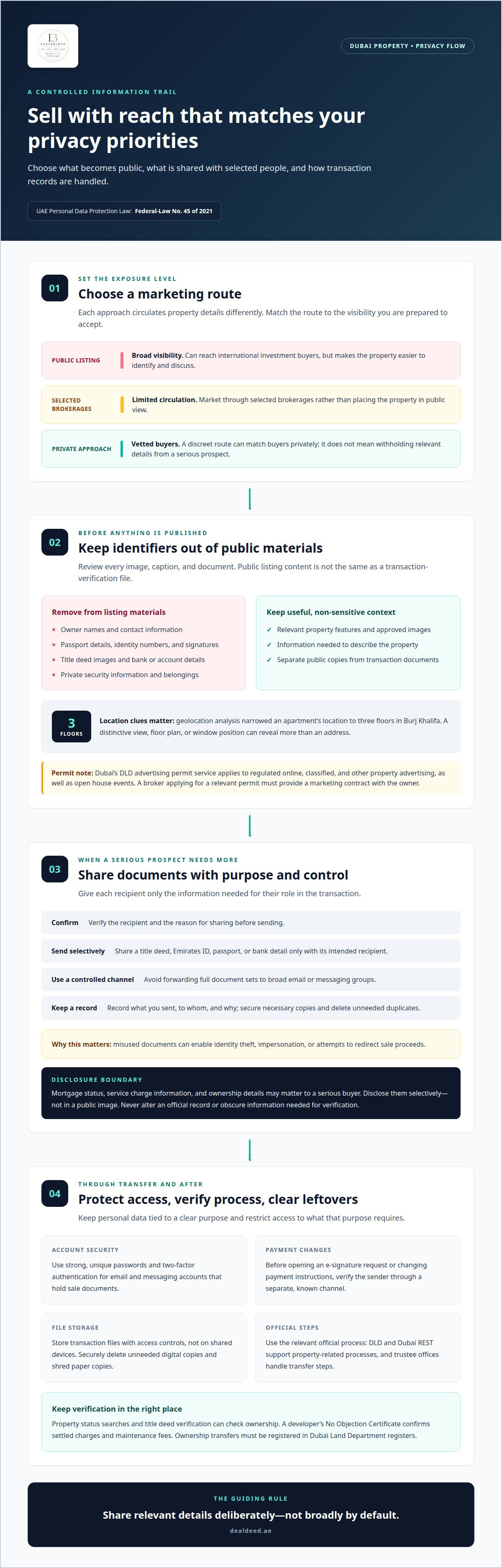
Public, selected-brokerage and private marketing
Choose a marketing route by balancing buyer reach against information exposure. In Dubai, public, selected-brokerage, and private approaches circulate property details in different ways.
-
Assess public marketing
Use public advertising only when broad visibility supports your sale strategy. Dubai’s DLD advertising permit service applies to regulated online, classified, and other property advertising, including open house events. A broker applying for a relevant permit must provide a marketing contract with the owner. Contract A records the agreement between the owner and brokerage, including property and brokerage terms.
When deciding how to prevent data leaks when selling a property in Dubai, consider what public materials actually need to reveal. Show relevant apartment features and approved images, not identity documents, bank details, or private security information. A listing may reach international investment buyers, but it also makes the property easier to identify and discuss.
-
Consider selected-brokerage marketing
Set the authorized broker group and define what each broker may circulate. In Dubai, two brokers may market the same property when the seller authorizes both under the agreed arrangement. Record permissions in the relevant agreement, including whether each broker may publish a listing or share details directly with buyers.
Limit duplication. Multiple listings can describe the same apartment inconsistently or show different asking terms, creating confusion during a real estate transaction. Give each authorized broker one approved set of details and clear boundaries for onward sharing. This extends access beyond one broker while keeping distribution narrower than unrestricted public advertising.
-
Consider private marketing
Choose a private approach when controlled introductions matter more than public reach. If you are deciding how to prevent data leaks when selling a property in Dubai, an initial brief can share general features and sale terms while reserving identifying details for serious prospects.
Private marketing still requires enough information for a buyer to assess the property. Release relevant details in stages as discussions progress instead of circulating a complete property file at the outset. Compare expected reach, buyer access, and information circulation before deciding. The right route depends on your priorities, not simply the property’s luxury status or investment appeal.
What personal and financial data is exposed when selling property in Dubai?
A Dubai sale involves several data categories, each serving a different transaction purpose. Map them before sharing anything, then limit access to the people handling each step.
- Separate identity records from property information. A title deed links an owner to a specific property, while a passport or Emirates ID identifies the seller. Together, these records can make impersonation easier if misused. Share identity documents only for a defined sale process, not as attachments to a public listing or general enquiry.
- Protect financial records and payment instructions. Non-resident sellers must provide a six-month history of their primary bank account and the account receiving sale proceeds. Treat statements, account numbers, and payment details as restricted records. Send only requested information to its intended recipient, and keep payment instructions separate from public property materials.
- Control copies that combine owner and property details. A document pack may include a seller’s name, passport information, title deed, and property address. Create a recipient-specific copy for each transaction stage. Keep necessary details intact for formal verification, but do not circulate a complete pack to buyers who need only initial property information.
- Track where sensitive records go. Keep a simple transaction log recording the document, recipient, purpose, and date shared. For example, note when a bank statement goes to the party processing sale proceeds, separately from a title deed shared for ownership checks. Remove duplicate working copies when they are no longer needed, while retaining records required for the sale.
- Review the information trail before the transfer. Confirm that a buyer receives property details relevant to their decision, while personal identity and banking data remain limited to the appropriate process. If controlled buyer introductions fit your priorities, explore a discreet sale route.
DealDeed
DealDeed gives Dubai property owners a discreet route when public exposure is unnecessary. Its private matching desk connects motivated sellers with serious, vetted buyers, with property details checked against Dubai Land Department data. Transactions are handled confidentially between RERA-licensed agents, without public listings or marketing.
Private Buyer Brief Matching, Quiet Disposal Mandates, and the Agent-to-Agent Deal Desk support different ways to structure a controlled sale. They suit situations where you want to limit circulation, reach qualified buyers, or coordinate through agents while keeping the process private. The right fit depends on your preferred marketing approach and transaction needs.
Contact DealDeed to discuss a discreet approach to selling your Dubai property.
Set the terms for a more discreet sale
Privacy is not a single setting. At each stage, decide what to disclose, to whom, and when. A clear disclosure plan is central to preventing data leaks when selling a property in Dubai, while still giving serious buyers the information they need to consider a transaction.
Before moving forward, decide whether broad visibility suits your priorities or a quieter route better fits your sale. DealDeed’s private matching and agent-to-agent options support a more controlled approach. The choice should reflect your preferences, not pressure to put every detail in public view.
Contact DealDeed to discuss your sale and consider the approach that fits your privacy priorities. A measured process can keep the next steps clear and deliberate.
Frequently Asked Questions
How can sellers verify Dubai real estate agents and buyers before sharing documents?
Confirm an agent’s identity and current RERA registration before sending sale records. DealDeed platform participation requires a valid RERA Office Registration Number and Broker Registration Number. For a buyer, establish their identity and role in the proposed transaction, and keep an offer or written expression of interest on record. Do not rely on a messaging profile alone to establish who will receive sensitive documents.
How can a seller protect data when listing a Dubai property online?
Prepare listing images and text to show the property’s appeal without exposing identifying clues. Before publishing, crop out unit numbers, building access panels, family photographs, visible mail, and documents on desks. Remove location metadata from image files and use a general area description instead of an exact unit address. Review the live listing after publication for details that could identify the seller or residence.
Who should sellers contact in the UAE to report a data breach or property-sale fraud?
Notify the UAE Data Office about a personal data breach as soon as you become aware of it.


