

More exposure doesn’t always create stronger demand. It can give buyers more reasons to wait. Understanding how to avoid price erosion from public listings in Dubai starts with recognising how repeated appearances, visible price cuts, or a long time on the market may shape a buyer’s view of your negotiating position.
That concern is reasonable. Buyers can use listing history, comparable sales, and previous reductions to support a lower offer. But a price adjustment isn’t automatically a mistake: it may be justified when current market evidence shows the asking price no longer fits the property or its competition. The key is to distinguish a measured response from listing fatigue.
This article explains which public listing patterns can weaken buyer perception, how to assess a price change against evidence, and how controlled, qualified outreach compares with broad exposure. It also outlines how private matching can connect a property mandate with a serious buyer brief. DealDeed checks property details against Dubai Land Department data and handles introductions confidentially between RERA-licensed agents. The aim is clarity and control, not a promised price or sale.
Key Takeaways
- Price erosion can mean weaker buyer confidence or bargaining power, not necessarily a decline in the property’s underlying market value.
- Before repricing, validate comparable completed sales, review enquiry quality, and assess the listing’s presentation and accuracy.
- To understand how to avoid price erosion from public listings in Dubai, weigh broad reach against control over information circulation and buyer qualification.
- Before changing or withdrawing a listing, organise property records, set disclosure limits, and keep details consistent across agent communications.
- Private matching connects a seller’s mandate with a buyer brief through RERA-licensed agents, with property details checked against Dubai Land Department data.
How public property listings can weaken a Dubai seller’s negotiating position
Price erosion doesn’t necessarily mean a property’s market value has fallen. It can mean buyers have become less confident in the asking price or believe the seller has less room to hold firm. Repeated price changes, outdated presentation, or conflicting details across listings can give buyers reasons to question the property, even when its condition and fundamentals haven’t changed.
Public exposure alone doesn’t prove that a property is overpriced. It does make visible listing history part of the conversation. A portal asking price shows what a seller is seeking, not what a buyer has paid. To assess value, compare the property with relevant, recent Dubai Land Department transaction evidence, accounting for differences in location, size, condition, and property type.
What buyers may infer from repeated listing changes
A visible reduction may prompt questions: Is the seller under time pressure? Has a condition issue emerged? Is there more flexibility than the current asking price suggests? These are possible interpretations, not proof of distress or a defect.
For example, a buyer sees the same home reappear with changed details and a lower asking price. They may treat the sequence as an opening to negotiate, even if the seller adjusted the price after reviewing new evidence. Clear, consistent information helps distinguish a considered decision from a signal buyers might read into repeated listings.
Market repricing versus exposure-related price pressure
A repricing decision should start with evidence, not discomfort about how long a listing has been visible. Review recent DLD transaction data for genuinely comparable properties, then account for condition, layout, view, building, and location. Portal asking prices can show the competition, but they don’t establish completed sale values.
Next, distinguish market changes from reactions to listing history. If comparable transactions or the property’s condition support a different price, an adjustment may be justified. If the evidence is unchanged but buyers cite repeated exposure or past reductions, the pressure may relate more to perceived flexibility. Each property, location, condition, and buyer pool needs individual assessment.
That distinction matters in negotiation. A seller who can explain the basis for an asking price is better placed to respond calmly to an offer than one reacting to a buyer’s assumptions. Reviewing negotiation principles can help clarify why information, alternatives, and boundaries shape the discussion. For sellers considering how to avoid price erosion from public listings in Dubai, the first move is to separate verified market evidence from perception, then decide whether the price, presentation, or exposure strategy needs attention.
How to tell whether a Dubai listing needs repricing or a reset
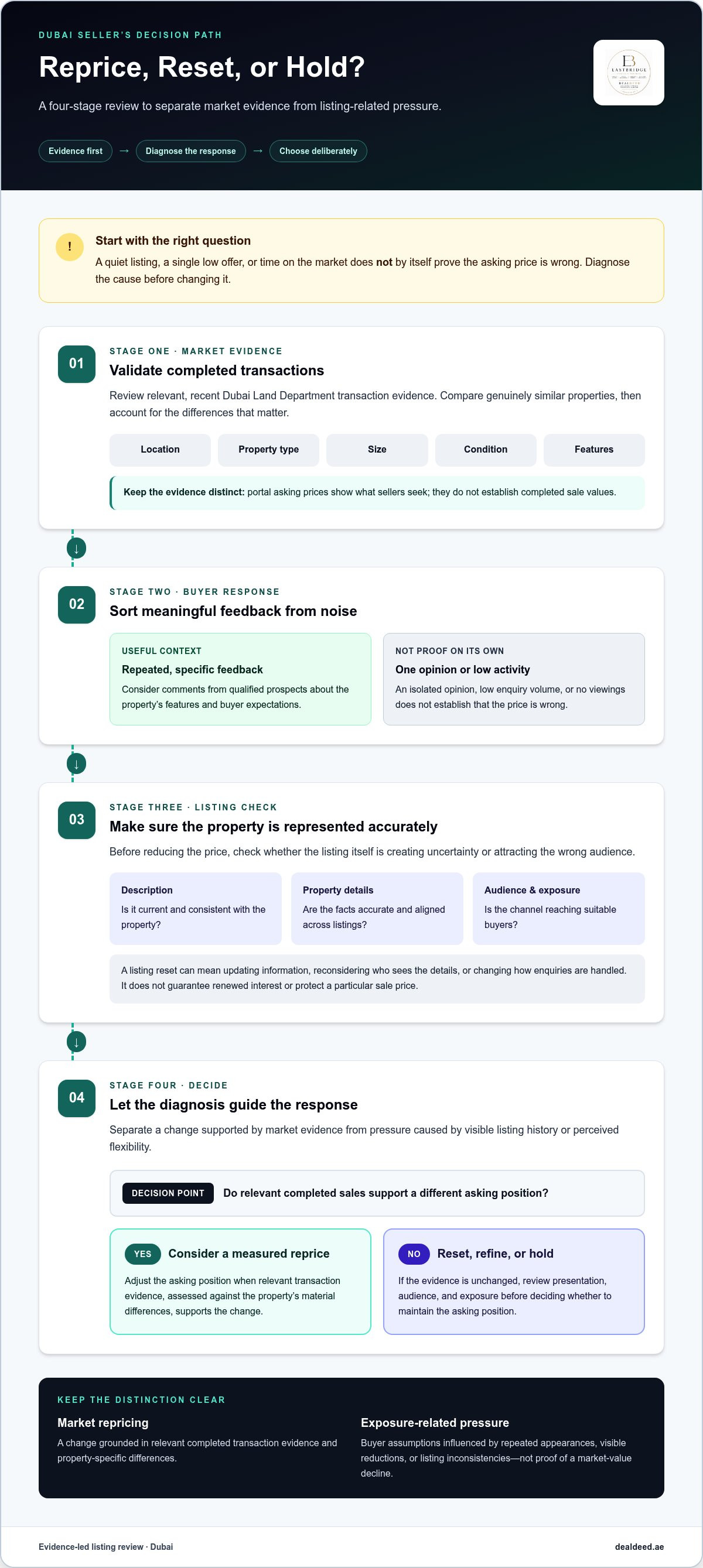
A quiet listing doesn’t automatically mean the asking price is wrong. Diagnose the cause before changing it. Work through the evidence, buyer response, and presentation in order, then decide whether to reprice, reset the listing, or hold your position.
- Validate the evidence. Review relevant completed Dubai transactions and note differences in location, property type, size, condition, and features.
- Inspect enquiries. Separate serious buyer interest and specific feedback from casual questions or unsupported opinions.
- Review presentation. Check whether the description and property details are accurate, consistent, and current.
- Choose a response. Adjust the asking position only if the evidence supports it. Otherwise, consider whether the issue lies in presentation, audience, or exposure.
Which signals justify reviewing the asking position?
Look for a pattern, not a single comment. Relevant completed sales that differ consistently from the asking position may warrant a review, especially when the comparison accounts for the property’s condition and location. Check transaction dates and details before relying on any market figure. The official UAE government housing portal provides broader context on housing services, but it isn’t a substitute for property-specific transaction evidence.
Enquiry quality adds context. Repeated, specific feedback from qualified prospects may help identify a mismatch between buyer expectations and the property’s features. An isolated opinion, low enquiry volume, or lack of viewings does not establish that the price is wrong. Evidence-led repricing means adjusting the asking position in response to relevant completed transaction data, accounting for the property’s material differences.
When a listing reset may matter more than a price cut
Before reducing the price, check for stale descriptions, conflicting details, or copy that no longer reflects the property. A mismatch between the listing and the asset can create uncertainty or attract the wrong audience. Correct the record first. Then assess whether the current channel and communication approach are reaching suitable buyers.
A reset may involve updating information, reconsidering who sees the details, or changing how enquiries are handled. It doesn’t guarantee renewed interest or protect a particular sale price. If you prioritise qualified introductions with controlled circulation, confidential property buyer matching offers another route to consider. The decision should still rest on verified evidence, not the hope that a relaunch alone will change buyer behaviour.
For sellers weighing how to avoid price erosion from public listings in Dubai, keep the diagnosis disciplined: market evidence may support repricing; weak enquiry quality or outdated presentation may call for a different response.
Public listings versus private matching: compare control, reach, and buyer quality
The choice is not simply visibility or secrecy. It is a decision about how widely property information circulates, how enquiries are handled, and what kind of buyer access matters to you. Public marketing may reach a broader audience. Private matching offers more controlled introductions. Neither route guarantees a particular price or sale.
| Factor | Public listings | Private matching |
|---|---|---|
| Audience reach | Potentially broad exposure to portal users and other market participants. | Focused circulation through buyer briefs and agent-to-agent introductions. |
| Information control | Once published, details may be viewed or recirculated beyond the seller’s direct control. | Information is shared through a more controlled matching process, subject to the seller’s disclosure choices. |
| Buyer qualification | Enquiries can vary in readiness, fit, and seriousness. | Introductions are directed toward serious, vetted buyers whose briefs align with the property mandate. |
| Exposure and history | Listing details and visible changes may remain part of the public conversation. | Less public circulation can limit visibility of listing history, but does not remove the need for evidence-based pricing. |
When public marketing may fit the seller’s priorities
If broad visibility and open-market reach are your priority, public listings may suit your sale strategy. They can put a property in front of a wide pool of potential buyers. That reach still needs oversight: keep details consistent across materials, monitor how enquiries develop, and base asking-price decisions on relevant completed transactions rather than portal prices alone. Public portals and agents are channels, not inherently harmful or unreliable ones.
When confidential buyer matching may fit better
Controlled circulation may better fit a seller who values discretion or wants introductions shaped around a property’s specific buyer profile. DealDeed matches a seller’s property mandate with serious buyer briefs through RERA-licensed agents. Property details are checked against Dubai Land Department data as a process step, not as a valuation or legal certification. Matching can improve control over how an opportunity is introduced; it cannot promise a higher price, faster sale, or completed transaction.
For a closer look at the approach, read Private Real Estate Matching in Dubai: The Insider Guide to Off-Market Deals. Sellers considering a more discreet route can also consult Sell Property Quietly in Dubai: The 2026 Guide to Private Disposal.
The right channel depends on your priorities, the property, and the likely buyer pool. If you’re deciding how to avoid price erosion from public listings in Dubai, compare the value of broad reach with the control and qualification offered by private matching. Choose deliberately, then keep the asking position grounded in evidence.
How to protect price integrity before changing or withdrawing a Dubai listing
Before making a visible change, create a clear record of what you know, what you’ve shared, and why you’re considering a different approach. A measured process protects consistency and helps prevent a price decision from being driven by isolated comments or public noise.
- Assemble the records. Organise ownership and property details, prior listing information, enquiry notes, and buyer feedback. Keep sensitive documents private unless they’re needed for a defined review or transaction step.
- Validate the price evidence. Compare relevant completed transactions and account for differences in location, condition, layout, and features. Record the evidence behind any proposed adjustment.
- Set disclosure boundaries. Decide which property details can be shared, with whom, and at what stage. Apply the same rules across agent communications and any public materials.
- Choose the channel. Match the route to your priorities: broad reach, controlled circulation, or qualified buyer introductions.
- Review the response. Set a review point and assess enquiry quality, specific feedback, and relevant transaction evidence, not exposure volume alone.
Prepare the evidence and disclosure boundaries
Consistency matters. Confirm that descriptions, property features, and other shared facts match across communications. Conflicting details can create avoidable questions and weaken confidence in the information presented.
DealDeed checks property details against Dubai Land Department data as part of its matching process. That verification is a process feature, not a valuation or legal certification. For further context, see Dubai Land Department Verified Deals: The Professional Guide to Private Market Validation.
Choose a channel and review market response
Broad public visibility may suit a seller seeking open-market reach. A more controlled route may better fit priorities around confidentiality and qualified introductions. Whichever channel you choose, agree in advance how you’ll assess the response. A high volume of enquiries is not the same as serious buyer demand.
If you change the asking position, document the reason: for example, new comparable transaction evidence, a material change in condition, or a revised assessment of the buyer pool. Don’t reduce the price simply because a listing has attracted attention or because one prospect made a forceful argument. A clear rationale supports a steadier negotiating position.
For sellers considering how to avoid price erosion from public listings in Dubai, disciplined records and controlled disclosure help keep decisions grounded. Explore the Dubai Real Estate Deal Desk: The Professional’s Guide to Private Matching, or explore confidential property matching through DealDeed.
How DealDeed supports confidential property matching in Dubai
For sellers who want to limit public circulation, DealDeed provides a confidential matching desk. The process starts with a seller’s property mandate and relevant details. Those details are checked against Dubai Land Department data, then considered alongside serious, vetted buyer briefs. Where there is a fit, the introduction is handled confidentially between RERA-licensed agents.
This is a matching process, not direct brokerage or a public property portal. Verification supports the handling of property information; it isn’t a valuation or legal certification. A suitable introduction may create a relevant buyer conversation, but it doesn’t guarantee a buyer, sale price, completion, or timeline.
What happens in a private matching process?
The seller or participating agent provides a property brief or disposal mandate with accurate, relevant details. DealDeed checks property information against Dubai Land Department data, then matches the mandate against buyer requirements. If a potential match is identified, the opportunity is introduced through the agent-to-agent process. This keeps the exchange focused on fit and confidentiality rather than broad public circulation.
Private matching can be considered alongside other sale routes. It doesn’t require a seller to assume that public listings are always unsuitable. The choice depends on the seller’s priorities, including how widely information should circulate and whether a controlled introduction better fits the property and likely buyer pool. For owners assessing how to avoid price erosion from public listings in Dubai, matching offers another way to manage exposure without making promises about price or outcome.
How sellers and agents can take the next step
Sellers and agents can submit a property brief or disposal mandate for the matching process. Include clear property facts and the seller’s priorities for disclosure and buyer fit. Accurate information helps agents communicate consistently and lets the opportunity be assessed against buyer requirements.
DealDeed charges participating agents a fixed introduction fee only if a matched deal completes. Sellers pay no upfront registration or subscription cost. The process is based on matching and an agent introduction, with the fee tied to successful completion.
Ready to pursue a discreet, evidence-led route? Submit a private property brief or disposal mandate to begin the matching process. Keep the details accurate, define your disclosure preferences, and let the introduction be guided by relevant buyer requirements.
Protect your position with a deliberate next step
Public exposure doesn’t automatically reduce a property’s value, but repeated changes, inconsistent details, and visible listing history can affect buyer confidence. Keep price decisions tied to relevant completed-sale evidence, not portal asking prices or isolated opinions. Before repricing or withdrawing, review the property information, enquiry quality, and level of disclosure you’re comfortable with.
For sellers considering how to avoid price erosion from public listings in Dubai, a controlled buyer introduction can be an alternative to broad circulation. DealDeed matches property mandates with buyer briefs through RERA-licensed agents. Property details are checked against Dubai Land Department data, and participating agents pay a fixed introduction fee only if a matched deal completes. Matching supports a process, not a guaranteed buyer, price, or sale.
If discretion and relevant buyer introductions suit your priorities, submit a private property brief or mandate. Keep the facts clear, the evidence close, and your next move deliberate. A disciplined approach gives you a stronger basis for the conversation ahead.
Frequently Asked Questions
Can public listings reduce a Dubai property’s sale price?
Public listings don’t automatically reduce a Dubai property’s market value, but visible listing history may affect buyer expectations and negotiation. Repeated price changes, outdated details, or inconsistent information can prompt questions about urgency or flexibility. Buyers may use that context when making an offer. Keep the distinction clear: exposure can influence perception, while the property’s value and achievable sale price depend on its specific features and relevant transaction evidence.
How do I avoid price erosion when listing a property in Dubai?
Base your asking position on relevant completed transactions, not portal asking prices alone. Make property details accurate and consistent across communications, monitor the quality of enquiries, and set disclosure boundaries before sharing information. Don’t reduce the price in response to one unsupported opinion. If broad public exposure doesn’t suit your priorities, consider controlled buyer introductions. These steps help you assess how to avoid price erosion from public listings in Dubai without assuming a particular channel guarantees a sale.
Should I remove my Dubai property listing before reducing the price?
Not necessarily. First identify why the listing may be underperforming. If the price is inconsistent with relevant completed sales, a documented adjustment may be justified. If the issue is stale presentation, inaccurate details, or poor audience fit, correct those factors before deciding whether to withdraw or change channels. Removing a listing doesn’t erase buyer awareness or guarantee renewed interest. Make the decision against evidence and your priorities for reach and confidentiality.
Do repeated price reductions make buyers think a Dubai seller is desperate?
They can lead some buyers to question the seller’s urgency or flexibility, but reductions don’t prove distress. A buyer may also interpret a change as a considered response to new transaction evidence or a change in property condition. Keep a record of the reason for each adjustment and ensure the details presented to buyers remain consistent. A clear rationale helps address questions without accepting a buyer’s assumption as fact.
Is a private property sale in Dubai always better than a public listing?
No. Public listings may suit sellers who prioritise broad visibility and open-market reach. Private matching may better fit those who value controlled circulation and qualified introductions. The right route depends on the property, its likely buyer pool, and the seller’s disclosure preferences. DealDeed connects property mandates with buyer briefs through confidential handling between RERA-licensed agents. Matching offers a different process, not a guaranteed higher price, faster sale, or completed transaction.
How can I verify a Dubai property’s asking price against market evidence?
Compare the asking position with relevant completed Dubai transactions, using property-specific factors such as location, condition, size, layout, and features. Check transaction dates and confirm that the comparisons are genuinely similar. Portal listings show what sellers are asking, not what buyers have paid. Treat enquiry feedback as context, not a substitute for transaction evidence. DealDeed checks property details against Dubai Land Department data as part of its matching process, not as a valuation.
Does off-market matching guarantee a higher property price in Dubai?
No. Off-market matching can provide a controlled way to introduce a property to serious, vetted buyers whose briefs may fit the seller’s mandate, but it can’t guarantee a higher price, buyer, sale, or completion date. DealDeed handles matching confidentially between RERA-licensed agents and checks property details against Dubai Land Department data. Participating agents pay a fixed introduction fee only if a matched deal completes. Price still depends on the property, evidence, and buyer negotiation.


