

In the high stakes world of Dubai property, visibility is often a liability. For the city's most significant assets, public portals are the last resort. This is the realm of dubai real estate pocket listings. Here, silence is the ultimate currency. You already know the cost of over-exposure. You've seen premium assets devalued by window shoppers and unverified data. True exclusivity isn't found on a public search engine.
The noise of the general market often obscures the highest quality opportunities. This guide provides the mechanics to master the silent market with absolute discretion. You'll learn how to access or dispose of high value assets without the risk of public exposure. We prioritize data integrity over marketing fluff. This ensures every match is valid, vetted, and secure. It's a professional alternative to the chaos of the public domain.
We will examine the DLD-backed systems that verify off-market supply and the professional protocols required to execute transactions with surgical precision. This is a briefing on how to navigate the private side of Dubai real estate. It's time to move beyond the public clutter and secure the market's most exclusive mandates.
Key Takeaways
- Protect asset integrity by navigating dubai real estate pocket listings, ensuring high-value properties remain shielded from public portal devaluation.
- Avoid the stale listing trap by utilizing quiet disposal mandates that prioritize buyer relevance over broad, unverified reach.
- Establish direct connections through RERA-licensed agents who operate within vetted, private matching desks.
- Leverage DLD-verified data to secure accurate property matching, replacing public market noise with surgical precision.
- Eliminate commission-based conflicts by adopting a flat-fee introduction model focused on successful, discreet completion.
What Are Dubai Real Estate Pocket Listings?
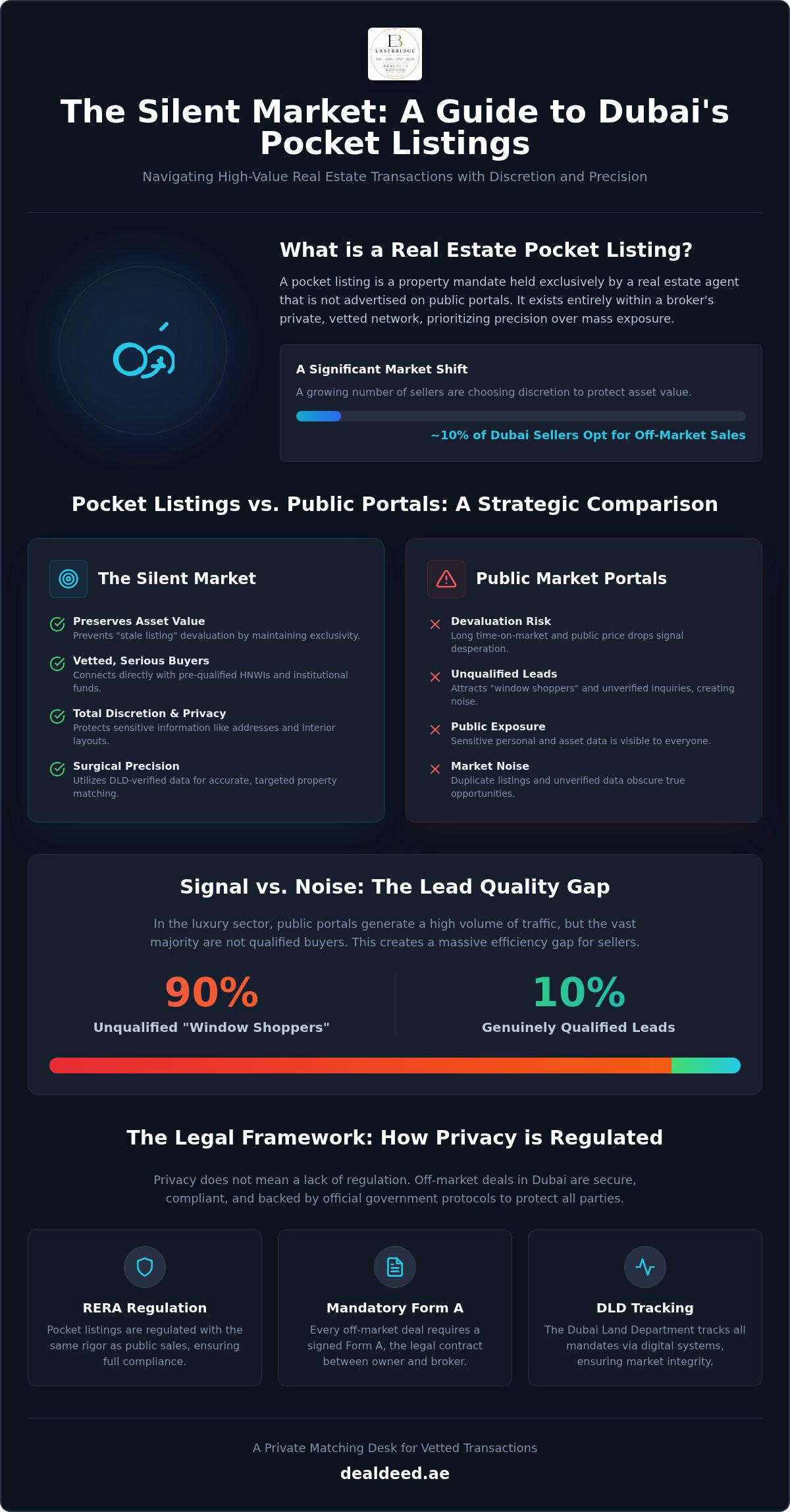
A pocket listing is a property mandate held by a broker that never reaches public portals. It exists entirely within a broker’s private network. While public markets prioritize volume and visibility, the silent market prioritizes vetting and precision. Understanding What Are Dubai Real Estate Pocket Listings? requires looking past the 2026 digital noise. Historically, the term "pocket" referred to a broker keeping a listing in their physical pocket, shared only with a trusted inner circle. In Dubai's modern landscape, this has evolved into a sophisticated, regulated method for high-value asset disposal.
The 2026 landscape is defined by a sharp divide between the public and private markets. Public portals are crowded. They often contain duplicate listings and unverified data. In contrast, the silent market operates on directness. Industry estimates suggest that approximately 10% of home sellers in Dubai now opt for off-market sales. This shift is driven by a desire for control. Sellers don't want their assets to become commodities. They want a targeted match, not a public broadcast.
The Legal Framework of Off-Market Deals
Privacy does not mean a lack of regulation. RERA regulates dubai real estate pocket listings with the same rigor as public ones. Every off-market deal requires a signed Form A. This is the legal contract between the owner and the broker. Even without public exposure, the Dubai Land Department tracks these mandates through digital registration systems. The DLD "Three Broker Rule" remains relevant here; sellers cannot list with more than three brokers, even privately. This prevents the "listing spam" that devalues property. Agents must maintain strict compliance to avoid penalties. For the client, this means security. For the market, it ensures every "silent" deal is backed by official, licensed protocols.
Why Pocket Listings Dominate the Luxury Sector
Luxury assets suffer when they are over-exposed. A villa listed on public portals for 180 days becomes "stale" in the eyes of the market. Digital footprints of price drops create a narrative of desperation that buyers exploit. Private mandates prevent this asset devaluation by maintaining a "new to market" status for a vetted audience. High Net Worth Individuals (HNWIs) also view privacy as a functional requirement. They don't want their home addresses, interior layouts, or asset values accessible to the general public. Exclusivity creates a "need-to-know" environment. It filters out unqualified leads and ensures only serious, pre-vetted buyers gain access to the details. In the luxury sector, silence isn't just a preference; it's a strategy to preserve value.
The Mechanics of the Silent Market: Why Privacy Matters
Exposure is not synonymous with liquidity. In the luxury segment, mass exposure often functions as a liability. When a premium asset is broadcast on public portals, it enters the "stale listing" trap. Time on market becomes a public record. Every day without a sale erodes the perceived value. Buyers don't see an exclusive opportunity; they see an asset others have rejected. This digital footprint of price drops and prolonged visibility devalues the property before a single viewing occurs.
The market is shifting. Institutional funds and sophisticated family offices now prioritize private real estate matching in Dubai over public bidding wars. They value the "need-to-know" aura of dubai real estate pocket listings. This approach replaces the chaotic noise of public sites with surgical precision. It moves the transaction from a public spectacle to a private briefing. Success here is measured by the quality of the match, not the quantity of the clicks.
Protecting Asset Value Through Discretion
The psychology of the off-market buyer is rooted in the search for the "unfindable." High-profile sales in enclaves like Emirates Hills or Jumeirah Bay Island are rarely the result of a portal search. These sellers prioritize quiet disposals to control the narrative. They prevent market speculation that can arise from public listings. By keeping the mandate private, the seller maintains the upper hand. They aren't reacting to the market; they are inviting a vetted inner circle to participate in a secure transfer. This level of discretion preserves the asset’s prestige and its price point.
The Information Gap: Signal vs. Noise
Public portals are optimized for traffic, not transactions. In the luxury sector, up to 90% of portal leads are unqualified window shoppers. This creates a massive information gap. High-value transactions require a signal, not noise. Efficiency comes from matching a seller directly to a vetted buyer brief. This process relies on data integrity. Every transaction, even those conducted in silence, must eventually culminate in official registration with the Dubai Land Department. Using DLD records to pre-verify property details ensures that the matching process is based on fact, not marketing fluff. For those seeking a streamlined path, a private deal desk provides the necessary infrastructure to bridge this gap without public exposure.
Pocket Listings vs. Public Portals: A Strategic Comparison
Choose your path based on the asset's requirement. Public portals prioritize reach. They cast a wide net to capture volume. This is a broadcast strategy. dubai real estate pocket listings prioritize relevance. They target a specific profile through a private briefing. It's the difference between a billboard and a surgical strike. One seeks anyone; the other seeks the right one.
Time is a hidden cost in the public market. Portals generate high lead volumes, but the noise to signal ratio is often poor. In the luxury segment, filtering through unqualified "window shoppers" can take months. Private matching often closes faster because the vetting happens before the introduction. Efficiency is built into the process. This speed is a primary driver for institutional investors and high net worth individuals who value time as much as capital.
When to Use a Public Portal
Standard assets thrive on volume. If you're moving mass market apartments or high volume developments, portals are the correct tool. They reach the retail buyer effectively. Standard rental listings with fixed market rates also benefit from this broad exposure. Here, maximum visibility is the primary goal. The objective is to be seen by the largest possible audience to secure a standard market price.
When to Opt for a Pocket Listing
Ultra luxury mandates require a different protocol. For mansions or penthouses valued at AED 50M+, public portals are often counterproductive. They expose the asset to unnecessary scrutiny and devaluation. Commercial assets also demand confidentiality to protect ongoing business operations. Sellers who prioritize selling property quietly in Dubai choose this path to maintain asset integrity. It's about controlling the narrative from the first interaction.
The financial structure also differs. Standard brokerage typically involves a 2% commission plus 5% VAT. In the off-market space, sophisticated matching desks often utilize flat introduction fees. This removes the percentage-based conflict of interest. It aligns the facilitator with the quality of the match rather than just the final price. Transparency remains absolute. Accountability is maintained through DLD-verified data, ensuring that every private mandate is legitimate and every transaction is secure. It's a professional environment where security replaces the chaos of the public market.
How to Access and Manage Off-Market Mandates
Accessing the silent market is a methodical process. It requires four distinct steps to ensure security and efficiency. First, identify a RERA-licensed professional with a track record in private mandates. Second, articulate your requirements with surgical precision. Third, verify all property data against official DLD records. Finally, engage a matching desk to facilitate the introduction. This structured approach replaces the haphazard nature of public searching with a controlled, professional workflow.
The matching process relies on absolute data integrity. A private desk uses DLD-backed systems to ensure the match is valid before any introduction occurs. This eliminates the risk of unverified data or "ghost" listings. It's a system designed for results, not clicks. By following these steps, you move from a passive observer of the public market to an active participant in the city's most exclusive transactions.
The Role of the RERA-Licensed Agent
Licensed agents act as the primary filter. They are the gatekeepers of dubai real estate pocket listings. Their role extends beyond finding property; they manage the strict KYC (Know Your Customer) protocols required for high-value transfers. This ensures every participant is vetted and serious. These professionals often collaborate through a Dubai real estate deal desk to find off-market matches that never reach the public eye. It's a collaborative environment built on trust and regulatory compliance.
Crafting an Effective Investment Brief
Precision replaces volume. A generic "3-bed villa" request is useless in the off-market space. A professional brief must specify ROI targets, exact plot sizes, and preferred orientations. For sellers, a "Quiet Disposal" mandate outlines the specific terms of engagement. It defines exactly who can see the asset and under what conditions. Expect to sign NDAs early. Confidentiality agreements are the baseline for any serious interaction here. They protect the seller's privacy and the buyer's intent.
If you are ready to move beyond the noise of public portals, you can submit a private buyer brief to begin the matching process with vetted, off-market supply.
DealDeed: The Private Matching Desk for Vetted Transactions
DealDeed represents the structural evolution of dubai real estate pocket listings. Traditional off-market transactions often relied on fragmented, informal broker networks. We replace that uncertainty with a professional matching desk. It's a data-driven environment where precision is the baseline. Every match is grounded in reality. We utilize DLD-verified property data to ensure that every private mandate is legitimate before an introduction occurs. This is a system built for the insider, not the observer.
We don't operate a public portal. We don't seek mass-market traffic. Instead, we provide a secure infrastructure for RERA-licensed agents to match buyer briefs with quiet disposal mandates. This approach removes the noise of unverified data and unqualified leads. It's a sober alternative to the chaotic visibility of the general market. Here, results are achieved through silence and verification.
The Flat Introduction Fee Model
Incentives must be aligned. Traditional models often create conflicts through percentage-based commission splits. DealDeed operates on a flat introduction fee model. There are no upfront registration costs and no hidden subscription fees. Agents pay only upon the successful completion of a deal. This creates a predictable cost structure for the professional. It ensures that our focus remains entirely on the quality of the match. We only win when the transaction closes. This is a professional alternative to the standard brokerage split, designed for efficiency and transparency.
Security and Data Integrity
Privacy is our core value proposition. DealDeed protects sensitive property information through a strict vetting process. Only RERA-licensed agents are granted access to the desk. This gatekeeper model ensures that high-value asset data never reaches the public domain. We facilitate a "Quiet" approach to non-public real estate in Dubai by ensuring all parties are pre-vetted and serious. We don't just share data; we manage its exposure. This discipline prevents the asset devaluation that comes from public over-exposure.
The next steps are direct and methodical. Agents can register their private mandates or buyer briefs through our secure portal. Once a potential match is identified, our desk facilitates the introduction. This moves the transaction from a speculative search to a vetted reality. It's time to manage your mandates with the discretion they deserve. Register your brief today to access the market's most exclusive supply.
Securing the Silent Advantage
The public market is built for volume. The silent market is built for value. Successfully navigating dubai real estate pocket listings requires a shift from broad exposure to surgical matching. You've seen how discretion prevents asset devaluation. You understand why DLD-verified data is the only acceptable baseline for security. Silence isn't a lack of action; it's a controlled strategy for the city's most significant transactions.
DealDeed provides the professional infrastructure for this elite matching. Our model relies on a strict RERA-licensed agent network and a transparent flat-fee matching model. We prioritize data integrity over marketing noise. It's a system designed for those who value efficiency and absolute privacy. It's time to step away from the unverified clutter of public portals. Secure your position by moving beyond the reach of the general market.
The most exclusive opportunities are rarely found by looking where everyone else is. Experience a more precise way to transact. Register your private buyer brief or seller mandate with DealDeed today.
Frequently Asked Questions
What is a pocket listing in Dubai real estate?
A pocket listing is a property mandate held by a broker that isn't advertised on public portals. It's shared only with a vetted inner circle. This is the core of dubai real estate pocket listings. It prioritizes privacy and targeted matching over mass exposure. In Dubai, this method is increasingly used for luxury assets to prevent devaluation through over-exposure. It ensures only serious, pre-qualified buyers gain access to the property details.
Are pocket listings legal according to RERA?
Yes, off-market transactions are fully legal provided they comply with RERA regulations. This includes having a signed Form A and being registered through official channels. The Dubai Land Department tracks these mandates even if they aren't public. Discretion doesn't mean bypassing the law; it means choosing a private marketing path. All legal transfer processes remain the same as public sales, including the standard 4% DLD transfer fee.
How do I find off-market properties in Dubai?
Access to the silent market requires a network of RERA-licensed agents or a specialized matching desk. Public portals won't show these assets. You must submit a specific buyer brief to professionals who hold private mandates. This ensures you only see properties that match your requirements, bypassing the noise of the general market. Platforms like DealDeed facilitate this by matching buyer briefs directly with vetted seller mandates behind the scenes.
Why would a seller choose a pocket listing over a public portal?
Sellers choose pocket listings to protect asset value and personal privacy. Public listings create a digital trail of price changes and days on market, which can devalue a premium home. High-net-worth individuals often prefer quiet disposals to keep their property details away from window shoppers. This approach maintains exclusivity. It allows the seller to control the narrative and ensures the property remains fresh to a serious, targeted audience.
Do I need an NDA for a pocket listing transaction?
Non-Disclosure Agreements (NDAs) are standard practice in the off-market space. They protect the sensitive data of both the buyer and the seller. Before receiving detailed property information or viewing a private mandate, you'll likely be required to sign a confidentiality agreement. This ensures that the transaction remains secure and the property's privacy is maintained. It's a professional protocol that filters out unqualified leads and prioritizes security over visibility during the matching process.
How does DealDeed verify off-market property data?
DealDeed utilizes official Dubai Land Department data to verify every property mandate. We don't rely on marketing descriptions or unverified claims. By benchmarking against official records, we ensure that every match on our private desk is grounded in reality. This verification process is essential for maintaining integrity in a market that values substance over appearance. It provides agents and investors with the evidence needed to move forward with absolute confidence.
Are commissions different for pocket listings?
Standard brokerage commissions often apply, but matching models vary. DealDeed uses a flat introduction fee for participating agents rather than a percentage-based split. This removes the traditional conflict of interest. The goal is to align incentives around the quality of the match and the successful completion of the deal. It's a transparent, predictable cost structure that prioritizes the efficiency of the introduction over the final transaction volume or public price record.
Can any real estate agent handle a pocket listing?
Any RERA-licensed agent can hold a private mandate, but effective management requires specific infrastructure. Most agents focused on the public market lack the network of vetted buyers required for private matching. Success in the silent market requires specialized protocols and data verification tools. It's a discipline focused on quiet, direct introductions. Choosing an agent with inner circle access ensures your mandate is handled with the necessary level of discretion and professional oversight.


