

In the world of high-stakes Dubai real estate, visibility is often the enemy of value. You've likely seen premium assets lose their luster because they were over-exposed on public portals or shopped around by unvetted intermediaries. It’s a frustrating cycle of wasted time, complex commission friction, and devalued mandates that costs you more than just money. Mastering DealDeed best practices for agents allows you to step away from this noise and reclaim your role as a high-level facilitator.
We'll show you how to leverage Dubai’s premier private matching desk to close off-market transactions with surgical precision. You'll learn to move beyond the loud, high-energy sales tactics of the general market. Instead, you'll gain access to genuine mandates and vetted buyers through a system built on absolute discretion and DLD-verified data. This guide explores the mechanics of quiet disposal, the importance of precise buyer briefs, and the specific steps required to turn private matching into your most powerful competitive advantage. It's time to operate with the silence and efficiency that sophisticated clients expect.
Key Takeaways
- Protect luxury asset value by transitioning from noisy public portals to the "Quiet Market" of private matching.
- Implement core DealDeed best practices for agents to swap generic listings for high-precision, DLD-verified mandates.
- Master the 5-step sourcing process to connect with genuine, vetted buyers while maintaining absolute client confidentiality.
- Ensure seamless transactions by adhering to RERA-licensed standards and the platform’s strict non-disclosure protocols.
- Leverage the flat-fee introduction model to eliminate complex commission splits and increase your operational efficiency.
The Shift to Private Matching: Why Discretion is the New Luxury
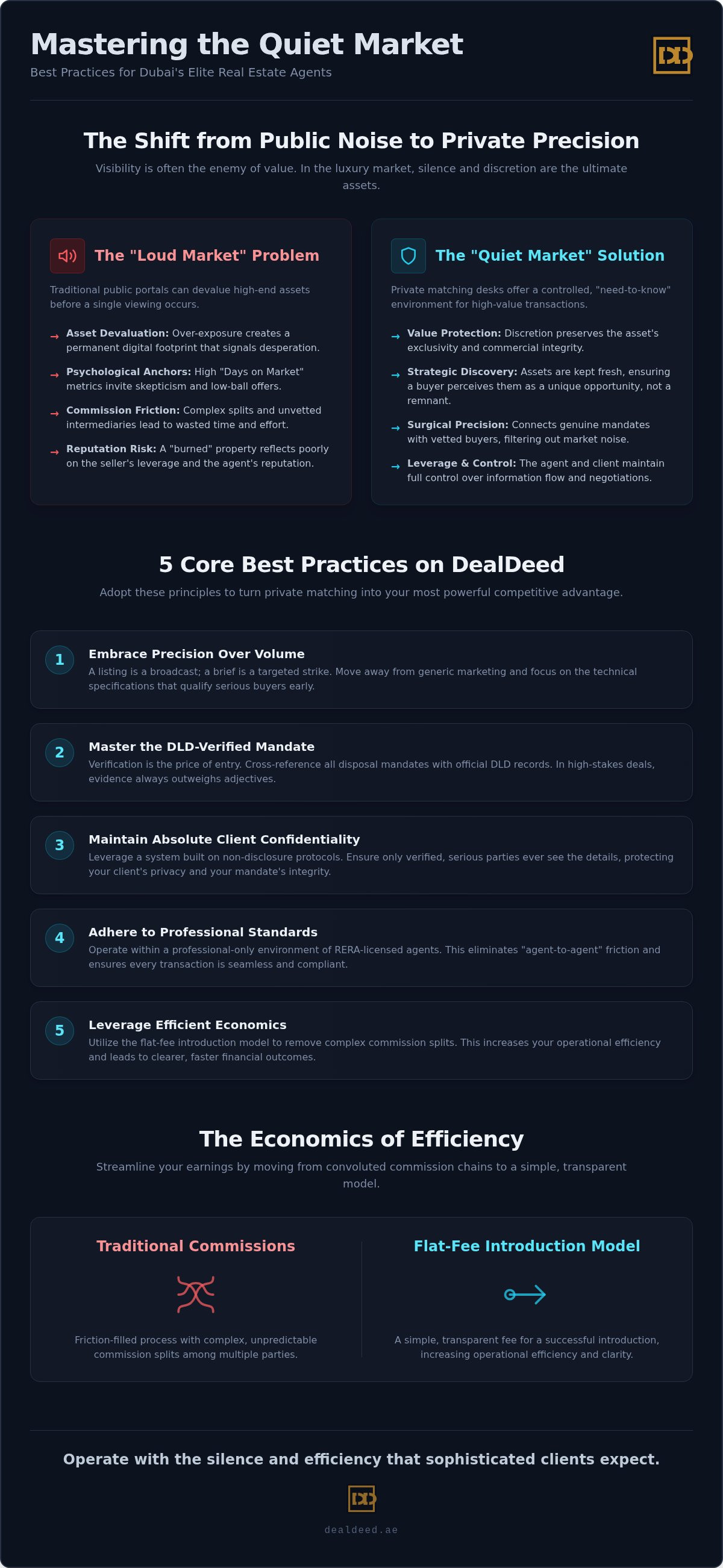
In the luxury corridors of Dubai, volume is not value. Silence is. The "Quiet Market" represents a strategic shift away from public spectacle toward controlled, off-market transactions. For ultra-high-net-worth individuals, a public listing is often a liability. It creates a permanent digital footprint that can devalue an asset before a single viewing occurs. RERA-licensed professionals are increasingly adopting DealDeed best practices for agents to mitigate these risks and preserve the exclusivity of their mandates. This isn't just about privacy. It's about maintaining the commercial integrity of the transaction.
Traditional property marketing relies on the Multiple Listing Service (MLS) model. This system prioritizes maximum visibility. While effective for mid-market units, it's often detrimental to the prestige of a د.إ 100 million villa in Emirates Hills. Private matching desks offer a sober alternative. They replace the loud energy of public portals with a "need-to-know" discipline. By moving transactions into a private desk environment, agents ensure that only verified, serious parties ever see the details. This approach filters out the noise and focuses strictly on the match.
The Cost of Public Exposure
Public listings can "burn" a property. When a high-value asset sits on a portal for months, the "Days on Market" metric becomes a psychological anchor. It suggests desperation. It invites low-ball offers. High-value buyers view over-exposed properties with skepticism, assuming there's a hidden flaw or a pricing error. Private matching keeps the asset fresh. It ensures that when a buyer finally sees the mandate, it feels like a discovery rather than a remnant. Discretion protects the seller’s leverage and the agent’s reputation.
DealDeed’s Role as a Facilitator
DealDeed is a matching desk, not a portal. It doesn't sell photography or public marketing services. Its sole purpose is to connect RERA-licensed agents through vetted data. This professional-only environment eliminates the "agent-to-agent" friction often found in unverified groups. By utilizing DealDeed best practices for agents, you remain the central gatekeeper of your client's interests. The platform acts as a silent partner, providing the infrastructure for a discreet match without ever interfering with your established relationships. It’s a tool for those who value results over visibility.
Mastering the Mandate: Precision Over Marketing Volume
A listing is a broadcast. A brief is a targeted strike. In the private matching ecosystem, the power of your mandate lies in its precision, not its reach. High-value buyers don't browse; they search for specific parameters. Adopting DealDeed best practices for agents means stripping away the marketing fluff and focusing on the underlying evidence. This isn't about selling a lifestyle. It's about presenting a verified investment opportunity to a vetted audience.
Professional standards in Dubai are evolving. While the NAR Code of Ethics provides a foundational framework for global real estate integrity, the local market demands absolute data transparency through the Dubai Land Department. In the private market, your reputation is tied to the accuracy of your data. If the BUA or plot size in your brief contradicts official records, you lose credibility instantly. Evidence always outweighs adjectives in high-stakes transactions.
Data Integrity and Verification
Verification is the price of entry. DealDeed cross-references all disposal mandates against DLD records to ensure every match is based on fact, not speculation. Unverified mandates are rejected to protect the integrity of the desk. When you provide clean, verified data, you earn a "Trust Dividend." This leads to faster matches and fewer failed inspections. It ensures that when you submit private disposal mandates, you're seen as a serious professional by other licensed agents.
The Art of the Quiet Disposal
Quiet disposals rely on technical specifications to qualify buyers early. Instead of wide-angle photography, focus on the floor plans, the orientation, and the specific material finishes. Use the brief to answer the questions a sophisticated buyer's agent will actually ask. This methodical approach ensures that by the time a viewing is requested, the buyer is already 90% committed to the deal. In the private market, the absence of public imagery acts as a filter that attracts only the most sophisticated and prepared capital.
Strategic Sourcing: Best Practices for Buyer Briefs
Efficiency in the off-market sector is built on the quality of your input. In the DealDeed ecosystem, a "Serious Buyer" isn't defined by their budget alone. They're defined by the clarity of their intent. Vague requirements create matching noise. They waste time. They erode trust. Adopting DealDeed best practices for agents requires a shift from passive searching to active, strategic sourcing. You aren't just looking for a property; you're executing a specific acquisition mandate.
To maximize your success rate, follow this 5-step process for submitting a high-conversion buyer brief:
- Verify Readiness: Confirm the buyer has immediate liquidity or pre-approved financing in AED.
- Define Granular Parameters: Move beyond bedroom counts. Specify plot sizes, architectural styles, or proximity to specific landmarks.
- Align with Data: Ensure the buyer’s price expectations reflect current DLD-verified transaction trends.
- Establish the Window: Clearly state the required closing timeframe.
- Submit to the Desk: Provide these details directly to the facilitator to trigger the matching algorithm.
Defining the Requirement
Generic requests like "3-bedroom villa in Dubai" have no place here. That's portal logic. In the private market, you're looking for an investment mandate. This means specifying a sub-community, a preferred developer, or a minimum ROI for tenanted units. Use verified data to set realistic price ceilings. If a buyer’s budget doesn't align with the last six months of DLD records, the brief is flawed. Precision at this stage prevents friction later. It ensures every match provided by the desk is worth your time.
Filtering for Quality
The DealDeed matching desk acts as a high-level filter. It vets incoming disposal mandates against your brief with surgical precision. To maintain professional integrity, adhere to the "one brief, one buyer" rule. Do not shop the same requirement across multiple platforms or intermediaries. This protects the exclusivity of the off-market deal. Frequent communication with the matching desk also helps. It allows you to refine parameters as market conditions shift. By following these DealDeed best practices for agents, you position yourself as a disciplined professional who values substance over speculation. You become the agent that other high-level facilitators want to work with.
Professional Standards and Regulatory Compliance
Entry into the private market is restricted. It requires a RERA license. This isn't a suggestion; it's a security protocol. DealDeed operates exclusively for licensed professionals to ensure every participant understands the legal weight of a private mandate. By restricting access, the platform maintains a high-integrity environment where speculation is replaced by professional accountability. Adhering to DealDeed best practices for agents ensures that your transaction remains within the strict regulatory framework of the Dubai Land Department. It protects your license. It protects your client.
Ethical agent-to-agent matching relies on mutual respect for the mandate. In the public market, "listing poaching" and unverified intermediaries create a chaotic environment that devalues the profession. DealDeed eliminates this noise by acting as a controlled gateway. Matches are made between verified peers, ensuring that the chain of command remains intact. This professional-only structure supports DLD-compliant transaction flows, moving deals from a private match to a formal MOU with surgical efficiency. You focus on the closing; the platform handles the verification of the counterparty.
Confidentiality Protocols
High-value deals require absolute silence. Information is shared only with vetted peers who have a confirmed buyer or disposal mandate. In a digital environment, protecting sensitive client data is paramount. You must handle brief details with the same care as an official NDA. Move from the matching desk to a direct agent conversation only after the desk validates the match. This sequence prevents the leakage of asset details to unvetted third parties. It preserves the "need-to-know" aura that high-net-worth clients demand. Discretion is not just a preference; it is a contractual obligation.
The Role of the Matching Desk
The desk acts as a neutral third party. It doesn't compete with you; it facilitates for you. Every RERA credential is verified before access is granted, creating a circle of trust that doesn't exist on public portals. The desk streamlines the "introduction" phase by providing only high-probability matches based on data, not hope. This removes the friction often found in "agent-to-agent" groups where mandates are often three or four steps removed from the source. To secure your position in this exclusive network, you should register as a verified agent and begin submitting your mandates through the secure desk.
The Economics of Efficiency: Flat Fees vs. Commissions
Traditional real estate models often collapse under the weight of commission friction. In the public market, agents spend significant time and capital on upfront marketing. They pay for portal subscriptions. They pay for photography. They pay for lead generation. Most of these leads are unvetted. This creates a high-risk, low-reward cycle. Implementing DealDeed best practices for agents flips this equation. By shifting to a success-based flat-fee model, you eliminate the financial drain of public exposure and focus strictly on the result.
The DealDeed model is built for professional alignment. The platform doesn't charge for listings or access. It charges an introduction fee only upon the successful completion of a transaction. This aligns the matching desk’s interests perfectly with yours. You aren't a subscriber; you're a partner in a closed-loop ecosystem. This structure allows you to scale your brokerage by reducing "marketing waste." Instead of broad-spectrum advertising, you invest your time in refining mandates and securing verified data. Public marketing is an expense. Private matching is an investment.
Predictable Transaction Costs
Flat fees simplify the "split" conversation. In complex, high-value deals involving multiple parties, percentage-based negotiations often lead to late-stage friction. They can derail a transaction at the eleventh hour. A flat introduction fee removes this volatility. It provides a fixed, transparent cost that you can account for from the start. This clarity extends to the settlement process. With DealDeed best practices for agents, the financial roadmap is as precise as the property match. The result is a cleaner ledger. A faster close. A more professional reputation.
Integration into Your Workflow
Sophisticated agents use the private desk as their primary sourcing tool for institutional clients. Sovereign wealth funds and family offices in the UAE don't browse portals. They demand discreet, off-market opportunities. Transitioning your luxury portfolio to an off-market-first strategy positions you as an insider with exclusive access. You become the facilitator who provides "quiet" deals that aren't visible to the general public. This methodical approach builds long-term trust and ensures your high-net-worth clients remain protected from market noise. To secure your position in this exclusive professional network, you should Register as a Vetted Agent on DealDeed and begin leveraging the power of private matching today.
Securing the Future of Discreet Transactions
The transition to private matching is a strategic evolution for the modern agent. It replaces the chaos of public portals with the surgical precision of verified data. By following DealDeed best practices for agents, you move from broadcast marketing to direct, high-value matching. You protect the asset's integrity and your client's privacy simultaneously. This shift isn't just about changing tools. It's about elevating your professional standard in an increasingly crowded market.
Success in the "Quiet Market" is defined by substance. The platform provides a secure environment exclusively for RERA-licensed professionals. Every match is backed by DLD-verified transaction data to ensure absolute accuracy. There are no subscription costs. There is no upfront marketing waste. You pay a fixed flat fee only upon success. It's a model built for those who value results over visibility and efficiency over noise. It's time to reclaim your role as a high-level facilitator.
Join the Private Matching Desk - Register Now
Frequently Asked Questions
Do I need a RERA license to use DealDeed?
Yes. A valid RERA license is a non-negotiable requirement for access. DealDeed operates as a professional-only environment to ensure that every participant is legally authorized to conduct real estate transactions in Dubai. This restriction maintains the high-integrity nature of the matching desk and protects the interests of all agents involved.
How does DealDeed verify property data in Dubai?
The platform cross-references all submitted mandate details against official Dubai Land Department (DLD) records. This process confirms plot sizes, built-up areas, and ownership status before a match is ever suggested. By relying on verified data rather than unverified descriptions, the system eliminates speculation and ensures that every match is based on fact.
Is there a subscription fee for agents to join the platform?
No. There are no subscription fees, joining costs, or recurring charges for RERA-licensed agents. Access to the private matching desk is provided at no upfront cost. The platform’s interests are fully aligned with yours, as it only generates revenue when you successfully close a deal through a provided match.
What happens if a match is made but the deal falls through?
No fee is charged if the transaction does not close. The model is strictly success-based. If a match is made but the buyer or seller decides not to proceed, there is no financial obligation to the platform. This removes the risk typically associated with traditional marketing spend and upfront portal costs.
How does the flat introduction fee work compared to commission?
DealDeed utilizes a fixed flat-fee model rather than a percentage-based commission split. This approach simplifies the financial conversation between agents and removes the friction often found in percentage negotiations. By using a predictable fee structure, agents can calculate their ROI with precision and avoid late-stage disputes over split amounts.
Can I list properties that are already on public portals?
No. DealDeed is dedicated to the "Quiet Market" and off-market transactions. One of the core DealDeed best practices for agents is maintaining the exclusivity of the asset. Properties that already have a public digital footprint are excluded to preserve the value and discretion that high-net-worth clients expect from a private matching desk.
How does DealDeed ensure my buyer brief stays confidential?
Buyer briefs are only shared with vetted agents who have a verified, matching disposal mandate. Your client’s sensitive information is never broadcast to a general audience or published on a public-facing site. This "need-to-know" protocol prevents the leakage of requirements to unvetted third parties and keeps you in full control of the transaction chain.
What areas of the UAE does DealDeed currently cover?
The platform currently focuses on the Dubai real estate market. It utilizes specific DLD API integrations to provide verified data for luxury and investment hubs across the emirate. This localized focus ensures that agents have access to the most accurate and relevant off-market opportunities within Dubai’s premier communities.


