

In Dubai’s private market, a vague brief is a security risk, not just a missed opportunity. You've likely shared your requirements with multiple brokers only to receive the same generic, public-portal listings everyone else sees. It's a common frustration. This lack of precision often leads to data leaks and wasted time on unverified property data. Understanding the common mistakes when submitting a buyer brief is the first step toward reclaiming your privacy and your time.
You deserve a process that prioritizes substance over visibility. This article shows you how to refine your property mandate to access Dubai’s most exclusive off-market inventory without the noise of public portals. We'll explore how specific, DLD-verified data creates a higher match rate for your investment criteria. We'll also detail how a professional, vetted approach ensures a discreet acquisition process from start to finish.
Key Takeaways
- Define the mandate as a tactical tool. A professional brief isn't a public search alert; it requires surgical precision to trigger the right matches.
- Narrow your geographic scope. Broad location data leads to unverified spam, while hard boundaries ensure you only receive DLD-verified inventory.
- Prioritize financial transparency. Providing vetting early prevents you from being filtered out as a casual observer by elite agent-to-agent networks.
- Identify common mistakes when submitting a buyer brief, such as ignoring data integrity or failing to define specific technical asset profiles.
- Secure the acquisition process. Use a private matching desk to keep your search quiet and protect your data from the noise of public portals.
The Role of the Buyer Brief in Dubai’s Private Market
A buyer brief is a tactical mandate. It's not a casual wishlist or a conversational starting point. In the private market, precision is the price of admission. While public portals cater to the masses, private matching desks operate on specific, verified data points. A well-drafted brief acts as a professional instruction that signals serious intent without compromising buyer anonymity. It's the difference between a broadcast and a targeted transmission. For those seeking assets in the real estate market in the United Arab Emirates, the brief is the primary tool for bypassing public noise.
Understanding the logic of private deal desks is essential. These desks don't "search" for properties in the traditional sense. They match mandates. If your brief is vague, the match fails. This is where many investors falter. One of the common mistakes when submitting a buyer brief is assuming the recipient will fill in the blanks. In the off-market ecosystem, blanks are ignored. Professionals prioritize mandates that demonstrate a clear understanding of asset class, geographic boundaries, and technical requirements. A precise brief protects your time by ensuring you only see DLD-verified inventory that fits your exact criteria.
Brief vs. Search: Understanding the Difference
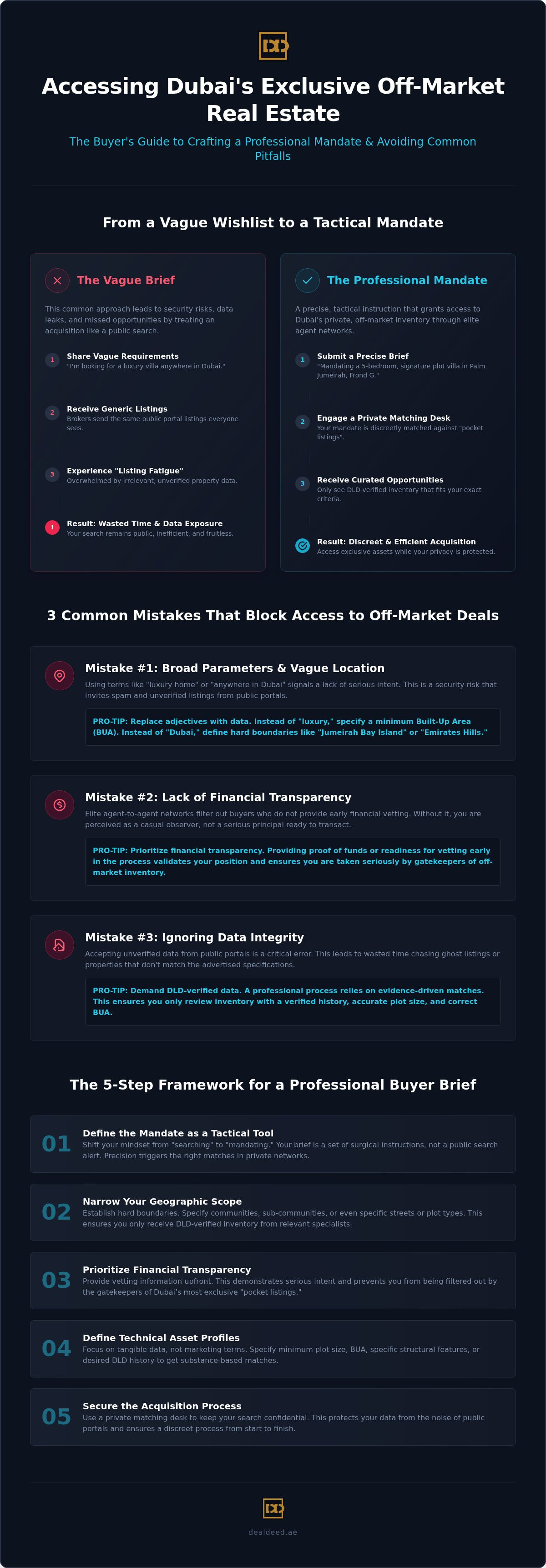
Public searches cast a wide net. They're designed for browsing. Private briefs target specific asset profiles. They're designed for acquisition. High-net-worth individuals must shift from "looking for a villa" to "mandating a 5-bedroom signature plot in Frond G." The private market ignores generic inquiries because they represent a high risk of "listing fatigue" and data leaks. One of the common mistakes when submitting a buyer brief is treating it like a search alert. A professional brief is a definitive instruction that triggers a private match; it's not an invitation for a broad market survey.
The "Pocket Listing" Ecosystem in Dubai
The most exclusive inventory in Dubai often never reaches a public portal. Motivated sellers use private desks for "quiet disposal" to maintain asset value and avoid market overexposure. This creates an ecosystem of "pocket listings" accessible only to a vetted inner circle. RERA-licensed agents at these desks act as gatekeepers. They protect sensitive data by only sharing it with buyers who have submitted a professional mandate. Your brief is your ticket into this ecosystem. It validates your position as a serious buyer and ensures that the matching process remains discreet, efficient, and evidence-driven.
Mistake #1: Broad Parameters and Vague Location Data
Vague boundaries lead to unnecessary exposure. In the private market, stating you want a property "Anywhere in Dubai" is not a strategy; it's a security risk. It signals a lack of intent and invites unverified noise into your inbox. Broad parameters are among the most common mistakes when submitting a buyer brief. They trigger a flood of generic listings that fail to meet specific investment criteria. This results in "listing fatigue," where the buyer becomes overwhelmed by irrelevant data and misses genuine, DLD-verified opportunities.
Precision is the primary filter of a professional deal desk. A brief that specifies "Palm Jumeirah" provides more utility than one seeking a "waterfront villa." Even better is a mandate that identifies specific Fronds or signature plot requirements. Defining these hard boundaries ensures that the matching process remains surgical. It prevents your data from being leaked to agents who specialize in areas outside your target zone. By narrowing your focus, you increase the matching speed and quality of the inventory presented to you.
The Problem with "Luxury" as a Criterion
"Luxury" is a marketing term, not a technical specification. In the off-market ecosystem, adjectives carry no weight. Value is defined through tangible data: plot size, Built-Up Area (BUA), and specific structural upgrades. A professional brief replaces flowery language with hard numbers. Precision in asset class selection means defining the technical profile before the aesthetic one. Instead of requesting a "luxury home," specify a minimum BUA of 12,000 square feet with a verified DLD history. This clarity allows for private buyer brief matching that focuses on substance over appearance.
Geographic Specificity in the UAE
Dubai and Abu Dhabi operate on distinct market dynamics. A single brief attempting to cover both without clear distinctions will likely fail. Each community has its own regulatory nuances and supply chains. Using specific sub-community names, such as Emirates Hills or Jumeirah Bay Island, filters out irrelevant off-market supply immediately. This level of detail is essential for RERA-licensed agents to execute a quiet search. One of the common mistakes when submitting a buyer brief is failing to account for these micro-market variations. Specific location data doesn't just improve match rates; it protects your anonymity by limiting the number of participants involved in the search.
Mistake #2: Lack of Financial Transparency and Vetting
Transparency is the currency of the private market. In public listings, visibility is the priority; in private matching, verification takes precedence. Many investors treat their financial status as a secondary detail to be disclosed during negotiations. This is a tactical error. One of the common mistakes when submitting a buyer brief is withholding financial clarity until a specific property is identified. This approach fails because elite matching desks and RERA-licensed agents prioritize mandates backed by pre-vetted liquidity. Without a clear signal of financial readiness, your brief remains inactive.
Vetting is a tool for security, not just a procedural hurdle. Sellers in the off-market sector choose "quiet disposal" specifically to avoid exposure to unvetted parties. If a buyer brief lacks transparency, it represents a potential risk to the seller's privacy. Providing proof of funds or a vetted buyer profile ensures you are viewed as a serious participant rather than a "window shopper." This level of clarity is what triggers "first-look" access to the most exclusive DLD-verified inventory. DealDeed utilizes these vetted profiles to maintain desk integrity, ensuring that every match is based on substantiated data and mutual readiness.
The Role of KYC in Private Real Estate
RERA-licensed agents are legally required to follow Know Your Customer (KYC) protocols. In the private market, these checks happen before sensitive data is shared. This protects the buyer's anonymity and the seller's asset value from unnecessary market exposure. Professional platforms handle sensitive financial info through secure, direct channels. There's a fundamental difference between a "serious buyer" who has intent and a "vetted buyer" who has evidence. The private market only moves for the latter.
Moving Beyond the "Mortgage Approval" Letter
Off-market transactions move at a different pace than the general market. While mortgage buyers are not excluded, cash buyers and institutional funds often dominate this sector due to their speed of execution. Signaling financial readiness requires more than a standard bank letter. It requires a comprehensive "all-in" budget that demonstrates an understanding of the total cost of acquisition. This budget should account for specific technical costs:
- The asset acquisition price.
- Dubai Land Department (DLD) transfer fees, typically 4%.
- Trustee and administrative costs.
- Professional matching and introduction fees.
A brief that includes these technical boundaries signals a high level of sophistication. It eliminates the risk of being filtered out by high-level facilitators who value efficiency and silence. One of the common mistakes when submitting a buyer brief is failing to demonstrate this operational readiness from day one. In a market characterized by speculation, clarity is your greatest advantage.
Mistake #3: Ignoring Data Integrity and DLD Verification
Data integrity is the bedrock of a secure acquisition. In the public domain, "phantom listings" are a persistent noise. These are properties that are either already sold, incorrectly priced, or entirely fabricated to harvest leads. One of the common mistakes when submitting a buyer brief is failing to demand evidence-driven matching at the outset. A brief that doesn't explicitly require DLD-verified data invites unverified speculation. You waste time on assets that don't exist or don't belong to the person claiming to sell them. This is a source of unnecessary exposure that serious investors can't afford. It creates a cycle of misinformation that erodes trust in the acquisition process.
Verification must precede inspection. Physical surveys are useless if the title deed is compromised or the seller's mandate is non-existent. DealDeed verifies every property against Dubai Land Department records before a match is even suggested. This ensures the "quiet" market remains a "verified" market. Entrusting your requirements to unlicensed intermediaries is a significant risk. These participants often lack access to official data and operate without regulatory oversight. It's one of the common mistakes when submitting a buyer brief to prioritize speed over rigorous data validation. Professionals know that speed without verification is just a fast track to a failed deal.
Verification as a Filter
Insist on RERA-licensed agent representation within your brief. This isn't just a preference; it's a regulatory safeguard. Unverified property mandates often lack specific title deed details or DLD validation codes. These are red flags that should trigger an immediate exit. DLD data is the gold standard for off-market trust because it provides an immutable, government-backed record of ownership and encumbrances. It removes the guesswork from the matching process and ensures that the "pocket listing" you're reviewing is legally sound.
The Flat-Fee Advantage in Matching
Percentage-based commissions can create a conflict of interest. If a facilitator's payout depends on the transaction size, the matching process may become biased toward higher-priced assets rather than the most suitable ones. This is "sales" logic, not "matching" logic. A fixed-fee introduction model ensures neutral matching. The match is based entirely on the technical parameters of the brief. This model is particularly beneficial for institutional buyers who require transparency and predictability for their compliance departments. It ensures that the gatekeeper's incentive is perfectly aligned with the buyer's specific mandate. To secure your next acquisition through a verified, neutral desk, you can submit a private buyer brief today.
How to Submit a Professional Buyer Brief: A 5-Step Framework
Precision is a choice. A professional brief is the execution of that choice. To avoid the common mistakes when submitting a buyer brief, you must follow a structured, data-driven methodology. This framework ensures your mandate is actionable and respected by the market's most discreet facilitators. It moves you from the noise of public portals into the quiet efficiency of verified matching.
- Step 1: Define the Asset Profile. Categorize the requirement immediately. Is it residential, commercial, or a development plot? Mixed-use mandates often fail due to a lack of focus.
- Step 2: Set Hard Boundaries. Specify the sub-community and technical specs. Use BUA and plot size as your primary metrics. Technical boundaries filter out irrelevant noise.
- Step 3: Establish a Timeline. Define your window for acquisition. A 30-day closing window signals a different level of intent than a 6-month research phase.
- Step 4: Provide Verification. Include KYC and Proof of Funds (POF) as part of the initial package. This validates your position as a vetted participant.
- Step 5: Select a Private Platform. Use a matching desk with direct DLD integration. This ensures every match is backed by government-verified data.
Drafting the "Non-Negotiables"
Distinguish between "Must-Haves" and "Nice-to-Haves" early. A brief cluttered with 20 non-negotiables is a recipe for failure. It dilutes the matching logic and makes a successful match statistically unlikely. Focus on three to five core criteria that define the asset's utility. This creates a high-probability match while leaving room for professional negotiation. One of the common mistakes when submitting a buyer brief is over-specifying minor details at the expense of the primary investment goal. Precision requires sacrifice; you must prioritize the technical specs that truly drive value.
Executing with DealDeed
The process is streamlined and secure. Register as a buyer or a RERA-licensed agent on the platform. Submit your brief to the private matching desk. Our system cross-references your mandate against DLD-verified inventory. When a match is found, the Agent-to-Agent protocol is activated. This ensures the transaction remains discreet and professional throughout the entire cycle. No public listings. No unverified spam. Just direct, data-driven results that respect your time and privacy. Submit your private buyer brief to DealDeed today.
Secure Your Next Acquisition with Precision
Private market success is built on data, not speculation. By refining your geographic boundaries and ensuring financial transparency, you distance yourself from the chaotic noise of public portals. Avoiding the common mistakes when submitting a buyer brief ensures your mandate is prioritized by the market's elite agents. Your acquisition strategy deserves the security of DLD-verified property data and the integrity of an exclusive RERA-licensed agent network. This methodical approach protects your privacy while delivering genuine, validated results from the start.
Efficiency is the direct result of a well-drafted instruction. Our flat-fee introduction model ensures neutral matching based entirely on your technical criteria. You gain access to a "need-to-know" ecosystem without the bias of commission-driven sales tactics. It's time to move beyond the unverified clutter and unverified participants of the general market. A professional mandate is your primary tool for reclaiming control over your search. Start your discreet acquisition: Submit a Buyer Brief. Precision leads to clarity, and clarity leads to a successful, quiet ownership.
Frequently Asked Questions
What is a buyer brief in the context of Dubai real estate?
A buyer brief is a tactical mandate used by private matching desks to identify specific off-market assets. Unlike a public search alert, it defines hard technical boundaries and specific asset profiles. It acts as a professional instruction for RERA-licensed agents to execute a discreet search. This document is the primary tool for bypassing public noise and accessing DLD-verified inventory that isn't visible on general portals.
Can I submit a buyer brief without being a RERA-licensed agent?
Yes, individual investors and institutional buyers can submit briefs directly to the matching desk. However, the matching process itself occurs exclusively between RERA-licensed professionals. This structure ensures that every transaction remains compliant with Dubai Land Department regulations. It protects the buyer's anonymity while maintaining a professional agent-to-agent deal desk environment. You provide the requirements; we facilitate the professional match through licensed channels.
How does DealDeed verify that an off-market property is actually for sale?
Every property is cross-referenced against official Dubai Land Department (DLD) data. This verification confirms current ownership, title integrity, and the existence of a valid quiet disposal mandate. We eliminate the risk of phantom listings by requiring evidence-driven matching before any data is shared. This methodical approach ensures that the inventory you see is genuine, available, and legally cleared for a private transaction.
What happens if my buyer brief is too specific?
High specificity is a strategic advantage in the private market. It reduces unnecessary exposure and increases the probability of a high-quality match. While restrictive technical specs might limit the total volume of listings, they ensure that the matches you receive are surgically precise. A specific brief signals serious intent. It allows the matching desk to focus on substance over appearance, saving you from unverified noise.
Is there a fee for submitting a buyer brief on DealDeed?
Submitting a brief is the first step in our private matching process. DealDeed operates on a flat-fee introduction model once a successful match is identified and validated. This ensures neutral matching based entirely on your technical criteria. We avoid the biased incentives found in percentage-based commissions. This model provides institutional-grade transparency for buyers who value efficiency and predictable transaction costs in the off-market sector.
How is my privacy protected when I submit a brief?
Privacy is maintained through a secure, need-to-know matching protocol. Your identity remains anonymous during the initial matching phase. Requirements are shared only with vetted, RERA-licensed agents who are bound by strict confidentiality standards. We prioritize security over excitement. By avoiding public portals, you prevent data leaks and keep your acquisition strategy within a controlled, private ecosystem of professional facilitators.
What is the difference between a buyer brief and a mandate?
A buyer brief is the technical document detailing your specific requirements and asset profile. A mandate is the formal authority granted to a professional to act on your behalf. In the off-market sector, a professional brief serves as the foundation for a matching mandate. Identifying the common mistakes when submitting a buyer brief helps you draft a more effective instruction that agents can execute with precision.
How long does it take to find a match for a private brief?
Matching speed depends on the precision of your parameters and the current DLD-verified inventory. Because we prioritize verification over speculation, the process is methodical and intentional. Avoiding the common mistakes when submitting a buyer brief, such as vague location data, ensures your mandate is processed with maximum efficiency. Most serious buyers see matched, verified opportunities as soon as the technical criteria align with our quiet disposal mandates.


