

A higher property price does not have to mean a higher introduction fee. The benefits of a fixed introduction fee in UAE real estate include predictable costs and a clear separation from deal value: the fee stays constant instead of rising as a percentage of the transaction. Who pays and when payment is due depend on the agreement, so set out both before making an introduction.
That distinction matters in a market where residential sale commissions in Dubai are usually 2% of the sale price. An introduction fee is different from brokerage commission, so the written terms should identify the introduction, the payer, the fee and the event that triggers payment. This guide explains who typically pays, how a fixed amount compares with deal value, and which contractual and regulatory considerations may apply in the UAE. The question isn't simply whether a fixed fee is lower. It's whether the arrangement is clear, proportionate to the introduction and understood by everyone involved.
Key Takeaways
- Identify the payer and the event that triggers payment before making an introduction.
- Separate an introducer’s role from brokerage activity; terminology alone doesn’t define the arrangement.
- Assess whether a fixed fee stays proportionate as the transaction value changes.
- Clear written terms can reduce disputes and help clarify how the arrangement relates to Dubai’s regulatory framework.
Buyer and seller payment responsibilities
Payment responsibility changes with transaction type, not simply with the label attached to a fee. In Dubai, buyers pay 0% commission when purchasing off-plan directly from a developer. Developers usually pay agents. That brokerage commission is separate from an introduction fee. Its agreement should identify the payer and the event that triggers payment.
In secondary-market sales, buyers commonly pay commission, with responsibility agreed early in the transaction. A seller may also agree to pay commission for marketing, such as photography, videography, portal advertising, events and digital campaigns. These are separate obligations: a buyer’s brokerage agreement does not automatically settle a seller’s separate agreement.
The Dubai Land Department charges a mandatory 4% transfer fee on the property purchase price. This is a transfer cost, not an agent’s commission or an introduction fee. For a transaction, keep the transfer fee and any separately agreed commissions clear in the cost allocation. The distinction matters because each payment has a different purpose and recipient.
Rental responsibilities follow another structure. A commonly used tenant commission in Dubai is 5% of annual rent, plus 5% VAT. That rental commission should not be confused with a fixed introduction fee connected to a property sale. Name the transaction type in the agreement so sale, rental and introduction payments aren’t treated as interchangeable.
A fixed introduction fee does not have an automatic payer just because someone introduced a buyer. The written arrangement should state who pays and define what counts as the introduction, which transaction it covers and when the fee becomes due. For example, the terms can distinguish a completed sale from an initial meeting that does not proceed. Record the payment responsibility and trigger before sharing buyer details. This gives each party a clear reference if the sale progresses, changes structure or does not complete. Keep the fee separate from the Dubai Land Department transfer charge and any agent commission. A clear allocation makes the transaction easier to account for.
Finder's fee and introducer fee terminology
“Finder’s fee” and “introducer fee” often describe payment for connecting parties. Neither label explains the work performed or the payment trigger on its own. A finder might identify a potential buyer, while an introducer might connect a seller with an agent. The written terms should describe the actual contribution rather than rely on a title alone.
Brokerage commission is different in purpose. In Dubai, the usual residential sale commission is 2% of the sale price. It relates to brokerage under an agreement, rather than simply naming a prospective party. An introduction arrangement should identify whether payment is due for making the connection or only after a successful transaction. That distinction prevents an introduction from being mistaken for a completed sale.
Consider a seller introduced to an agent who later brings a buyer. The agreement should define which introduction qualifies, whose services must be engaged and whether a later transaction counts. It should also identify the payer and recipient. If several agents or intermediaries are involved, precise wording can distinguish the original introduction from subsequent brokerage work.
A percentage-based referral fee links payment to deal value, while a fixed fee stays the same regardless of transaction size. These structures can serve different commercial purposes, but the label alone does not settle which applies. State the amount or calculation method, the qualifying parties and the payment trigger clearly. Keep the introduction payment distinct from commission, even if both relate to the same property transaction.
The Dubai Land Department’s transfer process is separate from the private relationship between an introducer and an agent. For a discreet agent-to-agent arrangement, documented introduction arrangements can help keep the roles and payment terms distinct.
Fixed fee compared with deal value
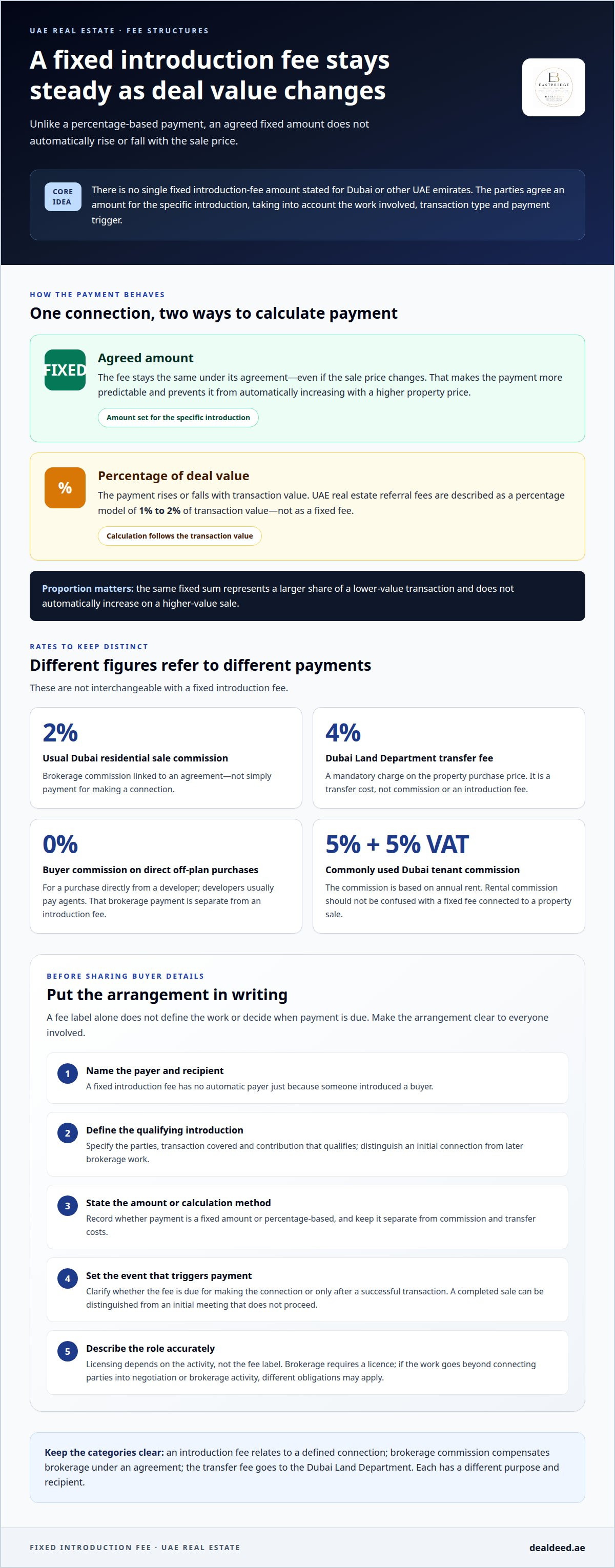
There is no single fixed introduction-fee amount stated for Dubai or other UAE emirates. The parties agree the amount for the specific introduction, considering the work involved, transaction type and payment trigger. UAE real estate referral fees are also described as 1% to 2% of transaction value. That is a percentage model, not a fixed fee.
The difference becomes clear when property values change. A fixed fee remains constant, while a percentage rises or falls with the deal value. If the same introduction leads to sales at different prices, the fixed amount stays unchanged under its agreement; a percentage-based payment changes with each sale price. The benefits of a fixed introduction fee in real estate UAE include predictable payment that does not automatically rise with the sale price.
For a Dubai property, compare the proposed fixed amount with the relevant commission rate, but do not treat them as interchangeable. An agent’s brokerage commission compensates brokerage under an agreement; an introduction fee relates to a defined connection. The agreement should identify the introducer’s role, the parties covered, the qualifying transaction and whether payment is due after a completed sale. These distinctions help parties assess the benefits of a fixed introduction fee in real estate UAE for their circumstances.
Licensing depends on the activity, not the fee label. Brokerage requires a licence. If the introducer only connects parties, the agreement should describe that limited role. If the person negotiates or undertakes brokerage work, different obligations may apply. Define the scope before payment becomes due.
A practical comparison considers whether the fixed amount fits the contribution, how a percentage changes with deal value and which party benefits from the connection. On a high-value sale, a fixed sum does not automatically increase with the price. On a lower-value transaction, that same sum represents a larger share of the value. The benefits of a fixed introduction fee in real estate UAE depend on clear terms and a sensible fit between the fee, role and transaction.
Regulatory and contractual aspects
Dubai Law No. (16) of 2007 establishes the Real Estate Regulatory Agency, according to Dubai Legislation Portal. This matters because an introduction arrangement must be distinguished from brokerage activity. Brokerage requires a licence. The work performed, not the agreement’s title, determines how the relationship should be understood.
For Dubai property transactions, document commission terms clearly. RERA’s Form A records the seller’s brokerage agreement, while Form B records the buyer’s agreement before closing. Dubai does not set a mandatory commission percentage; the parties agree the rate. A referral fee should have separate terms that identify its scope and payment trigger.
For an introducer who is not acting as a licensed broker, the arrangement described for this context favours a referral agreement with the brokerage. It cautions against making the introducer a party to an agreement with the buyer or seller concerning the transaction. This distinction helps define the introducer’s limited role. Wording alone does not turn brokerage work into a referral.
Record the parties, the specific introduction, the property or transaction covered and the condition for payment. For example, the terms can state whether payment follows a completed sale or another defined outcome. Clarify whether the arrangement covers buying, selling, off-plan properties or a later transaction involving the same parties. A mortgage or change in transaction structure can affect timing, so specify how those circumstances relate to the payment trigger.
For a seller seeking a controlled route to introduce a property, Quiet Disposal Mandates provide a relevant context for setting clear terms. Discuss a confidential property introduction when a private disposal needs a defined process.
DealDeed
DealDeed helps parties make discreet property introductions with defined terms and a clear completion trigger. Its Private Buyer Brief Matching, Quiet Disposal Mandates and Agent-to-Agent Deal Desk support different sides of a transaction without public listings or marketing.
Property details are verified against Dubai Land Department data, and transactions are handled confidentially between RERA-licensed agents. DealDeed charges a fixed introduction fee to participating agents only when a matched deal completes. Its private matching desk may suit sellers seeking a discreet route to a serious buyer, or agents coordinating an introduction while keeping their responsibilities distinct.
If you’re considering a discreet property introduction, contact DealDeed to discuss the arrangement.
Set the Terms Before the Next Introduction
A property introduction can shape a transaction long before negotiations begin. Treat its terms as part of the deal structure, not an administrative detail to resolve after the parties connect. A clear arrangement gives everyone a shared understanding of the introducer’s role and the basis for payment.
The benefits of a fixed introduction fee in real estate across the UAE are clearest when the arrangement fits the transaction and is recorded before the introduction. Preparation supports a more controlled process, especially when privacy and carefully matched parties matter. It also gives agents and property participants a practical starting point for discussing responsibilities without confusing an introduction with brokerage.
If you’re considering a discreet introduction for a property transaction, contact DealDeed to discuss your options. Bring the transaction context and the parties involved; the conversation can begin with the arrangement you need. Take the next step with clarity and discretion.
Frequently Asked Questions
What is a fixed introduction fee in UAE real estate?
A fixed introduction fee is an agreed flat payment for connecting relevant parties to a property opportunity, rather than an amount calculated as a percentage of the sale price. For example, an agreement might define payment for connecting a seller with a buyer through an agent. The document should distinguish this limited introduction from brokerage and explain what event makes the fee payable.
What are the benefits of a fixed introduction fee for UAE property buyers and sellers?
A fixed amount is easier to account for because it does not automatically rise with the property’s value. Buyers and sellers can also distinguish the introducer’s compensation from other transaction expenses. The arrangement is most useful when its scope is clear: identify the parties and opportunity covered, then define the event that triggers payment. This reduces ambiguity if discussions change direction.
How does a fixed introduction fee compare with a percentage-based real estate commission in the UAE?
A fixed introduction fee stays constant as the property value changes. A percentage-based commission varies with the agreed calculation base, such as the sale price. If negotiations produce a different final price, for example, a percentage commission changes accordingly while a fixed fee does not. These payments compensate different roles, so the agreement should state whether payment is for an introduction or brokerage.
What UAE laws or RERA rules govern property introduction fees and referral commissions?
In Dubai, Dubai Law No. (16) of 2007 establishes the Real Estate Regulatory Agency, according to Dubai Legislation Portal. Dubai’s RERA framework uses Form A for a seller’s brokerage agreement and Form B for a buyer’s agreement. These forms document brokerage arrangements; they shouldn’t be treated as automatic approval of every separate referral arrangement. The nature of the activity and contract wording matter.
What should a UAE property introduction fee agreement include?
Set out the introducer’s role, the parties and property opportunity covered, the fee calculation, the payer and the payment trigger. Also state whether the terms apply if the parties transact through an agent or later pursue a different property together. For example, define whether payment follows completion or another specified event. Clear wording helps separate the introduction from brokerage duties.
Who pays the introduction fee in UAE property transactions, and when is it due?
There is no automatic payer for every introduction; the agreement should name the responsible party and the event that makes payment due. Under DealDeed’s model, each participating agent pays a fixed introduction fee when a matched deal completes. Buyers and sellers do not pay DealDeed directly. This distinction matters: a private referral arrangement may allocate payment differently from the transaction’s brokerage commission.


